
AI Voice Scam Calls in India: A Family Code Word Plan
Stop cloned-voice and fake-official calls with a family code word, a call-back rule and fast reporting to 1930, cybercrime.gov.in and Chakshu on Sanchar Saathi.
By Redbison Dev · · 10 min read
India edition. Indian edition: reporting money lost to the 1930 helpline or cybercrime.gov.in, reporting fraud calls and messages on Chakshu (Sanchar Saathi, Department of Telecommunications), and how the RBI's customer-liability rules treat payments you approve yourself. US edition
If a call in your child's or parent's voice says they are in trouble and need money on UPI right now, do three things before paying a single rupee: ask for your family's code phrase, cut the call whatever the answer, and call them back on the number saved in your phone. If money has already gone, call the 1930 cyber crime helpline or file at cybercrime.gov.in immediately; the Department of Telecommunications' Sanchar Saathi portal gives exactly those two routes for anyone who has lost money. Fraud calls and messages where nothing was lost can be reported on Chakshu, within 30 days.
This edition covers India's reporting channels and payment rules. How cloned voices are made, with FTC and FBI sources, is in the US version; phrases below are checked in the Password Strength Checker.
What these calls look like in India
The Chakshu service lists the kinds of fraud communication it wants reported: messages and calls about a bank account, payment wallet, SIM, gas, electricity or KYC update, impersonation of a government official, sextortion and similar. A cloned voice adds one more disguise to that list, the voice of someone you love. The scripts share the same ingredients:
- Urgency: an accident, an arrest, a hospital deposit, a phone that "broke" so you cannot call back.
- Authority: a second voice claiming to be police or another official, telling you the matter is confidential.
- Instant payment: UPI to an unfamiliar ID or QR code, or a bank transfer, because the money moves in seconds.
Treat any caller who asks for your UPI PIN, an OTP or a payment to "settle" a case as a fraud. If a call combines a relative's voice with an official demanding money, treat it as a scam until you have reached the relative yourself.
The family plan
- Agree one code phrase per family, face to face. Do not type it into WhatsApp or any family group: a hacked account would hand it over.
- Ask for it without hints. "Bolo, what's our phrase?" not "Is it the one with the dog's name?"
- Cut the call and call back on the number saved in your contacts, or call another family member who would know where they are.
- Nothing is paid before that call-back, however urgent the second voice sounds.
- Teach elders the rule specifically. A grandparent who hears a grandchild's voice is the person a "your grandson has been arrested" script is written for.
Choosing a phrase nobody can find online
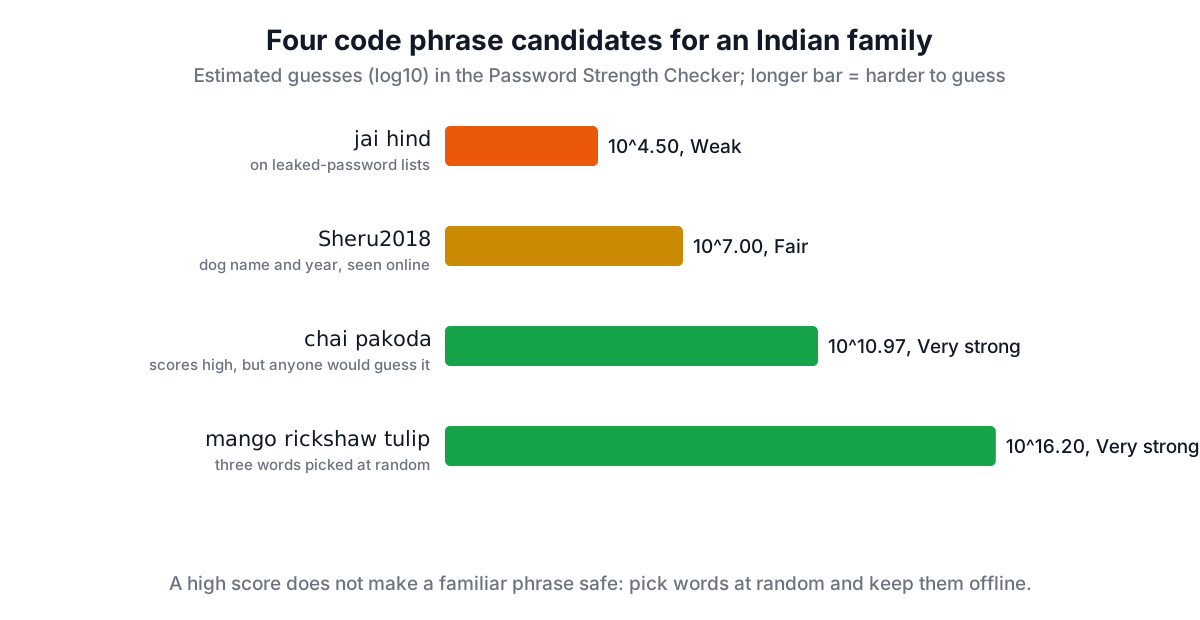
A scammer gets one or two tries on a call, so the risk is not guessing by computer but research: Instagram, school WhatsApp groups and family videos. The checker shows how quickly some favourites fall:
| Phrase | Guesses (log10) | Score | Problem |
|---|---|---|---|
jai hind | 4.50 | 1, Weak | on leaked-password lists |
Sheru2018 (dog's name and year) | 7.00 | 2, Fair | visible on social media; much weaker once the name is entered as a personal word |
chai pakoda | 10.97 | 4, Very strong | scores high but any Indian would guess it |
mango rickshaw tulip | 16.20 | 4, Very strong | three unrelated words, picked at random |
The checker's word lists are mostly English, so Hindi and other Indian-language words it does not recognise are scored as random letters and can look stronger than they are. chai pakoda is the clearest example: a high score for a phrase that is anything but secret. Choose unrelated words by chance, for example by opening a dictionary at random three times.
If money has gone: report first, then everything else
Speed matters more than anything else here, because a payment you approved yourself is treated differently from one taken without your knowledge.
The RBI's 2017 circular on limiting customer liability in unauthorised electronic banking transactions gives zero liability in some cases, for example where the bank was at fault, or where a third-party breach was reported within three working days. It also says that where a customer was negligent, such as by sharing payment credentials, the customer bears the loss until the transaction is reported, and the bank bears any loss after that. A UPI payment you approved yourself after a convincing call is unlikely to count as "unauthorised" under that circular, so recovery depends on the money being traced and held before it is withdrawn.
So, in this order:
- Call 1930 or file at cybercrime.gov.in with the UPI transaction ID or UTR number, the amount, time, the receiving UPI ID or account, and the number that called.
- Call your bank using the number on your card or in its official app, and ask it to raise a fraud complaint on the transaction.
- Report the calling number on Chakshu if you have not lost money, or alongside the complaint if you have, within 30 days.
- Change passwords and PINs if you shared anything on the call.
Example: a father sends ₹45,000 in three UPI payments of ₹15,000 after a call that sounds like his son. Note all three transaction IDs; each is a separate payment for the complaint, and the total of ₹45,000 is what goes in the amount field.
Protecting the accounts behind the plan
A scammer who takes over a family member's WhatsApp or email can read the code phrase and send voice notes from a trusted account. Give each account a unique password from the Password Generator, turn on two-step verification in WhatsApp and on email, and never share an OTP. The guide to TOTP codes explains why authenticator apps are safer than SMS codes.
Frequently asked questions
What should I do if I get a call in my son's voice asking for money?
Ask for your family code phrase, then cut the call and phone your son on the number saved in your contacts. Do not pay anything until you have spoken to him on a call you started.
Where do I report a cyber fraud in India?
If you have lost money, call the cyber crime helpline 1930 or file a complaint at cybercrime.gov.in, as the Sanchar Saathi portal directs. Suspected fraud calls and messages can be reported on Chakshu within 30 days.
Will my bank refund a UPI payment I made to a scammer?
Not automatically. The RBI's customer-liability rules are written for unauthorised transactions, and a payment you approved yourself is unlikely to be treated as one. Report it at once to 1930 and your bank so the money can be traced and held.
Can police arrest someone over a phone or video call and ask for money?
Treat any call that demands payment to settle an arrest or a case as a fraud. Chakshu lists impersonation of government officials among the frauds to report.
Should the code phrase be in Hindi or English?
Either works if it is random and nobody outside the family knows it. Avoid famous phrases, film dialogues and anything posted online.
Sources and further reading
- Chakshu: report suspected fraud communication, Sanchar Saathi, Department of Telecommunications. Fraud types, the 30-day window, and 1930 or cybercrime.gov.in for money lost.
- Cybercrime Portal, Government of India. Online complaints for cyber fraud.
- Sanchar Saathi, Department of Telecommunications.
- Customer Protection: Limiting Liability of Customers in Unauthorised Electronic Banking Transactions, Reserve Bank of India, 2017.
- Report a scam phone call, UK National Cyber Security Centre. How impersonation calls ask for personal details or transfers.
- Phishing scams: if you've shared sensitive information, UK National Cyber Security Centre. Steps after sharing passwords or bank details.