
Voice Clone Scam Calls: A Family Code Word Plan for the UK
Set up a family code word against cloned-voice emergency calls, call back via 159, report to Report Fraud or 7726, and know the PSR's £85,000 refund rules.
By Redbison Dev · · 10 min read
United Kingdom edition. UK edition: reporting through Report Fraud, Police Scotland and the 7726 text service as the NCSC sets out, the 159 bank line, and the Payment Systems Regulator's reimbursement rules for bank transfers made since 7 October 2024. US edition
If a call sounds exactly like your son, daughter or parent and asks for money urgently, the safest UK response has three parts: ask for the family code phrase, hang up whatever the answer, and ring the person back on the number already saved in your phone. If the caller claims to be your bank, hang up and dial 159, which connects customers of more than 99% of UK retail current accounts to their own bank. And if money has already gone by bank transfer, tell your bank at once: since 7 October 2024 the Payment Systems Regulator (PSR) requires banks to reimburse most victims of authorised push payment (APP) scams, up to £85,000.
This edition covers the UK numbers and rules. The general mechanics of cloned-voice calls and how to choose a phrase are in the US version; phrases here are checked with the Password Strength Checker.
How these calls reach UK families
The NCSC describes scam phone calls as unsolicited calls from someone pretending to be an organisation you trust, such as your bank or the police, which may be automated or a real person, and which ask for personal details or tell you to transfer money. A cloned-voice call swaps "your bank" for "your daughter", and the script adds a reason you cannot call back: a broken phone, a police station, a hospital. The US version explains, with FTC and FBI sources, how the voice is copied from recordings people post online.
A transfer from a UK banking app can reach the scammer's account in seconds, which is why the call-back has to come before the payment, and why the reimbursement rules below matter if it does not.
The family plan
- Agree one phrase per household, in person, never by text, email or a family chat that a hacked account could expose.
- Ask for it without hinting. "What's our phrase?" not "Is it the one about the dog?"
- Hang up whatever the answer, then call back on the number in your contacts. If they do not answer, ring another family member who would know where they are.
- No money moves until you have spoken to them on a number you chose.
- For calls "from the bank" or "the police", hang up and use 159 or the number on the back of your card.
Choosing a phrase a scammer cannot find
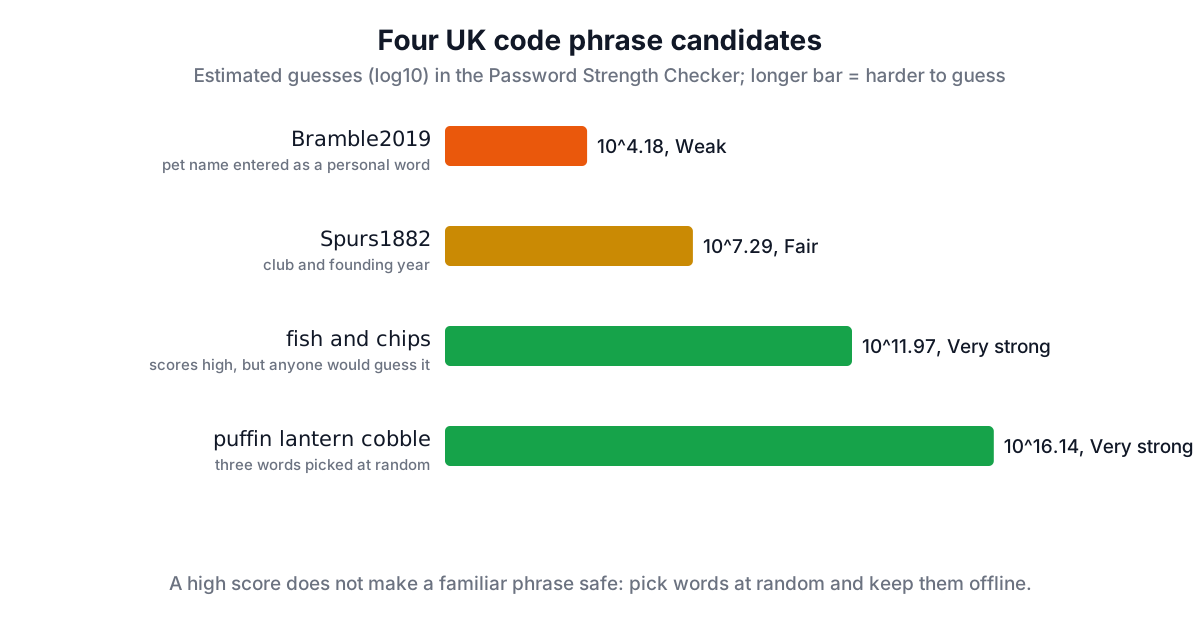
A code phrase is only asked a few times on a call, so the real threat is not brute force but research: anything on Facebook, a school newsletter or a dog's Instagram. The checker still shows which phrases are guessable, and which are guessable by anyone who knows you:
| Phrase | Personal words entered | Guesses (log10) | Score |
|---|---|---|---|
Bramble2019 (the dog and the year you got her) | Bramble | 4.18 | 1, Weak |
Spurs1882 | none | 7.29 | 2, Fair |
fish and chips | none | 11.97 | 4, Very strong |
puffin lantern cobble | none | 16.14 | 4, Very strong |
Two lessons. First, enter pet names, children's names and teams in the checker's "words about you" box: Bramble2019 drops from 10^6.26 guesses to 10^4.18 once the checker knows the dog's name, and a scammer who has seen your posts knows it too. Second, fish and chips scores 4 because the checker prices each common word separately, but it is the first thing anyone British would guess. Pick words at random, ideally by rolling dice against a word list, as in puffin lantern cobble.
Reporting a cloned-voice call in the UK
The NCSC's phishing guidance gives the reporting routes, and the 159 bank line is run by Stop Scams UK:
- England, Wales and Northern Ireland: report to Report Fraud at reportfraud.police.uk or on 0300 123 2040.
- Scotland: report to Police Scotland on 101.
- A scam text that came before or after the call: forward it free to 7726, which lets most providers trace and block the sender.
- If you have shared bank details or sent money: call your bank first, using 159 or the number on your card.
If money has gone: the PSR reimbursement rules
The PSR's consumer guidance sets out the protections for APP scams, where you were tricked into sending the payment yourself:
| Rule | What it means |
|---|---|
| Start date | Payments made on or after 7 October 2024 |
| Payments covered | UK bank transfers over Faster Payments or CHAPS between UK accounts |
| Maximum claim | £85,000 (the PSR says this covers over 99% of claims); a firm may pay more |
| Excess | optional, up to £100; cannot be applied to vulnerable customers |
| Deadline | report as soon as possible, and within 13 months of the payment |
| Speed | usually reimbursed within 5 business days of the claim |
| Exceptions | no refund if you were complicit or grossly negligent, a "high bar" that does not apply to vulnerable customers |
| Above £85,000 | you can take the unreimbursed part to the Financial Ombudsman Service, whose limit is £430,000 |
Suppose a parent sends £2,400 by Faster Payments to a "new account" after a convincing call. If the bank applies the full £100 excess, the refund is £2,300; if the parent is treated as vulnerable, no excess applies and the refund is £2,400. Card, cash and cheque payments are outside this scheme; the PSR notes they have their own protections, which is one more reason the plan says no money moves before a call-back.
Sending and receiving banks split the cost 50:50, so both have a reason to stop the payment. Telling your bank fast still matters most.
Protecting the accounts behind the plan
A scammer who controls a family member's email or WhatsApp can read the code phrase and send convincing messages. Give each account a unique password from the Password Generator and switch on two-step verification; the UK password guide covers the NCSC's three random words advice for passwords you must remember.
Frequently asked questions
What number do I call if I think a call from my bank is a scam?
Hang up and dial 159. It connects customers of more than 99% of UK retail bank current accounts directly to their own bank, so you know you are speaking to the real bank.
Will my bank refund money I sent to a scammer who cloned my child's voice?
If you sent it by UK bank transfer (Faster Payments or CHAPS) on or after 7 October 2024, the PSR rules require reimbursement up to £85,000 unless you were complicit or grossly negligent, minus an optional excess of up to £100. Report it within 13 months.
Where do I report a scam call in the UK?
In England, Wales and Northern Ireland, to Report Fraud online or on 0300 123 2040; in Scotland, to Police Scotland on 101. Forward any related scam text to 7726.
Should the code phrase be the same for grandparents and teenagers?
One phrase per household is easiest to remember. What matters more is that everyone who might receive a call knows it and nobody has ever typed it into a message.
What if the caller says they forgot the code phrase?
Treat that as a no. Hang up and call the person back on the number you have saved, or ring another relative. A real emergency will survive a two-minute call-back.
Sources and further reading
- Report a scam phone call, National Cyber Security Centre. Report Fraud, 0300 123 2040 and Police Scotland 101.
- Report a scam text, National Cyber Security Centre. Forwarding to 7726.
- APP fraud reimbursement protections, Payment Systems Regulator. Start date, £85,000 limit, £100 excess, 13 months and 5 business days.
- APP scams, Payment Systems Regulator. The 50:50 cost split between sending and receiving firms.
- 159, Stop Scams UK. The short code to reach your bank safely.
- Phishing scams: if you've shared sensitive information, National Cyber Security Centre.