
Grandparent Scams and AI Voice Clones: A Family Code Word
Stop emergency "grandparent" calls with a family code word and a call-back, know that bail is never paid in cash or crypto, and report to police and the CAFC.
By Redbison Dev · · 10 min read

Canada edition. Canadian edition built on the Canadian Anti-Fraud Centre's emergency-grandparent fraud guidance (cash couriers, "gag orders", spoofed caller ID, bail rules) and its reporting route through local police and reportcyberandfraud.canada.ca. US edition
The Canadian Anti-Fraud Centre (CAFC) calls it emergency-grandparent fraud: a caller claiming to be a grandchild, or calling on their behalf, says they need money right away for bail, a lawyer or a hospital, and may claim a "gag order" stops you from talking about it. A cloned voice makes the grandchild sound real. The CAFC's answer works whatever the voice: hang up and call the family member directly on a number you already have. A family code word adds a check before you hang up, and one fact settles most of these calls on its own: the CAFC says the Canadian criminal justice system does not allow someone to be bailed out of jail with cash or cryptocurrency.
If you have already paid, contact your local police as soon as possible and report it to the CAFC at reportcyberandfraud.canada.ca. The US version of this article, with the FTC and FBI's description of how voices are cloned, is here.
How the Canadian version of the scam works
The CAFC's description of the scheme reads like a script:
- The call, often to a senior's home phone or landline, from a "grandchild" or someone calling for them: arrested, in an accident, stuck abroad, in hospital.
- Authority figures: callers claiming to be police officers or lawyers, using urgency and threats to get you to withdraw money.
- A "gag order": a claim that you are legally barred from talking about the case, which keeps you from calling the family.
- Cash or crypto: the fraudsters arrange to pick up the money in person, or ask you to mail cash.
- The text variation: a message saying the loved one's phone is broken or fell in water, with a new number, and a request for money or gift cards.
The CAFC also warns that caller ID can be spoofed to show a trusted number, and that fraudsters mine social media and dating sites for the names and details of your family. AI voice cloning fits straight into that playbook: the details come from posts, the voice from videos.
The family plan
- Agree a code phrase in person with everyone who might be called, grandparents first. Never send it by text, email or Facebook Messenger.
- Ask for it without hints. "What's our phrase?" not "Is it the one about the cottage?"
- Hang up whatever the answer. Call the family member back on the number you already have, not one the caller gives you. If the caller says they are police, hang up and call your local police on a number from a reputable source.
- Remember the bail rule. Nobody is bailed out with cash or cryptocurrency, so a request for either ends the conversation.
- Never hand cash to someone at the door. The CAFC describes fraudsters arranging to pick up the money in person, so a courier or "officer" collecting cash is a warning sign in itself.
Choosing a phrase a fraudster cannot look up
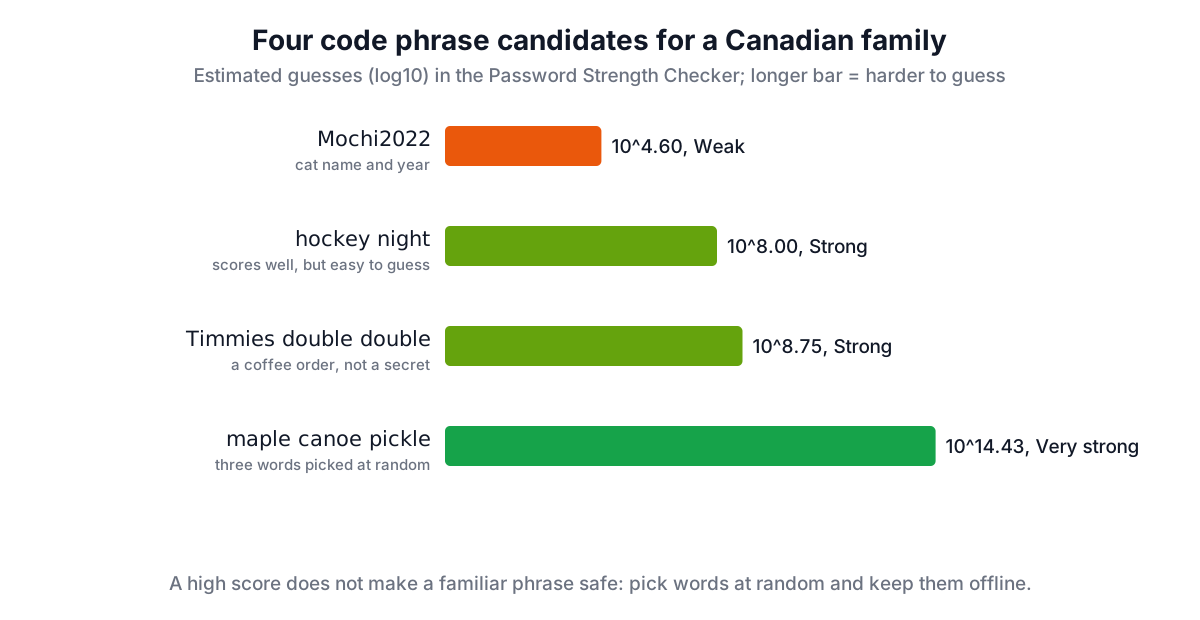
A fraudster gets one or two guesses on a call, so the threat is what can be found about your family online. The Password Strength Checker shows which phrases are weak, and which are only strong on paper:
| Phrase | Guesses (log10) | Score | Problem |
|---|---|---|---|
Mochi2022 (the cat and the year) | 4.60 | 1, Weak | pet names are on social media and on leaked-password lists |
hockey night | 8.00 | 3, Strong | the first thing many Canadians would try |
Timmies double double | 8.75 | 3, Strong | a coffee order, not a secret |
maple canoe pickle | 14.43 | 4, Very strong | three unrelated words, picked at random |
Type pets' and grandchildren's names into the checker's "words about you" box to see how much any personal word costs. Then pick unrelated words by chance, for example by rolling dice against a word list, rather than choosing a phrase that sounds like your family.
If you have paid or shared details
The CAFC's reporting page says to contact your local police as soon as possible if you are a victim, because investigating is the police's role, and to report the fraud to the CAFC as well, whether you are a victim or not. Reports go through reportcyberandfraud.canada.ca, can be anonymous, and are shared with the National Cybercrime Coordination Centre (NC3) to link cases together. The CAFC also takes reports by phone on 1-888-495-8501, Monday to Friday from 10 am to 4:45 pm ET, closed on holidays.
In practice, do it in this order:
- Your bank, on the number on your card, if money left by transfer or you shared banking details.
- Local police, especially if a courier collected cash; describe the person and the time of the pickup.
- The CAFC report, with the phone numbers used, the amounts and how the money was sent.
- Your family, so the scammers cannot try the same story on another relative.
Example: a grandfather withdraws CA$6,000 and hands it to a "courier" sent by "his grandson's lawyer", then wires CA$2,500 more the next day. Both payments, CA$8,500 in total, go in one police report and one CAFC report, with the courier's description and the time of the pickup.
Protecting the accounts behind the plan
If someone takes over a relative's email or messaging account, they can read the code phrase and message the family from a trusted address. Give each account its own password from the Password Generator, turn on multi-factor authentication wherever it is offered, as the Government of Canada's Get Cyber Safe campaign advises, and read the password strength guide for passphrases you have to remember.
Frequently asked questions
What is the grandparent scam?
A fraud the CAFC describes as emergency-grandparent fraud: someone claims to be your grandchild, or calls on their behalf, and says they need money immediately for bail, a lawyer or a hospital, often claiming a "gag order" means you must not talk about it.
Can you pay bail in cash or Bitcoin in Canada?
No. The CAFC states that the Canadian criminal justice system does not allow someone to be bailed out of jail with cash or cryptocurrency. A caller asking for either is a fraudster.
Where do I report a grandparent scam in Canada?
To your local police as soon as possible, and to the Canadian Anti-Fraud Centre through reportcyberandfraud.canada.ca. You can report even if you did not lose money.
The call showed my grandson's real number. Could it still be a scam?
Yes. The CAFC warns that fraudsters spoof caller ID to show a trusted number. Hang up and call him back yourself on the number you have.
What if the caller says there is a gag order?
That is one of the tactics the CAFC lists. Treat it as pressure to keep you from checking, and call your family anyway.
Sources and further reading
- Emergency-grandparent fraud, Canadian Anti-Fraud Centre. Scenarios, cash pickups, gag orders, the bail rule and spoofing.
- Report fraud and cybercrime, Canadian Anti-Fraud Centre. Local police first, anonymous reports, sharing with the NC3.
- Report Cybercrime and Fraud, Government of Canada. The online reporting system.
- Canadian Anti-Fraud Centre, home page and current service notices.
- Multi-factor authentication, Get Cyber Safe, Government of Canada. Why a second login step protects an account whose password has leaked.