
Alcohol and Sleep: Standard Drinks and Your Night
How many standard drinks it takes to cut REM sleep, worked with glasses of wine and schooners, and why the 3 to 4 hour gap before bed is not always enough.
By Redbison Dev · · 9 min read
Australia edition. Written for Australian readers: drinks counted in 10 g standard drinks from 150 ml glasses and schooners, the Australian Guidelines' 10 a week and 4 a day, and the Sleep Health Foundation's advice on stopping before bed. US edition
A nightcap is a common Australian habit: a Sleep Health Foundation survey found that four in ten adults had had an alcoholic drink in the hour before sleep. Laboratory studies show what it costs. Alcohol helps some people fall asleep, but it delays and cuts REM (dream) sleep and makes the second half of the night lighter and more broken as the body clears it. In the largest meta-analysis, REM sleep was already disrupted in the low-dose group, up to 0.50 g/kg: up to about three standard drinks for a 62 kg woman, or two generous glasses of wine. It found no lower threshold.
This edition counts in Australian standard drinks of 10 g, works an evening through the Australian BAC Calculator and the Sleep Calculator, and checks the Sleep Health Foundation's advice to stop drinking three to four hours before bed against the research. It is general information, not medical advice.
The research doses in standard drinks
Sleep studies dose alcohol in grams per kilogram of body weight. An Australian standard drink is about 10 g of alcohol, which healthdirect describes as roughly what the body can process in an hour. Here is what the key doses mean for two typical adults:
| Dose in the research | 62 kg woman | 85 kg man |
|---|---|---|
| 0.50 g/kg, the top of the "low dose" band in the 2025 meta-analysis | 31 g, about 3.1 standard drinks | 43 g, about 4.3 |
| 0.55 g/kg, given six hours before bed in Landolt and colleagues' study | 34 g, about 3.4 | 47 g, about 4.7 |
| 0.85 g/kg, the dose where falling asleep faster first appeared | 53 g, about 5.3 | 72 g, about 7.2 |
On healthdirect's standard drinks chart, a 150 ml glass of 13.5% wine is 1.6 standard drinks and a 425 ml schooner of 4.8% beer is also 1.6. Two glasses of wine, or two schooners, already sit close to the low-dose band. The Australian Guidelines recommend healthy adults have no more than 10 standard drinks a week and no more than 4 on any one day; four standard drinks is within or above the low-dose range in which REM sleep fell, so staying within the daily limit does not mean your sleep is untouched.
What the studies measured
Gardiner and colleagues (2025) combined 27 laboratory studies. Up to 0.50 g/kg, the first REM period came later and total REM fell, and higher doses did more. A shorter time to fall asleep, and an earlier start to deep sleep, appeared only at 0.85 g/kg and above. The studies disagreed too much to say what happens to total sleep time.
Ebrahim and colleagues (2013) described the overall shape: a more settled first half of the night, then more disruption in the second half, with the first REM period delayed at all doses.
healthdirect notes that adults spend about 20% of the night in REM sleep and that sleep runs in cycles of about 90 minutes. Alcohol shifts that balance: REM is pushed later and shortened while the alcohol is present. Roehrs and Roth, reviewing the research for the US National Institute on Alcohol Abuse and Alcoholism, describe more waking and light sleep once the alcohol has cleared, and they found the sedative effect wears off within about three nights of regular drinking. The Sleep Health Foundation's fact sheet puts it simply: alcohol may help you fall asleep, but it disrupts how you move through the stages of sleep.
Worked example: dinner with wine and a 6am alarm
A 62 kg woman pours her first glass at 6:30pm and needs to be up at 6am.
Bedtime. In the Sleep Calculator, choose "I need to wake at", enter 06:00, and keep 15 minutes to fall asleep and 90-minute cycles. It suggests 8:45pm, 10:15pm (five cycles, 7 h 30 min asleep), 11:45pm or 1:15am. She chooses 10:15pm, inside healthdirect's 7 to 9 hours for most adults.
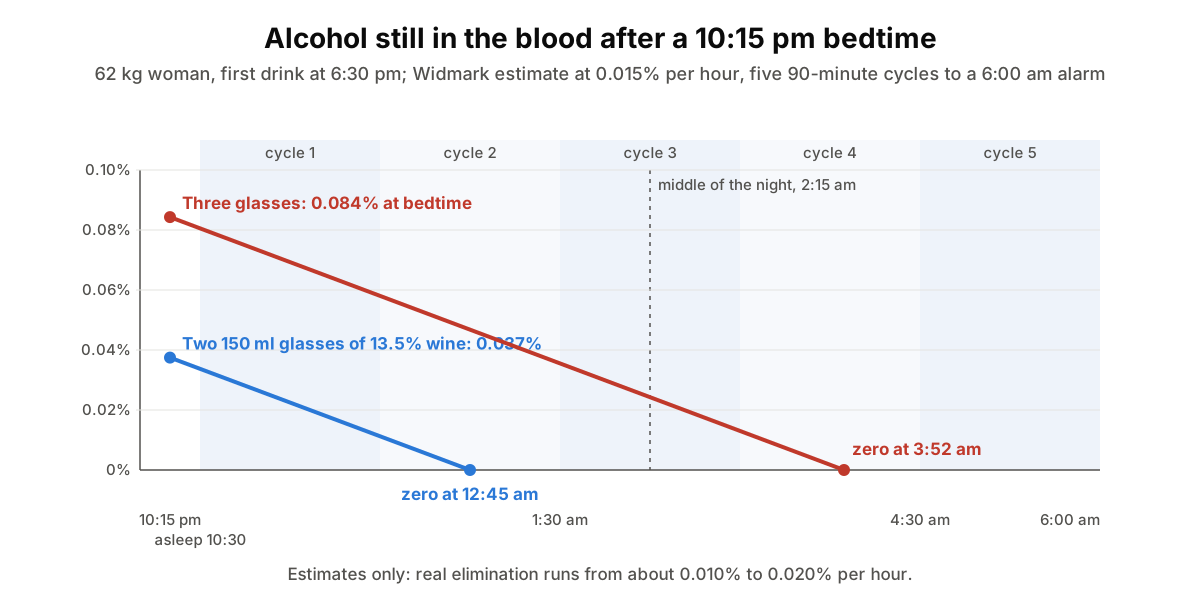
Two glasses. In the Australian BAC Calculator, enter 62 kg, Female, 3.75 hours since the first drink, and two 150 ml glasses of 13.5% wine. It shows 32 g, 3.2 standard drinks (0.52 g/kg), an estimated 0.037% at bedtime and about 2 h 30 min to zero, so alcohol is in her blood until about 12:45am, through her first sleep cycle.
A third glass. Change the wine count to three: 47.9 g, 4.8 standard drinks, already over the 4 a day in the guidelines. The bedtime estimate is 0.084% and zero comes at about 3:52am, past the middle of the night.
For an after-work session, take an 85 kg man who starts on schooners of 4.8% beer at 5:30pm and goes to bed at 10:15pm. Three schooners (48.3 g, 4.8 standard drinks) leave an estimated 0.012% at bedtime, clear by about 11:04pm. A fourth (64.4 g, 6.4 standard drinks) leaves 0.040% and runs to about 12:56am.
These are Widmark estimates at an average elimination rate of 0.015% per hour. Real rates vary from about 0.010% to 0.020% per hour and food slows absorption, so use the times to see how much of the night is affected, never to decide whether you can drive the next morning.
Is stopping three to four hours before bed enough?
The Sleep Health Foundation recommends avoiding alcohol for at least three to four hours before bedtime, and says some people need to stop earlier, for example if they are sensitive to alcohol or take medicines that interact with it. Two checks with the calculator and the research show why earlier is better.
- The alcohol may not be gone. The calculator's time to zero counts from the first drink. Two glasses of 13.5% wine take the 62 kg woman an estimated 6 h 15 min to clear, so to be at zero by 10:15pm she would have to start at about 4:00pm. A four-hour gap after the last glass leaves alcohol in her blood at lights out.
- Zero is not the finish line. Landolt and colleagues gave healthy men 0.55 g/kg six hours before bed. Breath alcohol was zero when they went to sleep, yet sleep efficiency, total sleep time and REM sleep all fell, and time awake in the second half of the night roughly doubled. For the 85 kg man that dose is about 4.7 standard drinks, three schooners.
The NHS in the UK suggests six hours without alcohol before bed, and Ireland's HSE four. None of these gaps is tested directly in the research; what the studies do show is that less alcohol, earlier, is better for the night than any fixed gap.
Snoring, sleep apnoea and when to get help
A 2018 meta-analysis by Simou and colleagues linked higher alcohol intake to a 25% higher risk of sleep apnoea, and the Sleep Health Foundation says even modest amounts can worsen snoring. If you snore loudly, stop breathing during sleep or wake up gasping, talk to your GP rather than adjusting your drinking around it.
healthdirect advises talking with your doctor if you want to reduce how much you drink. If you are relying on a drink to get to sleep most nights, or you wake every night and cannot get back to sleep, a GP can assess insomnia and sleep apnoea, both of which are treatable and both of which alcohol tends to make worse.
Tools for this job
- Australian BAC Calculator: standard drinks, grams and the estimated time until your blood alcohol reaches zero, starting from cans, glasses and nips.
- Sleep Calculator: bedtimes that fit whole 90-minute cycles before your alarm.
For how standard drinks, the 0.05 limit and the zero limit for provisional drivers work, see blood alcohol and standard drinks in Australia. For the stages behind the cycle arithmetic, read sleep cycles explained.
Frequently asked questions
How many standard drinks before bed affect sleep?
The 2025 meta-analysis found REM sleep disrupted at up to 0.50 g/kg, which is about 3 standard drinks for a 62 kg woman and 4 for an 85 kg man. There is no proven safe amount, so assume that any alcohol close to bed changes your sleep a little.
Does a glass of wine help you sleep?
It can make you drowsy, but in the research a clearly faster sleep onset only appeared at around 0.85 g/kg, which is about five standard drinks for a 62 kg woman. At one or two glasses, the measurable change is less REM sleep.
Why do I wake up at 3am after drinking?
Once the body has cleared the alcohol, sleep becomes lighter and you wake more easily. In the worked example the third glass pushed the time alcohol runs out from about 12:45am to about 3:52am, which places that restless stretch in the early hours.
Do the Australian Guidelines protect sleep?
The guidelines (no more than 10 standard drinks a week and 4 on any one day) are about long-term disease and injury risk, not sleep. Four standard drinks is within or above the low-dose range in which REM sleep fell in the research.
Sources and further reading
- Tips for safe and responsible drinking, healthdirect (Australian Government). No more than 10 standard drinks a week and 4 on any one day; a standard drink is about 10 g.
- Know your standard drinks, healthdirect. 150 ml of 13.5% wine and 425 ml of 4.8% beer are each 1.6 standard drinks.
- Sleep, healthdirect. 90-minute cycles, about 20% REM, 7 to 9 hours for most adults.
- Caffeine, food, alcohol, smoking and sleep, Sleep Health Foundation. Four in ten adults drank in the hour before sleep; avoid alcohol 3 to 4 hours before bed; modest amounts worsen snoring.
- The effect of alcohol on subsequent sleep in healthy adults: a systematic review and meta-analysis, Gardiner and colleagues, Sleep Medicine Reviews 2025.
- Alcohol and sleep I: effects on normal sleep, Ebrahim and colleagues, Alcoholism: Clinical and Experimental Research 2013.
- Late-afternoon ethanol intake affects nocturnal sleep and the sleep EEG in middle-aged men, Landolt and colleagues, Journal of Clinical Psychopharmacology 1996.
- Sleep, sleepiness, and alcohol use, Roehrs and Roth, Alcohol Research and Health (NIAAA) 2001.
- Alcohol and the risk of sleep apnoea, Simou and colleagues, Sleep Medicine 2018.
- Insomnia, NHS (UK). Six hours without alcohol before bed, for comparison.