
Alcohol and Sleep: What a Few Units Do to Your Night
Why two 175 ml glasses of wine or three pints can leave you awake at 3am, worked in UK units, and how the NHS six-hour advice compares with the sleep studies.
By Redbison Dev · · 9 min read
United Kingdom edition. Written for UK readers: drinks counted in 8 g units from pints, 175 ml glasses and 25 ml measures, the Chief Medical Officers' 14 units a week, and NHS insomnia advice to stop drinking six hours before bed. US edition
If a couple of glasses of wine send you off quickly but you are wide awake at 3am, that is the pattern sleep laboratories record. Alcohol shortens the time to drop off, then holds back dream (REM) sleep and leaves the second half of the night shallow and broken while your liver clears it. In UK terms, REM sleep was already disrupted in the low-dose group of the largest meta-analysis, up to 0.50 g/kg (about 4 units for a 10 st 3 lb woman, 5 for a 13 st man), and it found no lower threshold. That is well inside a normal evening, and the NHS insomnia page goes further than most countries' advice: no alcohol in the six hours before bed.
This edition counts drinks in UK units, uses the UK Blood Alcohol Calculator and the Sleep Calculator to show how much of a night two or three glasses cover, and explains what the six-hour rule does and does not protect. It is general information, not medical advice.
Units first: what the studies' doses look like in a UK glass
Sleep research gives doses in grams of alcohol per kilogram of body weight. The NHS defines one unit as 10 ml, or 8 g, of pure alcohol, and works units out as ABV times millilitres divided by 1,000. Converting the research doses into units for two typical British drinkers makes them easier to picture:
| Dose in the research | 10 st 3 lb woman (64.9 kg) | 13 st man (82.6 kg) |
|---|---|---|
| 0.50 g/kg, the top of the "low dose" band in the 2025 meta-analysis | 32 g, about 4 units | 41 g, about 5 units |
| 0.55 g/kg, the dose Landolt and colleagues gave six hours before bed | 36 g, about 4.5 units | 45 g, about 5.7 units |
| 0.85 g/kg, where a faster sleep onset finally appeared | 55 g, about 6.9 units | 70 g, about 8.8 units |
Using the NHS serving sizes, two standard 175 ml glasses of 12% wine are 4.2 units and two pints of 4% lager are 4.5 units. So the "low dose" in these studies is an ordinary night: a bottle of wine split between two people over dinner, or two or three pints after work. The UK Chief Medical Officers' weekly guideline (no more than 14 units a week on a regular basis, spread over three or more days) can be met while still drinking enough on one evening to change that night's sleep.
What the laboratory studies found
Two reviews do most of the work here, and both measured sleep with polysomnography, which records brain waves, eye movements and muscle tone.
- Gardiner and colleagues (2025) pooled 27 studies. Up to 0.50 g/kg, REM sleep was already pushed later and shortened, and the effect grew with the dose. Falling asleep faster, and reaching deep sleep sooner, only showed up at 0.85 g/kg or more. Total sleep time and time awake were too inconsistent between studies to pin down.
- Ebrahim and colleagues (2013) found that the first half of the night is more consolidated after alcohol and the second half more disrupted, with the first REM period delayed at every dose studied.
Put into units, that means the drowsy, quick-to-sleep effect people describe as a nightcap mostly belongs to seven or more units for a woman of average weight, while REM sleep was already reduced in the low-dose group, which tops out at about four units for her. Roehrs and Roth's review for the US National Institute on Alcohol Abuse and Alcoholism adds two points that matter to regular drinkers: the sedative effect fades within about three nights of drinking, and once the alcohol has gone the brain rebounds with lighter sleep and more waking.
Worked example: a 10 st 3 lb woman with a 6:30am alarm
She has her first glass at 7pm and wants to be up at 6:30am.
Bedtime. In the Sleep Calculator, keep the "I need to wake at" tab, enter 06:30 and leave 15 minutes to fall asleep and 90-minute cycles. It offers 9:15pm, 10:45pm (five cycles, 7 h 30 min of sleep), 12:15am or 1:45am. She picks 10:45pm.
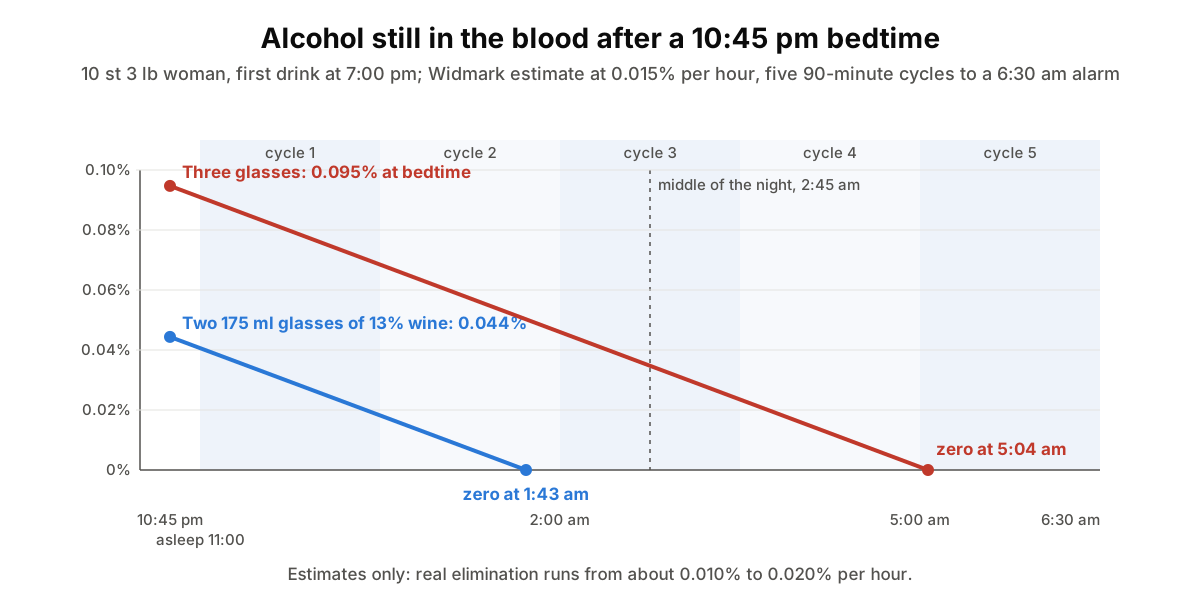
Two glasses. In the UK Blood Alcohol Calculator, choose st and lb and enter 10 st 3 lb, Female, 3.75 hours since the first drink, and two 175 ml glasses of 13% wine (clear the other drinks). The calculator shows 35.9 g, about 4.5 UK units (0.55 g/kg, the Landolt dose), an estimated 0.044% at bedtime, and about 2 h 58 min until zero. The alcohol runs out at about 1:43am, early in her second sleep cycle.
Three glasses. Change the wine to three glasses. That is 53.8 g, about 6.7 units, 0.83 g/kg, close to the dose where the meta-analysis found faster sleep onset. The estimate at bedtime is 0.095%, and zero comes at about 5:04am, in her last cycle before the alarm. The whole night is spent clearing alcohol, and the lighter, broken sleep that follows lands in the hours when she would normally get most of her REM sleep.
A pub evening tells the same story. A 13 st man who has three pints of 4% lager from 6pm (53.8 g, about 6.7 units) and goes to bed at 11:15pm for a 7am start is at about 0.017% at bedtime and reaches zero at about 12:23am. On paper his blood is clear early in the night; the next section explains why that is not the end of it.
All of these are Widmark estimates at the average elimination rate of 0.015% per hour. Real rates range from about 0.010% to 0.020% per hour, and food slows absorption, so treat the times as the shape of the night, never as a reason to drive.
The NHS six-hour rule, tested
The NHS insomnia page tells people not to smoke or drink alcohol, tea or coffee for at least six hours before bed. That is stricter than the four hours given by the HSE in Ireland and the three to four hours suggested by Australia's Sleep Health Foundation, and the research explains why the stricter figure is the better one.
First, six hours is not always enough for the alcohol to clear. Rerun the woman's two glasses with the first glass at 4:45pm, six hours before her 10:45pm bedtime: the calculator still estimates 0.011% at lights out, reaching zero at about 11:28pm. To be at zero by bedtime, she would have needed to start at about 4:02pm, because two 175 ml glasses take an estimated 6 h 43 min to clear from the first sip.
Second, even a clear bloodstream does not protect the night. In Landolt and colleagues' study, men given 0.55 g/kg six hours before bed had zero breath alcohol at lights out, yet their total sleep, sleep efficiency and REM sleep all fell and time awake in the second half of the night roughly doubled. For the 13 st man above, 0.55 g/kg is about 5.7 units, about two and a half pints of 4% lager.
So the six-hour rule is a sensible minimum, not a guarantee. What protects sleep is the amount: fewer units, earlier, and some evenings without any, which also matches the CMOs' advice to have several drink-free days a week if you want to cut down.
Snoring, sleep apnoea and when to see a GP
A 2018 meta-analysis by Simou and colleagues found that higher alcohol intake was linked to a 25% higher risk of sleep apnoea, and the Sleep Health Foundation notes that even modest amounts can worsen snoring. If you or your partner notice loud snoring, pauses in breathing or waking up gasping, see a GP rather than trying to time your drinking around it.
The NHS says to see a GP if changing your sleep habits has not helped, or if insomnia is affecting daily life. GPs now rarely prescribe sleeping pills; the usual first treatment is cognitive behavioural therapy for insomnia, face to face or through an online programme. If you notice you need a drink to get to sleep most nights, say so, and ask a pharmacist whether any medicines you take interact with alcohol.
Tools for this job
- UK Blood Alcohol Calculator: units, grams and the estimated time until your blood alcohol reaches zero, with pints, 175 ml glasses and weight in stones.
- Sleep Calculator: bedtimes that fit whole 90-minute cycles before your alarm.
For how units, the 80 mg and 50 mg drink-drive limits and the morning after work in the UK, read blood alcohol in UK units. For the stages behind the 90-minute arithmetic, see sleep cycles explained.
Frequently asked questions
How many units before bed affect sleep?
The 2025 meta-analysis found REM sleep disturbed at doses up to 0.50 g/kg, which is about 4 units for a 10 st woman and 5 units for a 13 st man, with bigger effects as the dose rises. No study shows a safe number, so any alcohol near bedtime is best assumed to change the night a little.
Does a glass of red wine help you sleep?
It may help you drop off, but the faster sleep onset in the research only appeared at about 0.85 g/kg, which is around 7 units for a woman of 10 st, roughly three 175 ml glasses of 13% wine. At one or two glasses the main measurable effect is less REM sleep, not better sleep.
Why do I wake at 3am after a few pints?
As the liver clears the alcohol, sleep becomes lighter and you wake more often. In the worked example, the third glass moved the point where alcohol runs out from about 1:43am to about 5:04am, so the light, broken sleep stretches across the early hours.
Is the six-hour NHS rule enough?
It is a good minimum, but not always enough. Two 175 ml glasses of 13% wine take a 10 st 3 lb woman an estimated 6 h 43 min to clear, and in the Landolt study about three drinks six hours before bed still reduced sleep quality with no alcohol left in the breath.
Sources and further reading
- Alcohol units, NHS. One unit is 10 ml or 8 g; ABV x ml / 1,000; 175 ml glass of 12% wine is 2.1 units; 14 units a week.
- Insomnia, NHS. No alcohol, tea or coffee for at least 6 hours before bed; when to see a GP; CBT as treatment.
- UK Chief Medical Officers' low risk drinking guidelines, Department of Health and Social Care, 2016. No more than 14 units a week, spread over 3 or more days, several drink-free days.
- Insomnia, HSE (Ireland). No alcohol, tea or coffee less than 4 hours before bed, for comparison.
- Caffeine, food, alcohol, smoking and sleep, Sleep Health Foundation (Australia). Avoid alcohol 3 to 4 hours before bed; modest amounts worsen snoring.
- The effect of alcohol on subsequent sleep in healthy adults: a systematic review and meta-analysis, Gardiner and colleagues, Sleep Medicine Reviews 2025. REM disrupted up to 0.50 g/kg; faster sleep onset from 0.85 g/kg.
- Alcohol and sleep I: effects on normal sleep, Ebrahim and colleagues, Alcoholism: Clinical and Experimental Research 2013.
- Late-afternoon ethanol intake affects nocturnal sleep and the sleep EEG in middle-aged men, Landolt and colleagues, Journal of Clinical Psychopharmacology 1996. 0.55 g/kg six hours before bed.
- Sleep, sleepiness, and alcohol use, Roehrs and Roth, Alcohol Research and Health (NIAAA) 2001. Tolerance within three nights and second-half rebound.
- Alcohol and the risk of sleep apnoea, Simou and colleagues, Sleep Medicine 2018. Relative risk 1.25.