
Alcohol and Sleep: Standard Drinks and a Broken Night
What NZ standard drinks do to REM sleep, worked with 330 ml bottles and glasses of wine, and why stopping four hours before bed is a minimum.
By Redbison Dev · · 9 min read
New Zealand edition. Written for New Zealand readers: drinks counted in 10 g standard drinks from 330 ml bottles and 150 ml glasses, Health New Zealand's daily and weekly limits, and Healthify's advice on alcohol before bed. US edition
A few beers or a couple of wines can make it easier to nod off, but the night that follows is worse. Sleep laboratory studies find that alcohol delays and cuts REM (dream) sleep and that the second half of the night turns lighter and more broken as the body clears it. For an 85 kg man, four New Zealand standard drinks, about three 330 ml bottles of 5% lager, reaches the top of the dose band in which REM sleep was disrupted.
This edition counts in New Zealand standard drinks of 10 g, follows an evening through the New Zealand Blood Alcohol Calculator and the Sleep Calculator, and checks the advice to stop at least four hours before bed against the research. It is general information, not medical advice.
The research doses in NZ standard drinks
Health New Zealand | Te Whatu Ora defines a standard drink as 10 g of pure alcohol. Sleep studies give doses per kilogram of body weight, which converts like this:
| Dose in the research | 65 kg woman | 85 kg man |
|---|---|---|
| 0.50 g/kg, top of the "low dose" band in the 2025 meta-analysis | 33 g, about 3.3 standard drinks | 43 g, about 4.3 |
| 0.55 g/kg, given six hours before bed in Landolt and colleagues' study | 36 g, about 3.6 | 47 g, about 4.7 |
| 0.85 g/kg, where falling asleep faster first appeared | 55 g, about 5.5 | 72 g, about 7.2 |
Health New Zealand's lower-risk limits are 2 standard drinks a day and 10 a week for women, 3 a day and 15 a week for men, with at least 2 alcohol-free days a week. The daily limits (2 standard drinks for a woman, 3 for a man) fall within the low-dose band, up to 0.50 g/kg, in which the 2025 meta-analysis already found REM sleep disrupted, so staying inside them does not protect the night's sleep. Four bottles at a barbecue (5.2 standard drinks, 0.61 g/kg for an 85 kg man) go past the top of that band.
What the studies measured
Gardiner and colleagues (2025) pooled 27 laboratory studies of healthy adults. Up to 0.50 g/kg, the first REM period came later and REM sleep fell, and the effect grew with the dose. Falling asleep faster and reaching deep sleep sooner only appeared from 0.85 g/kg, around seven standard drinks for an 85 kg man. Ebrahim and colleagues (2013) found the first half of the night steadier after alcohol and the second half more disturbed, with the first REM period delayed at every dose.
Healthify, the New Zealand health information site, sums it up in two lines: alcohol can disrupt the sleep cycle and lower sleep quality, and it stops you getting enough of the deep sleep you need. Roehrs and Roth's review for the US National Institute on Alcohol Abuse and Alcoholism adds that the sedative effect fades within about three nights of regular drinking, while the lighter sleep and waking after the alcohol clears do not.
Worked example: a barbecue and a 6am start
An 85 kg man opens his first 330 ml bottle of 5% lager at 6pm and has to be up at 6am.
Bedtime. In the Sleep Calculator, keep "I need to wake at", enter 06:00, and keep 15 minutes to fall asleep and 90-minute cycles. It offers 8:45pm, 10:15pm (five cycles, 7 h 30 min asleep), 11:45pm or 1:15am. He picks 10:15pm.
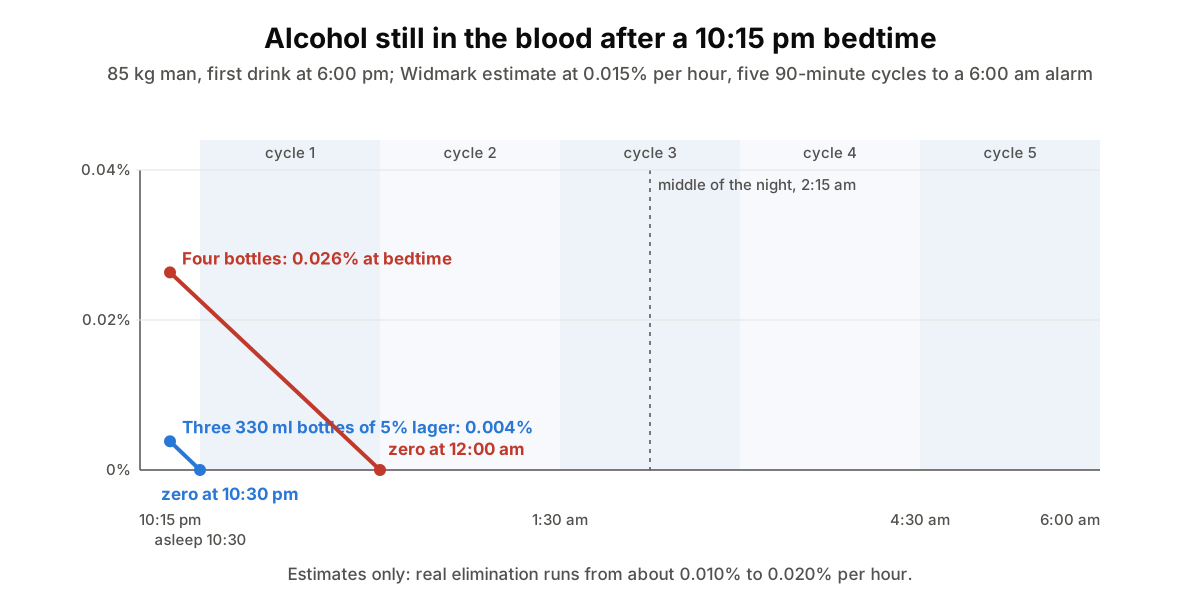
Three bottles. In the New Zealand Blood Alcohol Calculator, enter 85 kg, Male, 4.25 hours since the first drink and three 330 ml bottles at 5%. It shows 39.1 g, about 3.9 standard drinks (0.46 g/kg), already over the 3 a day for men, an estimated 0.004% at bedtime and zero at about 10:30pm.
Four bottles. Change to four: 52.1 g, about 5.2 standard drinks, 0.61 g/kg. Now the estimate is 0.026% at bedtime and the alcohol lasts until about 12:00am, through his first sleep cycle.
For wine with dinner, a 65 kg woman who has two 150 ml glasses of 13% wine from 7pm and goes to bed at 10:45pm has 30.8 g, about 3.1 standard drinks, over the 2 a day for women, an estimated 0.030% at bedtime and zero at about 12:44am.
These are Widmark estimates at an average elimination rate of 0.015% per hour. Real rates range from about 0.010% to 0.020% per hour, and food slows absorption, so treat the times as the shape of the night and never as a reason to drive in the morning.
Is four hours before bed enough?
Healthify advises stopping alcohol at least four hours before bedtime so the body has time to process it. The calculator and the research both suggest treating that as the least you should allow.
- The alcohol may still be there. Four bottles take the 85 kg man an estimated 6 h 00 min to clear, counted from the first one, and two glasses of 13% wine take the 65 kg woman about 5 h 44 min. If the last drink is four hours before bed, the first was not long before, and some alcohol is likely still in the blood at lights out.
- Zero is not the end of the effect. In Landolt and colleagues' study, healthy men drank 0.55 g/kg six hours before bed and had zero breath alcohol when they went to sleep. Their sleep efficiency, total sleep and REM sleep still fell, and time awake in the second half of the night roughly doubled. For the 85 kg man that dose is about 4.7 standard drinks, three and a half bottles of 5% lager.
Other countries' health services give different gaps: the NHS in the UK says six hours, Ireland's HSE four and Australia's Sleep Health Foundation three to four. None is tested directly. The research points to the amount, not the clock: fewer drinks, earlier in the evening, and the alcohol-free days Health New Zealand recommends.
Snoring, sleep apnoea and when to get help
Healthify notes that alcohol does not cause sleep apnoea but makes it worse, and a 2018 meta-analysis by Simou and colleagues linked higher alcohol intake to a 25% higher risk of it. If you snore loudly, stop breathing during sleep or wake gasping, see your GP rather than timing your drinking around it.
The same goes for needing a drink to get to sleep most nights, or waking every night and not getting back to sleep. Insomnia and sleep apnoea are treatable, and alcohol tends to make both worse. A pharmacist can tell you whether any of your medicines interact with alcohol.
Tools for this job
- New Zealand Blood Alcohol Calculator: NZ standard drinks, grams and the estimated time until blood alcohol reaches zero, starting from 330 ml cans and 150 ml glasses.
- Sleep Calculator: bedtimes that fit whole 90-minute cycles before your alarm.
For the 250 microgram breath limit, the zero limit for drivers under 20 and the morning after, read standard drinks and the NZ alcohol limit. For the stages behind the cycle arithmetic, see sleep cycles explained.
Frequently asked questions
How many standard drinks before bed affect sleep?
In the 2025 meta-analysis REM sleep was disrupted at doses up to 0.50 g/kg, about 3 standard drinks for a 65 kg woman and 4 for an 85 kg man. No study has found an amount with no effect, so assume any alcohol near bedtime changes the night somewhat.
Do a few beers help you sleep?
They can make you drowsy, but a clearly faster sleep onset needed about 0.85 g/kg in the research, around seven standard drinks for an 85 kg man, more than five 330 ml bottles of 5% lager. At three or four the measurable effect is less REM sleep.
Why do I wake at 3am after drinking?
When the body has cleared the alcohol, sleep becomes lighter and you wake more easily. The more you drink, the later that point comes: in the worked example a fourth bottle moved it from about 10:30pm to midnight, and a bigger session pushes it into the early hours.
Do the Health New Zealand limits protect sleep?
They are set for long-term health and injury risk, not sleep. The daily limits (2 standard drinks for a woman, 3 for a man) fall within the low-dose band, up to 0.50 g/kg, in which the 2025 meta-analysis already found REM sleep disrupted, so staying inside them does not protect the night's sleep.
Sources and further reading
- Drinking responsibly, Health New Zealand | Te Whatu Ora. A standard drink is 10 g; 2 a day and 10 a week for women, 3 a day and 15 a week for men; at least 2 alcohol-free days.
- Sleep and alcohol, Healthify (Health Navigator Charitable Trust). Stop at least 4 hours before bed; alcohol makes sleep apnoea worse.
- The effect of alcohol on subsequent sleep in healthy adults: a systematic review and meta-analysis, Gardiner and colleagues, Sleep Medicine Reviews 2025.
- Alcohol and sleep I: effects on normal sleep, Ebrahim and colleagues, Alcoholism: Clinical and Experimental Research 2013.
- Late-afternoon ethanol intake affects nocturnal sleep and the sleep EEG in middle-aged men, Landolt and colleagues, Journal of Clinical Psychopharmacology 1996.
- Sleep, sleepiness, and alcohol use, Roehrs and Roth, Alcohol Research and Health (NIAAA) 2001.
- Alcohol and the risk of sleep apnoea, Simou and colleagues, Sleep Medicine 2018.
- Insomnia, NHS (UK), and Insomnia, HSE (Ireland). Six- and four-hour gaps before bed, for comparison.