
Standard Drinks and BAC in Australia: 0.05 and Zero
How schooners, cans and glasses of wine turn into standard drinks and a BAC estimate, why 0.05 is no target, the zero limit for L and P plates, and the 5 am start.
By Redbison Dev · · 7 min read
Australia edition. Written for Australian drivers: 10 g standard drinks, schooners, middies, cans and 30 ml nips, weight in kilograms, the 0.05 general limit and zero limits (using Queensland's rules), and the NHMRC guideline of 10 a week and 4 a day. US edition
An Australian standard drink is 10 g of pure alcohol, and the general drink-driving limit for a full or open licence is 0.05 (in Queensland you are over it at 0.05 or more), with a zero limit for learners and P-platers. A BAC calculator can convert your schooners and glasses into standard drinks and an estimated blood alcohol level, and show how slowly it falls. It cannot tell you that you are right to drive. This guide works through Australian serves with the Australian version of the BAC Calculator and explains why the answer is never a number of drinks.
Standard drinks: almost nothing is exactly one
healthdirect, the Australian Government's health information service, puts a standard drink at about 10 g of alcohol and reminds you that the number of standard drinks is printed on every can, bottle and cask. Reading that label is the best habit you can build, because the common serves are rarely one:
| Serve | Grams of ethanol | Standard drinks |
|---|---|---|
| 285 ml middy of 4.8% beer | 10.8 | 1.1 |
| 375 ml can or stubby of 3.5% mid-strength | 10.4 | 1.0 |
| 375 ml can or stubby of 4.8% full strength | 14.2 | 1.4 |
| 425 ml schooner of 4.8% beer | 16.1 | 1.6 |
| 150 ml glass of 13% wine | 15.4 | 1.5 |
| 750 ml bottle of 13.5% red | 79.9 | 8.0 |
| 30 ml nip of 40% spirits | 9.5 | 0.95 |
healthdirect gives the same schooner figure, 1.6, and 1.6 for a 150 ml glass of 13.5% red. The calculator gets grams from volume x ABV x 0.789 (the density of ethanol) and divides by 10. Glass names and sizes vary by state, so go by the volume on the menu, not the name.
The NHMRC guideline is about health, not driving
The NHMRC guidelines, as summarised by healthdirect, advise healthy adults to drink no more than 10 standard drinks a week and no more than 4 on any one day, and advise against drinking while pregnant, planning a pregnancy or breastfeeding. Four standard drinks is less than three schooners, or half a bottle of red. The guideline says nothing about driving, and staying inside it does not mean you are under 0.05.
From standard drinks to an estimated BAC
The estimate uses the Widmark formula: grams of alcohol divided by body weight times a body-water factor (0.68 for men, 0.55 for women), minus 0.015% for every hour since the first drink. Australian BAC is written as grams per 100 ml, so 0.05 is the same as 0.05% on the calculator.
Example 1, four cans at a barbecue. An 85 kg man has four 375 ml cans of 4.8% beer over two hours:
- 56.8 g of alcohol, 5.7 standard drinks, not four
- peak if absorbed at once: 0.098%
- estimate now: 0.068%
- below 0.05 in about 1 h 13 min; about zero in 4 h 33 min
Example 2, three schooners at the pub. A 75 kg man has three schooners of 4.8% over two and a half hours:
- 48.3 g, 4.8 standard drinks
- estimate now: 0.057%, still over 0.05
- below 0.05 in about 29 min; about zero in 3 h 49 min
Three schooners is a modest session by pub standards, and the estimate still puts him over 0.05 when he would be walking to the car. Half an hour later the line dips under, but the estimate has a wide margin either way, and blood alcohol can keep rising for 30 to 60 minutes after the last drink, as Queensland's transport department notes.
Example 3, half a bottle of red with dinner. A 62 kg woman drinks 375 ml of 13.5% shiraz over two hours, the NHMRC daily maximum of 4 standard drinks:
- 39.9 g, 4.0 standard drinks
- estimate now: 0.087%
- below 0.05 in about 2 h 29 min; about zero in 5 h 49 min
Staying inside the health guideline put her well over the driving limit in the estimate. Weight and sex matter as much as the count.
Example 4, one middy for a P-plater. A 70 kg P1 driver has a single 285 ml middy of 4.8% beer: 10.8 g, 1.1 standard drinks. Any alcohol at all is over a zero limit, so there is nothing to calculate.
The 5 am start
healthdirect says your body can process about one standard drink an hour, and that a cold shower or coffee does not lower your BAC: the only way to lower it is with time. The calculator's steady fall of 0.015% an hour is close to one standard drink an hour for an 85 kg man, but only about half a standard drink for a 62 kg woman. That is a particular risk for anyone who starts work early.
Example 5, a long afternoon. An 85 kg tradie drinks ten schooners of 4.8% from 2 pm to 8 pm and sets the alarm for a 5 am start:
- 161.0 g of alcohol, 16.1 standard drinks
- estimate at 8 pm: 0.188%
- estimate at 5 am, 15 hours after the first schooner: 0.053%, still over 0.05
- below 0.05 at about 5:14 am; about zero at about 8:34 am
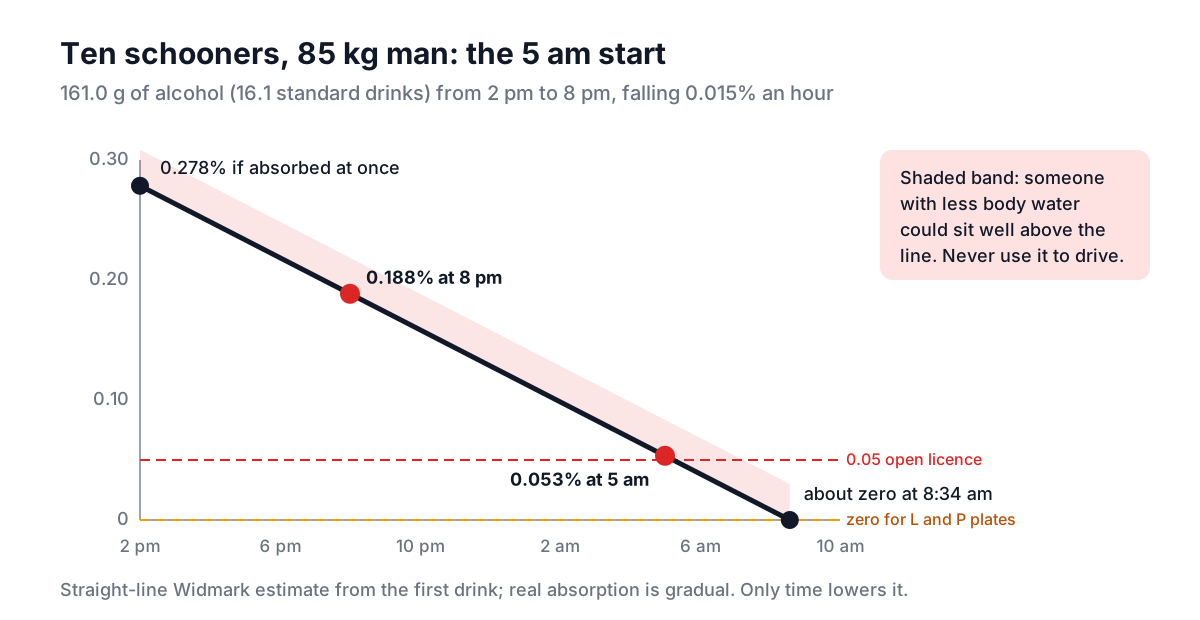
On these numbers he would be over 0.05 driving to the job, after nine hours' sleep, and if he held a P-plate he would be over his limit until about 8:30 am. A lighter person, a later finish or a few more drinks push those times later.
The limits, using Queensland's rules
Each state and territory sets its own limits and licence classes. The calculator's table uses Queensland's, which the Queensland Government publishes:
| Limit | You are over it at | Who it applies to |
|---|---|---|
| No alcohol | more than zero | learner, P1 and P2 provisional, probationary and restricted licences; interlock (code I) licences; drivers of trucks over 4.5 t GVM, buses built for more than 12 adults, articulated vehicles, taxis and other public passenger vehicles, dangerous-goods vehicles, tow trucks and driver trainers |
| General | 0.05 or more | open licence holders (riders in their first year on a class RE motorcycle licence must be at zero) |
| Middle | 0.10 or more | a higher offence band |
| High | 0.15 or more | the highest offence band |
The middle and high bands are offence levels with heavier penalties, not targets. If you drive in another state, look up its transport authority's page before you assume the same licence classes apply.
Why the estimate is only a guide
Queensland lists what changes your BAC: how much you drink and over what time, your weight, whether you have eaten, and your liver health. The formula treats all of those as averages. Two 85 kg men can carry different shares of body water; food slows absorption and lowers the peak; genetics and medication change the clearance rate. The straight line in the chart assumes all the alcohol was absorbed at the first drink, which real bodies do not do.
Use the calculator to learn what is in your usual drinks and how long a session takes to clear. Do not use it to decide that you are under 0.05. Plan the trip home first: a skipper who is not drinking, a taxi or rideshare, public transport, or staying over.
If someone who has been drinking is unable to respond or is unconscious, or their breathing is shallow, irregular or has stopped, healthdirect's overdose advice is to call triple zero (000) for an ambulance, roll them onto their side and not leave them alone.
Tools for this job
- BAC Calculator (Australian standard drinks): standard drinks, an estimate in percent and the time to fall below 0.05 and to zero.
- Hydration Calculator: a water target for the day after.
- Sleep Calculator: bedtimes and wake times, remembering that only time lowers BAC.
Frequently asked questions
How many standard drinks can I have and stay under 0.05?
There is no reliable number. In the examples above, three schooners keep a 75 kg man over 0.05 after two and a half hours, and four standard drinks of red put a 62 kg woman at an estimated 0.087%. The only safe plan when you are driving is not to drink.
How many standard drinks are in a schooner?
A 425 ml schooner of 4.8% beer is 1.6 standard drinks, which healthdirect also gives. A 285 ml middy is 1.1, a 375 ml can of full strength 1.4 and a can of mid-strength about 1.0. Glass names and sizes vary by state, so go by the volume on the menu, not the name.
Can I drink anything on my Ps?
No. Learner, P1 and P2 drivers must have a zero blood or breath alcohol reading. In Queensland that also covers probationary and restricted licences and many heavy, public passenger and dangerous-goods vehicle drivers.
How long does one standard drink take to wear off?
healthdirect says the body can process about one standard drink an hour. That is close to the calculator's 0.015% an hour for an 85 kg man (about 8.7 g an hour); a lighter person, especially a woman, clears less than one standard drink an hour on the same rate, about 5.1 g for the 62 kg woman in example 3. Ten schooners from a long afternoon can leave you over 0.05 at 5 am and above zero until about 8:30 am.
Does the NHMRC limit of 4 drinks a day keep me under 0.05?
No. It is a health guideline about long-term and short-term harm. In the third example, four standard drinks with dinner give a 62 kg woman an estimate well above 0.05.
Sources and further reading
- Alcohol limits, Queensland Government. No alcohol, general, middle and high limits, who they apply to, and peak BAC 30 to 60 minutes after the last drink.
- Know your standard drinks, healthdirect. About 10 g per standard drink; schooner, wine and spirit serves.
- Tips for safe and responsible drinking, healthdirect. The NHMRC guideline of no more than 10 standard drinks a week and 4 on any one day; the body processes about one standard drink an hour.
- How alcohol affects your health, healthdirect. A cold shower or coffee does not lower BAC; only time does.
- Drug overdose, healthdirect. Signs of overdose and what to do: call 000, roll the person onto their side and do not leave them alone.
- Australian guidelines to reduce health risks from drinking alcohol, National Health and Medical Research Council. The guidelines themselves.
- Alcohol calculations and their uncertainty, Medicine, Science and the Law. Searle on the Widmark formula and its error range.
- Evidence-based survey of the elimination rates of ethanol from blood, Forensic Science International. Jones, 2010.
More Wellness Tools
Every tool in the Wellness Tools section, free and in your browser.