
Area and Volume Formulas for Blocks, Tanks and Pools
Area and volume formulas worked in metric for Australian jobs: block sizes in m² and perches, house size in squares, rainwater tanks and pools in litres.
By Redbison Dev · · 9 min read
Australia edition. Written for Australian measuring jobs: block areas in square metres, hectares and old perches, house sizes in builders' squares, a trapezium-shaped pool and a round rainwater tank in litres and kilolitres, all worked in metric. US edition
Most Australian area and volume questions arrive in a mix of units. The contract says the block is 640 m², the old title says 25 perches, the builder quotes the house in squares, the tank is sold in litres and the landscape yard sells soil by the cubic metre. The formulas behind all of them are short: a flat shape's area is a version of base times height, a solid's volume is base area times height (a third of that for anything that tapers to a point), and every unit conversion squares or cubes the length factor. This edition works through those ideas on Australian jobs, with the numbers you can repeat in the Area Calculator (Australia) and the Volume Calculator.
Areas you can measure on the ground
A rectangle is length times width. Every straight-sided formula reuses that idea with the perpendicular height, the distance at right angles to the base, never a slanted side:
| Shape | Formula | Where it turns up |
|---|---|---|
| Rectangle | A = l × w | Rooms, slabs, lawns |
| Triangle | A = ½ × b × h | Gable ends, block corners |
| Trapezium | A = ½ × (a + b) × h | A sloping pool wall, a tapering garden bed |
| Parallelogram | A = b × h | Angled car spaces |
| Circle | A = πr² | Round tanks, garden beds |
Australian maths calls the four-sided shape with two parallel sides a trapezium; American sources, and some calculators, say trapezoid. The formula is the same.
An irregular block from its four sides
A block is rarely a rectangle, and you can usually measure the boundaries but not a perpendicular height. Split it with a diagonal into two triangles, measure every edge, and use Heron's formula for each:
s = (a + b + c) / 2
A = √(s(s − a)(s − b)(s − c))
Take a corner block with boundaries of 20.1, 35.2, 18.0 and 32.4 m and a diagonal of 40.0 m. The first triangle (20.1, 35.2, 40.0) is 353.60 m², the second (18.0, 32.4, 40.0) is 286.06 m², so the block is 639.66 m². In other units that is 0.0640 ha and 25.29 perches. The perch is the old Australian land unit of 30¼ square yards, about 25.29 m², and 160 perches make an acre, so this block is just over 25 perches. For comparison, the ABS found the average site area of new house approvals in the capital cities fell from 602 m² in 2005-06 to 467 m² in 2019-20.
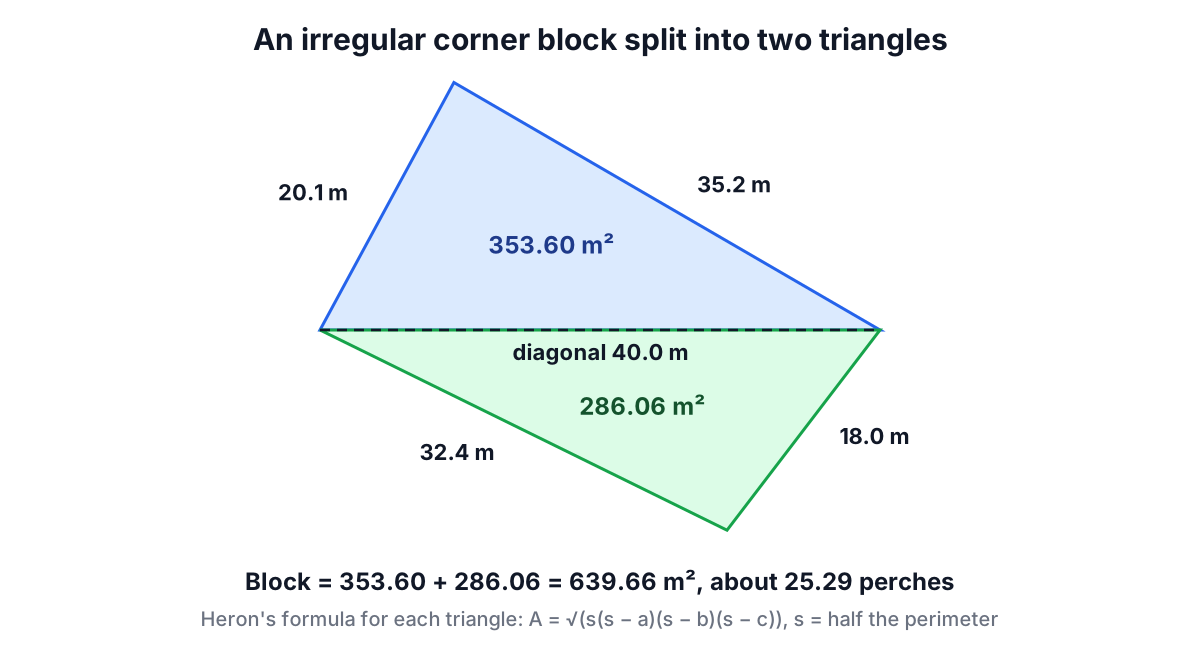
A surveyed plan is the authority for a block's area. A tape and Heron are fine for estimating turf or fencing, but a measuring error on the diagonal moves both triangles at once.
A house in squares
Builders and display homes still quote house size in squares. A square is 100 square feet, which is 9.290304 m² because a foot is exactly 0.3048 m. An L-shaped house of 15 × 12 m plus 8 × 6 m is 180 + 48 = 228 m², which is 24.54 squares. Treat a square as 10 m² and you would call it 22.8 squares and undersell the house by almost two. Builders also differ on whether the garage, alfresco and porch count, so compare quotes on the same basis.
Volumes: base area times height
A prism or cylinder holds its base area times its height. A cone or pyramid holds exactly one third of the matching prism, and a sphere two thirds of the cylinder that wraps it. Everything else in the Volume Calculator is a combination: a frustum (a bucket shape) is a big cone minus a small one, a tube is an outer cylinder minus an inner one.
A round rainwater tank
A round poly tank 2.4 m across and 2.1 m tall, measured inside, is a cylinder with r = 1.2 m:
V = π × 1.2² × 2.1 = 9.50 m³ = 9,500 L
That is the brim volume, and the Rainwater Tank Calculator gives the litres at any water level. The outlet sits above the base and the overflow below the top, so the water you can actually draw is less. If the usable depth between outlet and overflow is 1.9 m, the tank delivers 8.60 m³, or 8,595 L. When you compare tanks by their sales capacity, check whether it is the brim figure.
Filling it is the other half of the sum. One millimetre of rain on one square metre is one litre (0.001 m × 1 m² = 0.001 m³), so a 180 m² roof sheds up to 180 L per millimetre before gutter losses and first-flush diverters. Filling the empty 9,500 L tank takes about 53 mm of rain on that roof.
A pool with a sloping floor
An 8 × 4 m pool that runs from 1.0 m deep at the shallow end to 1.8 m at the deep end has a trapezium for its side profile:
side area = ½ × (1.0 + 1.8) × 8 = 11.2 m²
volume    = 11.2 × 4 = 44.8 m³ = 44,800 L
The same answer comes from treating it as a box 8 × 4 m at the average depth of 1.4 m. Chemical dosing and heat pump sizing work from that volume, which the Pool Volume Calculator (Australia) also gives in litres, so a pool shop that asks "how many litres?" wants 44,800, not the 57,600 L you would get by using the deep end all over.
Square and cubic metres do not convert like metres
A metre is 3.2808 feet, but a square metre is 10.764 square feet and a cubic metre 35.315 cubic feet, because each dimension converts. The metric side is kinder, but it has the same trap:
- 1 m = 100 cm, but 1 m² = 10,000 cm² and 1 m³ = 1,000,000 cm³.
- 1 m³ = 1,000 L = 1 kL. A 9.5 m³ tank is 9.5 kL.
- 1 ha = 10,000 m², about 2.471 acres. An acre is 4,046.86 m², or 160 perches.
- A perch is 25.29285264 m²; a square is 9.290304 m². Both are exact from the international yard and foot (NIST).
Landscape supplies sell soil, mulch and road base by the cubic metre. A garden bed 3 × 1.2 m topped up with 75 mm of mulch needs 3 × 1.2 × 0.075 = 0.27 m³. Convert the depth from millimetres to metres before multiplying; leaving it as 75 gives an answer a thousand times too big.
Measuring decisions that matter more than the formula
- Inside or outside. Inside dimensions for capacity (a tank, a pool), outside for material (formwork, cladding).
- Radius, not diameter. A tank's sales sheet gives the diameter. Entering 2.4 as the radius makes the tank four times bigger.
- Split odd shapes. An L-shaped house is two rectangles; a battle-axe block is a rectangle plus a strip for the handle.
- Add waste for orders. The Concrete Calculator and Tile Calculator add allowances for spillage and cuts.
Tools for this job
- Area Calculator (Australia): areas in square metres with squares, perches, hectares and acres alongside.
- Volume Calculator: cylinders, boxes, cones, frustums and tubes, with litres.
- Rainwater Tank Calculator: litres in a round or slimline tank at any water level.
- Pool Volume Calculator (Australia): litres in a pool, with doses and salt.
- Triangle Calculator: the missing sides or angles of a block corner.
- Unit Converter: any unit this guide does not list.
The US edition of this guide covers square feet, acres and US gallons.
Frequently asked questions
How do I work out the area of an irregular block?
Split it into triangles with diagonals, measure every side of each triangle and use Heron's formula, then add the areas. A block with sides of 20.1, 35.2, 18.0 and 32.4 m and a 40.0 m diagonal is 639.66 m², about 25.3 perches.
How many litres is a round water tank?
Multiply π by the radius squared by the height, in metres, then by 1,000. A tank 2.4 m across and 2.1 m tall holds 9,500 L to the brim; the usable volume between outlet and overflow is less.
How many litres of rain will my roof collect?
One litre per square metre of roof for every millimetre of rain, before losses. A 180 m² roof gives up to 180 L per millimetre, so 25 mm of rain is up to 4,500 L.
How big is a 24-perch block?
About 607 m², since a perch is 25.29 m². A 32-perch block is about 809 m² and a quarter acre (40 perches) about 1,012 m².
Sources and further reading
- Australians building houses on smaller blocks, Australian Bureau of Statistics. Site and floor areas of new houses, 2005-06 to 2019-20.
- SI Units: Length, National Institute of Standards and Technology. The international foot and yard behind the square and the perch.
- SI Units: Volume, National Institute of Standards and Technology. The litre and the cubic metre.
- Heron's Formula, Wolfram MathWorld.
- Trapezoid, Wolfram MathWorld. Area of a trapezium and the naming difference.
- Conical Frustum, Wolfram MathWorld.
More Geometry Calculators
Every tool in the Geometry Calculators section, free and in your browser.