
How Many Tonnes of Asphalt for a Driveway in Australia
Tonnes of hotmix for a driveway from m² and millimetres, why the council crossover is a separate job with its own build-up, and how far a tonne goes at 30 to 100 mm.
By Redbison Dev · · 9 min read
Australia edition. Written for Australian driveways in square metres, millimetres and tonnes, with hotmix, bitumen and spray seal terms, council vehicle crossing rules from Banyule and Brisbane, and prices in A$. US edition
To estimate hotmix for an Australian driveway, multiply the area in square metres by the compacted thickness in metres and by about 2.32 tonnes per cubic metre, then add 5 to 10% for edges and low spots. A 15 m by 3.2 m single driveway at 40 mm comes to about 4.7 tonnes with 5% extra. The section between your boundary and the kerb is different: it is the council's vehicle crossing, and where a council accepts asphalt there at all, it can ask for 100 mm or more, two and a half times the thickness. The Australian Asphalt Driveway Calculator handles both in tonnes and A$.
Hotmix, bitumen and spray seal
Australians use three words for a black driveway, and they are not the same product.
| Term | What it is | How it is priced |
|---|---|---|
| Asphalt or hotmix | Stone and sand bound with bitumen, mixed hot at a plant, laid by a paver and rolled | By the tonne of mix, plus laying |
| Bitumen | The black binder itself; also used loosely for any sealed driveway | Part of the mix |
| Spray seal | Bitumen sprayed on a prepared base and covered with aggregate | By the square metre |
This guide is about asphalt. A spray seal on a long rural driveway is a different job: there is no tonnage to calculate, and the quote is per m².
Hotmix is sold by weight, and selling goods by measurement in Australia falls under the national trade measurement laws administered by the National Measurement Institute, which require the measuring instrument used for the sale to be an approved type and verified. The tonnes on your delivery docket are the figure to check against the estimate.
The 23.2 kg rule and a worked driveway
One square metre of asphalt 10 mm thick is 0.01 m³. At a compacted density of 2,320 kg/m³ it weighs 23.2 kg. Everything else is scaling.
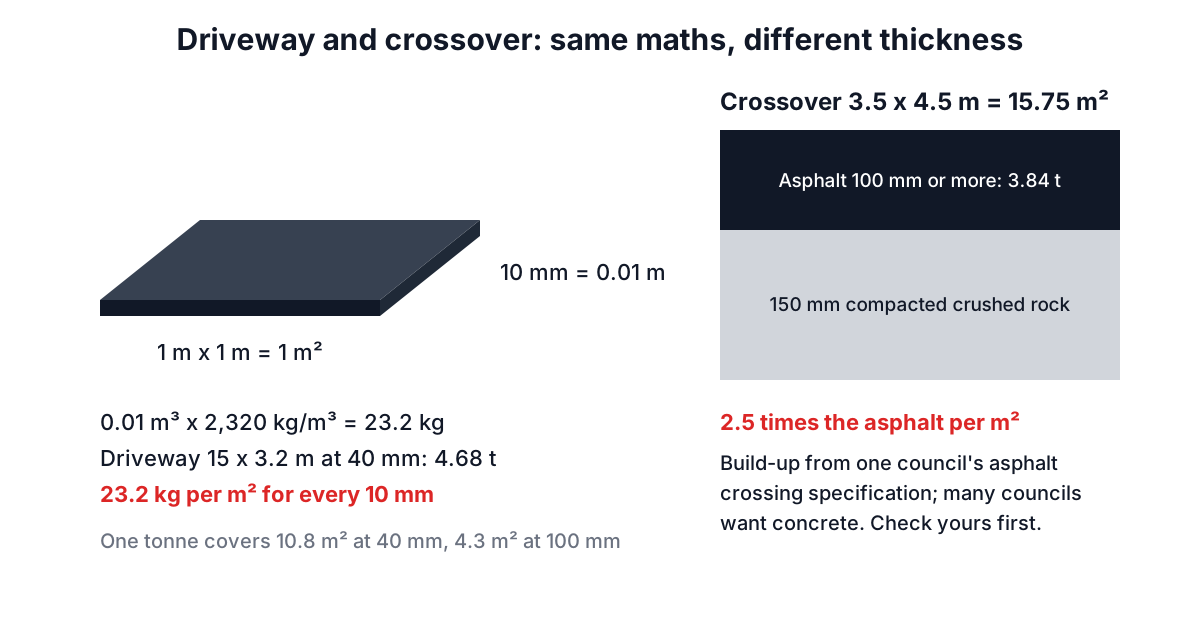
Take a single driveway 15 m long and 3.2 m wide (48 m²). In the calculator, choose a rectangle, enter the two sides in metres, the compacted thickness in millimetres, 2,320 kg/m³ and 5% extra.
| Driveway | Area | Compacted thickness | Volume | Tonnes with 5% extra |
|---|---|---|---|---|
| Single, 15 x 3.2 m | 48 m² | 30 mm | 1.44 m³ | 3.51 t |
| Single, 15 x 3.2 m | 48 m² | 40 mm | 1.92 m³ | 4.68 t |
| Double, 15 x 6 m | 90 m² | 50 mm | 4.50 m³ | 10.96 t |
The double driveway is about two 10-tonne truckloads, so ask the supplier what their trucks carry and whether the second load can arrive before the first has cooled. If you have a price per tonne, put it in the cost field in A$; the calculator multiplies it out.
The usual slip is the units. A 40 mm layer is 0.04 m. Enter 0.4 by mistake and the estimate is ten times too large; enter 40 in a field expecting metres and it is a thousand times too large. The tool takes millimetres directly, which avoids both.
How far a tonne goes
At 2,320 kg/m³ one tonne of compacted asphalt covers:
| Compacted thickness | Area per tonne |
|---|---|
| 30 mm | 14.4 m² |
| 40 mm | 10.8 m² |
| 50 mm | 8.6 m² |
| 100 mm | 4.3 m² |
Use it to sanity-check a quote: a 48 m² driveway at 40 mm is about 4.5 tonnes before waste. If the quote implies far more, the contractor is planning a thicker layer, and you should ask why. Always work in compacted thickness. The paver lays a loose mat that the roller presses down; the tonnes do not change, so a loose depth with a compacted density overstates the order.
The crossover belongs to the council
The vehicle crossing, or crossover, runs from the kerb to your property boundary across the nature strip and footpath. It sits in the road reserve, so the council sets the materials, the build-up and the inspection, and you need its permit before work starts. Two councils show how much the rules vary.
Banyule City Council (Victoria). Its specification for private and commercial vehicle crossings makes concrete the standard: at least 150 mm of 25 MPa concrete with F72 mesh over 50 mm of compacted fine crushed rock, 3 m to 5.6 m wide. Asphalt is a non-standard crossing that needs written approval first, and then must be 100 mm or more thick on at least 150 mm of compacted crushed rock. A permit is valid for 28 days, and the council inspects the work.
Brisbane City Council (Queensland). Its driveway technical standards accept concrete, asphalt or pavers but permit asphalt in non-urban areas only, with at least 100 mm of asphalt on at least 50 mm of compacted road base. It also caps gradients at 1:4 inside the property boundary and 1:6 outside it.
For tonnage, a crossover is simply another area at a thicker layer. A straight crossover 3.5 m wide and 4.5 m from kerb to boundary is 15.75 m²; at 100 mm that is 1.575 m³, or 3.84 tonnes with 5% extra. A flared crossover that widens from 3.5 m at the kerb to 5.6 m at the boundary over the same 4.5 m is a trapezoid of 20.47 m² (the calculator has a trapezoid shape), which takes 4.99 tonnes. Order the crossover and the driveway as separate items, and only after the council has approved the material.
Under the asphalt
On a driveway that carries cars, the base does more work than the asphalt. Both council build-ups above put compacted crushed rock or road base under the hotmix, and Banyule requires the subgrade to be uniformly hard, rejecting soft or spongy areas. A thin asphalt layer over a poorly compacted base will crack and rut no matter how carefully it was rolled. Heavier traffic, a caravan or a boat trailer, reactive clay and steep driveways are all reasons to ask for a thicker section or an engineer's design.
The Australian Mulch and Gravel Calculator sizes the road base or crushed rock in cubic metres and tonnes from the same area. If the block needs levelling first, the Cut and Fill Calculator estimates the earthworks, and if your council wants a concrete crossover, the Australian Concrete Calculator and the Australian concrete and flooring estimating guide cover cubic metres, bags and premix.
The industry's peak body, the Australian Flexible Pavement Association, is a starting point for finding asphalt contractors and technical background.
Before you accept a quote
- Ask for the compacted thickness and the mix, and the base depth under it.
- Measure the driveway yourself and check the m².
- Check your council's crossover specification and permit before anyone touches the kerb.
- Ask whether the price covers the crossover, and whether the council will accept asphalt there.
- Get the tonnes on the delivery docket and compare them with your estimate.
Frequently asked questions
How many tonnes of asphalt does a single driveway need?
A 15 m by 3.2 m driveway (48 m²) needs about 3.5 tonnes at 30 mm, 4.7 tonnes at 40 mm and 5.8 tonnes at 50 mm, each with 5% extra at 2,320 kg/m³. A double driveway of 90 m² at 50 mm needs about 11 tonnes.
Can I have an asphalt crossover?
It depends on your council. Banyule treats asphalt as a non-standard crossing that needs written approval and at least 100 mm of asphalt on 150 mm of crushed rock; Brisbane allows asphalt driveways only in non-urban areas. Ask before you order, because many councils want concrete.
Is a bitumen driveway the same as asphalt?
Not quite. Bitumen is the binder. Asphalt, or hotmix, is stone and sand mixed with hot bitumen and rolled; a spray seal is bitumen sprayed on and covered with aggregate. Both get called bitumen driveways, but only asphalt is ordered by the tonne.
Why is the crossover thicker than the driveway?
The crossover is in the road reserve, where vehicles turn across the footpath and kerb, and the council sets its build-up and inspects it. Banyule also makes the owner pay the extra cost of reinstating a non-standard crossing if a utility has to dig through it. That is why one council asks for 100 mm of asphalt there, while a car-only driveway inside the boundary might be 30 to 50 mm.
How much extra asphalt should I order?
Add 5% on a new, well-prepared base and up to 10% where the base is uneven or there is a lot of hand work around pits, edges and the garage slab. On the 48 m² example at 40 mm, that is the difference between 4.68 and 4.90 tonnes.
Sources and further reading
- Specification for construction of private/commercial vehicle crossing, Banyule City Council. Standard concrete crossing, asphalt as a non-standard crossing, widths, permits and inspections.
- Driveway technical standards, Brisbane City Council. Materials, asphalt in non-urban areas, base and gradients.
- Australian trade measurement laws, business.gov.au. Selling goods by measurement and approved instruments.
- Australian Flexible Pavement Association, AfPA. Peak body for the asphalt and flexible pavement industry.
- Asphalt Paving Handbook, Airport Asphalt Pavement Technology Program. Placement, compaction and in-place density.
- Hot Mix Asphalt Paving Handbook 2000, US Federal Highway Administration. Background on laying and compaction.
More Civil & Structural
Every tool in the Civil & Structural section, free and in your browser.