
How Many Tonnes of Asphalt for a Driveway in Canada
Turn a driveway quote in square feet into metric tonnes of hot mix, check it against Ontario specs like 80 mm in two lifts, and avoid the ton vs tonne mix-up.
By Redbison Dev · · 9 min read
Canada edition. Written for Canadian driveways, where contractors quote by the square foot but plants sell hot mix by the metric tonne, with Toronto and Oro-Medonte driveway specifications, Granular A bases and lifts in millimetres. US edition
A Canadian asphalt driveway is usually priced by the square foot, but the hot mix behind that price leaves the plant weighed in metric tonnes. To check a quote, convert the area to square metres, multiply by the compacted thickness in metres and by about 2.32 tonnes per cubic metre, and add a few percent. A 12 m by 3.6 m double driveway (465 ft²) paved 50 mm thick takes about 5.3 tonnes; build it like a Toronto residential driveway, 80 mm in two lifts, and it takes about 8.4. The Canadian Asphalt Driveway Calculator works in metres, millimetres and tonnes and shows the square footage alongside.
Square feet on the quote, tonnes at the plant
Most homeowners meet three unit systems on one job. The contractor measures the driveway in feet and quotes per square foot. The thickness is written in millimetres in municipal specifications, or in inches by some contractors. The plant ticket is in tonnes. Canada's Weights and Measures Act lists the tonne, or metric ton, as 1,000 kg in its schedule of units, so a Canadian tonne is not the US short ton of 2,000 lb (about 907 kg). A US article or video that says "11 tons" for a driveway is talking about a unit roughly 10% smaller than the one on your invoice.
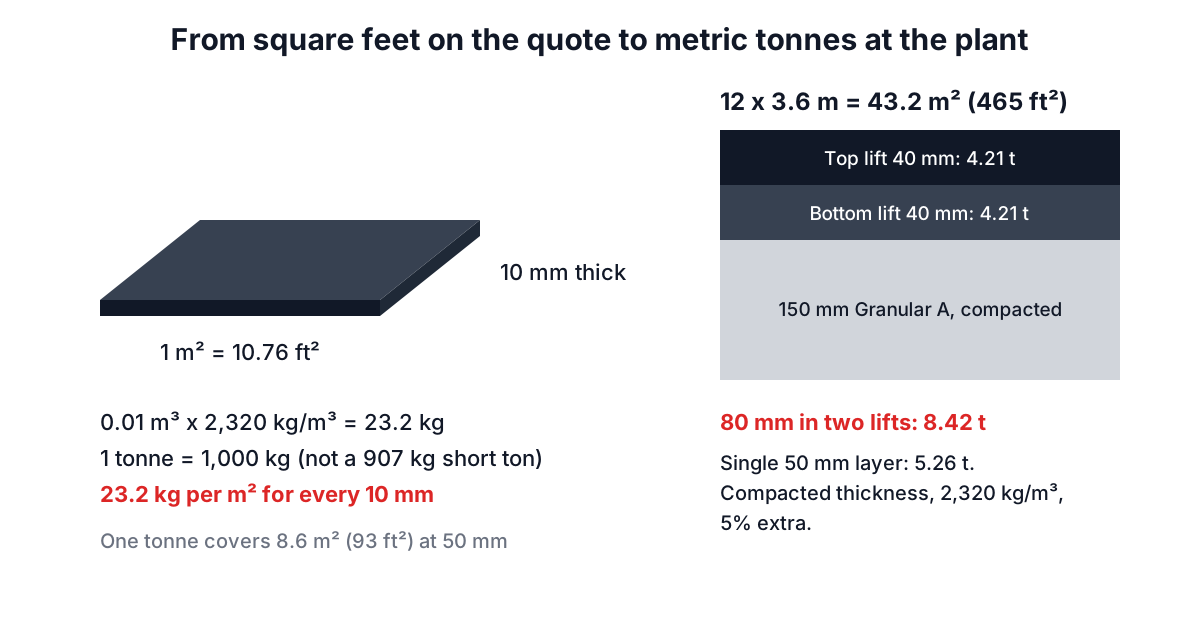
The working rule is simple once everything is metric: 1 m² of asphalt 10 mm thick is 0.01 m³, which at 2,320 kg/m³ weighs 23.2 kg.
What Ontario municipalities specify
Homeowners rarely get a pavement design for a driveway, but municipal standards show what a city asks for when the work is on its own land or at its entrances. They are the most useful benchmarks for checking a contractor's thickness.
| Specification | Granular base | Asphalt |
|---|---|---|
| City of Toronto TS 3.30, residential driveway | 150 mm Granular A | 80 mm in two 40 mm lifts of Superpave 9.5 |
| City of Toronto TS 3.30, commercial driveway | 150 mm Granular A | 60 mm Superpave 19.0 under 40 mm Superpave 9.5 |
| Township of Oro-Medonte, single-family entrance | 150 mm Granular A | 50 mm HL3 |
Toronto's construction specification TS 3.30 (September 2018) covers asphalt sidewalks, boulevards and driveways built for the city. It also sets the binder as PG 58-28, places the hot mix according to the provincial specification OPSS 311, and measures the finished work by area in square metres. The Oro-Medonte entrance standards apply to new single-family entrances in that township. Other municipalities publish their own; Toronto's full set is on its standards for city infrastructure page.
HL3 is the traditional Ontario fine-graded surface mix; Superpave 9.5 is the mix Toronto's TS 3.30 names for driveways. For tonnage they behave alike: enter the compacted thickness and use the density on the mix design or plant ticket if you have it.
Worked examples for one double driveway
Take a double driveway 12 m long and 3.6 m wide: 43.2 m², or 465 ft². In the calculator, enter the two dimensions, the thickness in millimetres, 2,320 kg/m³ and 5% extra.
| Build-up | Compacted thickness | Volume | Tonnes with 5% extra | US short tons (for comparison) |
|---|---|---|---|---|
| Single layer, like the Oro-Medonte entrance | 50 mm | 2.16 m³ | 5.26 t | 5.80 |
| Two lifts, like Toronto's residential spec | 2 x 40 mm | 3.46 m³ | 8.42 t (4.21 per lift) | 9.28 |
| Commercial-style, Toronto's two mixes | 60 mm + 40 mm | 4.32 m³ | 6.31 t + 4.21 t = 10.52 t | 11.60 |
Going from 50 to 80 mm adds 60% more asphalt, and that is most of the price gap between a "builder's grade" driveway and a two-lift job. When a plant supplies two different mixes, as in the commercial case, they are separate line items, so run the calculator once for each lift and add.
When the quote is in feet and inches
Suppose a contractor quotes a 24 by 20 ft driveway at 2 in of asphalt. Switch the calculator to feet and inches, or convert by hand: 480 ft² is 44.59 m², and 2 in is 50.8 mm. With 2,320 kg/m³ and 5% extra, that is 2.27 m³ and 5.52 tonnes. If the invoice says 6 "tons", it may be quoting short tons (6.08 for this job) rather than tonnes; ask which.
How much ground a tonne covers
At 2,320 kg/m³ one tonne of compacted asphalt covers:
| Compacted thickness | Square metres | Square feet |
|---|---|---|
| 40 mm | 10.8 m² | 116 ft² |
| 50 mm | 8.6 m² | 93 ft² |
| 80 mm | 5.4 m² | 58 ft² |
That gives a quick test of a quote. A 465 ft² driveway at 50 mm divided by 93 ft² per tonne is five tonnes before waste, which matches the table above. Always use the compacted thickness: the paver lays a loose mat that the roller presses down, and the tonnes on the truck are the same before and after rolling.
Frost, base and drainage
The asphalt is the visible part, but in most of Canada the granular base and the drainage decide how long a driveway lasts. Water that sits in a fine, poorly compacted base freezes and lifts the surface, and no extra 10 mm of hot mix fixes that. All three specifications above put 150 mm of compacted Granular A under the asphalt, and Toronto's requires the base to be compacted to its own standard before paving. Dig out soft clay and organic soil rather than paving over it, and grade the driveway so water runs off toward the street or a swale, not toward the house.
The Canadian Gravel and Mulch Calculator converts the Granular A layer into tonnes from the same area. If the lot needs regrading first, estimate the earth with the Cut and Fill Calculator. For a concrete driveway or pad, see the Canadian Concrete Calculator and the Canadian concrete and flooring estimating guide.
The boulevard is the city's
Between your property line and the road there is usually a strip of municipal boulevard, often with the sidewalk in it. Work there normally needs a municipal permit and has to follow the municipality's specification, which is why Toronto's TS 3.30 exists at all. Ask your municipality before a contractor extends the driveway apron, widens the curb cut or repaves the boulevard section; the tonnage you order for your own land stops at the property line.
Before you accept a quote
- Ask for the compacted thickness, and whether it is one lift or two.
- Ask which mix (HL3, Superpave 9.5 or another) and its compacted density.
- Measure the driveway yourself and check the square footage.
- Confirm whether the price is per tonne or per short ton, and the depth of Granular A included.
- Check what part of the work sits in the boulevard and who is getting the permit.
Frequently asked questions
How many tonnes of asphalt does a double driveway need?
A 12 m by 3.6 m (465 ft²) driveway needs about 5.3 tonnes at 50 mm and about 8.4 tonnes at 80 mm, both with 5% extra at 2,320 kg/m³. Longer driveways scale in proportion to the area.
Why is my asphalt quote in square feet if the plant sells tonnes?
Contractors price the whole job, including excavation, Granular A, equipment and labour, so they quote it by area. The tonnes are only the material. Converting the quote to tonnes lets you check the thickness they intend to lay.
Is 50 mm of asphalt enough for a driveway?
For cars on a well-compacted granular base, a single 50 mm layer is what Oro-Medonte specifies for a single-family entrance. Toronto's specification for the residential driveways it builds calls for 80 mm in two lifts. Heavier vehicles, soft ground or a long, sloping driveway are reasons to go thicker.
What does two lifts of 40 mm mean?
The asphalt is laid and rolled in two separate layers of 40 mm each rather than one 80 mm layer. Each lift is spread and rolled before the next goes on. For ordering, it is still 80 mm of asphalt: 8.42 tonnes on a 43.2 m² driveway with 5% extra.
Is a tonne the same as a ton?
No. A tonne is 1,000 kg under Canada's Weights and Measures Act. A US short ton is about 907 kg, so the same asphalt is about 10% more "tons" than tonnes.
Sources and further reading
- TS 3.30 Construction specification for hot mix asphalt sidewalks, boulevards and driveways, City of Toronto, September 2018. Residential and commercial driveway build-ups, PG 58-28 binder, measurement by m².
- Standards for designing and constructing city infrastructure, City of Toronto. Index of road specifications and drawings.
- Development engineering standards: entrances, Township of Oro-Medonte. 50 mm HL3 over 150 mm Granular A for single-family entrances.
- Weights and Measures Act, Schedule I, Justice Laws Website, Government of Canada. The tonne as 1,000 kg.
- Asphalt Paving Handbook, Airport Asphalt Pavement Technology Program. Placement, compaction and in-place density.
- Hot Mix Asphalt Paving Handbook 2000, US Federal Highway Administration. Background on lifts and compaction.
More Civil & Structural
Every tool in the Civil & Structural section, free and in your browser.