
How Many Tonnes of Tarmac for a Driveway? A UK Guide
Tonnes of tarmac from m² and millimetres, binder and surface courses worked separately, and the 5 m² front garden planning rule for impermeable drives in England.
By Redbison Dev · · 9 min read
United Kingdom edition. Written for UK driveways in square metres, millimetres and tonnes, with binder and surface courses worked separately, BS EN 13108 mix names, the England front garden planning rule and dropped kerbs. US edition
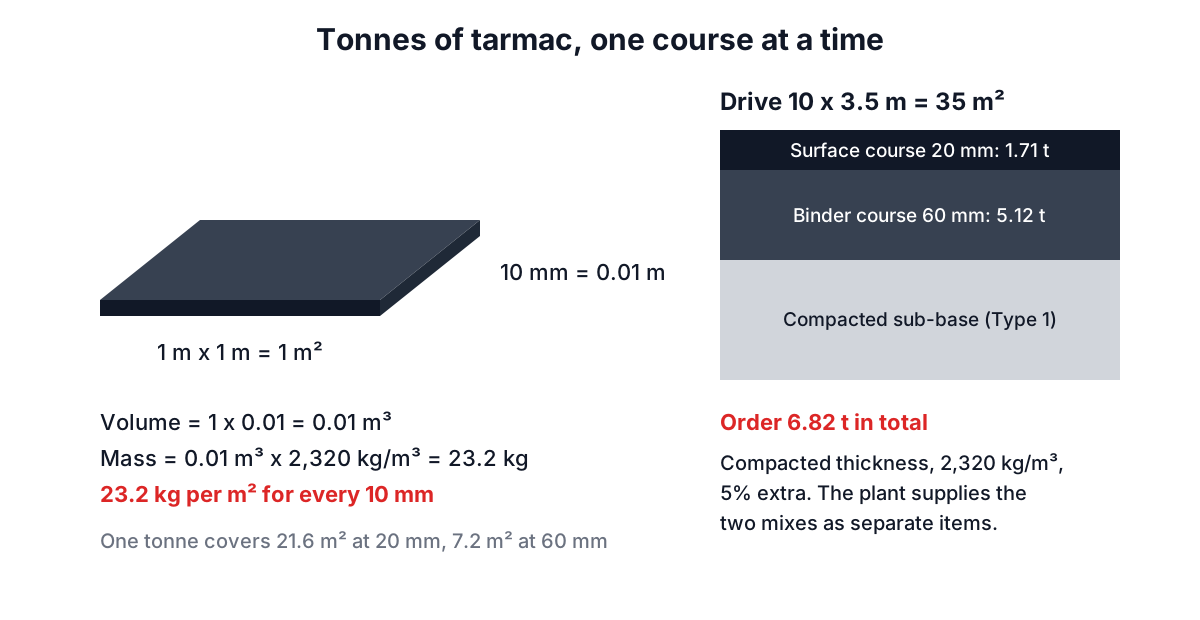
To work out how much tarmac a UK driveway needs, multiply the area in square metres by the compacted thickness in metres and by the density of the mix, then divide by 1,000 for tonnes. At a typical 2,320 kg/m³, every 10 mm of compacted thickness weighs 23.2 kg per square metre, so a 35 m² drive with a 60 mm binder course and a 20 mm surface course needs about 6.8 tonnes with a small allowance for waste. The UK Tarmac and Asphalt Calculator does the arithmetic per course. What it cannot do is tell you whether the drive needs planning permission, which in England depends on where the water goes.
Tarmac, asphalt and what is actually laid
Most people in Britain call any black drive tarmac. Strictly, tarmacadam was stone bound with tar, which has not been used for decades; what a contractor lays today is asphalt concrete, stone and sand bound with bitumen. The product standard is BS EN 13108-1:2016, which covers asphalt concrete for surface, binder, regulating and base courses on roads and other trafficked areas. Quotes may say tarmac, asphalt, bitmac or macadam and mean the same black surface.
The useful part for estimating is that a drive is laid in layers, and each layer is a different mix:
| Layer | What it does | How it is bought |
|---|---|---|
| Surface course (wearing course) | The finished, finer-textured top | By the tonne, often a smaller stone size |
| Binder course | Spreads wheel loads and gives the surface a true level | By the tonne, coarser stone |
| Sub-base | Compacted crushed stone that carries everything | By the tonne or bulk bag, from a quarry or merchant |
Because the plant weighs and invoices each mix separately, the sensible estimate is one line per course, not one figure for the whole drive.
Worked example: a 10 m by 3.5 m drive
Take a single-width drive 10 m long and 3.5 m wide, laid with 60 mm of binder and 20 mm of surface course, both measured after rolling. In the calculator, set the shape to a rectangle, enter 10 and 3.5 m, the thickness, a density of 2,320 kg/m³ and 5% extra.
| Course | Thickness | Volume | Tonnes with 5% extra |
|---|---|---|---|
| Binder | 60 mm (0.06 m) | 35 x 0.06 = 2.1 m³ | 5.12 t |
| Surface | 20 mm (0.02 m) | 35 x 0.02 = 0.7 m³ | 1.71 t |
| Total | 80 mm | 2.8 m³ | 6.82 t |
Two checks are worth doing on any quote. First, the millimetre trap: 60 mm is 0.06 m, not 0.6 m, and typing the wrong one gives an answer ten times too large. Second, the waste allowance. The same 80 mm of asphalt is 6.50 t with no allowance and 7.15 t with 10%, so a contractor's figure anywhere in that range is plausible for this drive. More than about 7.5 t suggests either a thicker build-up than quoted or a generous margin; ask which.
If the supplier quotes the two mixes at different prices per tonne, run the cost field once per course.
How much a tonne covers
Turning the sum round gives a quick check on any order. At 2,320 kg/m³:
| Compacted thickness | Area one tonne covers |
|---|---|
| 20 mm | 21.6 m² |
| 40 mm | 10.8 m² |
| 60 mm | 7.2 m² |
The calculator's thickness table shows tonnes for 40 to 100 mm side by side, which helps when you are comparing a single thick layer against a binder and surface build-up. Ask the supplier for the compacted density of their actual mix, from the mix design or the delivery ticket, and use that figure instead of the default.
Always work from the compacted thickness. The paver lays a loose mat that the roller then squeezes down; the tonnage is the same before and after rolling, so mixing a loose thickness with a compacted density overstates the order.
The 5 m² front garden rule in England
Paving a front garden in England carries a drainage condition; the government's permeable surfacing guidance notes that the restriction came into force on 1 October 2008. Under Class F of the General Permitted Development Order 2015, a hard surface between the front wall of the house and the road is permitted development only if, where it covers more than 5 square metres, it is made of porous materials or the run-off is directed to a permeable area within the property. A conventional tarmac drive that sheds water onto the road needs planning permission.
In practice that leaves four routes:
- Porous asphalt. Water drains through the surface into an open-graded sub-base. The government's guidance on permeable front gardens says a permeable drive is normally about 200 to 250 mm of construction in all, including about 150 mm of compacted open-graded sub-base over a geotextile, and warns that porous asphalt should be supplied and laid by a specialist.
- Dense tarmac draining to a lawn, border or rain garden. The surface itself can be conventional if the drive falls towards a permeable area inside the boundary. The same guidance says soakaways and rain gardens should be kept away from foundations, suggesting at least 3 m for small drives.
- Wheel tracks. Two paved strips with gravel or planting between them. The guidance gives a typical width of 300 to 600 mm per track and notes that tracks covering less than 5 m² need no permission.
- Apply for permission for an impermeable drive that drains to the road.
The wheel-track option is easy to size in the tool. Two tracks 0.45 m wide and 5 m long cover 4.5 m², just under the threshold; at 80 mm of compacted asphalt with 5% extra that is 0.88 t, a small-load delivery rather than a full lorry. Widen each track to 0.6 m and lengthen it to 6 m and the area becomes 7.2 m², over the limit, so the strips would have to drain to the planting between them, as the guidance says they must anyway.
The Planning Portal page on paving front gardens covers England only and says the policy in Wales may differ. Scotland and Northern Ireland have their own planning systems. Listed buildings, conservation areas and properties under an Article 4 direction can have tighter limits, so check with the council's planning team before you book a contractor.
The sub-base matters more than the top
The government guidance describes the conventional build-up as a compacted sub-base of MOT Type 1, a crushed stone with plenty of fines, under the asphalt. That is what makes a drive strong, and it is also why a conventional drive is impermeable: the fines stop water passing. Permeable construction swaps Type 1 for an open-graded stone such as 4/20 or Type 3 so the base can hold water while it soaks away.
The same document gives a simple check on the ground itself: if a 50 mm square wooden peg is hard to drive more than 150 mm into the soil, the ground is firm enough for a drive; if it goes in easily, get expert advice. It also notes that a drive steeper than 1 in 20 may not suit permeable surfacing. A soft spot in the subgrade will show through any thickness of tarmac within a winter or two, so dig it out and replace it with compacted sub-base before worrying about the extra 10 mm on top.
The UK Gravel and Mulch Calculator sizes the sub-base in tonnes from the same area. If the site needs levelling first, the Cut and Fill Calculator estimates the muck-away, and for a concrete drive instead, the UK Concrete Calculator and the UK concrete and flooring estimating guide cover cubic metres and bags.
Dropped kerbs and the public footway
The drive stops at your boundary. If a car has to cross the pavement or verge to reach it, you need a dropped kerb, and that work is on the highway, not your land. In England and Wales you apply to your local council, whose website explains who may carry out the work. The permeable paving guidance adds that the footway may need strengthening to protect pipes and cables beneath it. The tonnage in this guide stops at the property line.
Before you sign a quote
- Ask for the thickness of each course after compaction, not the depth of the dig.
- Ask which mix each course uses and its compacted density.
- Confirm how the drive drains, and whether that needs planning permission.
- Treat a doorstep offer to lay a drive with caution; the government guidance says casual jobbing contractors should not be used for permeable drives.
Frequently asked questions
How many tonnes of tarmac does a single drive need?
For a 10 m by 3.5 m drive with 60 mm of binder and 20 mm of surface course at 2,320 kg/m³, about 5.1 t of binder and 1.7 t of surface course with 5% extra, 6.8 t in all. A thicker or thinner build-up changes this in proportion: each 10 mm across 35 m² adds about 0.8 t before waste.
Can I tarmac over my front garden without planning permission?
In England you can if the area is 5 m² or less, if the surface is porous, or if the water runs off to a lawn, border or soakaway inside your boundary. A larger impermeable drive that drains to the road needs permission. Wales, Scotland and Northern Ireland have their own rules, and conservation areas and listed buildings can be stricter.
Is porous asphalt heavier or lighter than ordinary tarmac?
Lighter per cubic metre, because it is designed with open voids for water to pass through. Ask the specialist supplier for the compacted density of their porous mix and enter it in the calculator instead of the 2,320 kg/m³ default; using the dense figure will overstate the order.
What is the difference between a binder course and a surface course?
The binder course is a coarser layer that spreads loads and sets the level; the surface course is the finer, harder-wearing top. Both are asphalt concrete under BS EN 13108-1, ordered as separate mixes, so estimate their tonnes separately.
Sources and further reading
- The Town and Country Planning (General Permitted Development) (England) Order 2015, Schedule 2, Part 1, Class F, legislation.gov.uk. The 5 m² condition for hard surfaces in front of a house.
- Guidance on the permeable surfacing of front gardens, Department for Communities and Local Government and Environment Agency. Porous asphalt, construction depth and sub-base, wheel tracks, slopes, soakaways, and the 1 October 2008 start of the front garden restriction.
- Paving your front garden, Planning Portal. When planning permission is needed in England.
- Apply for a dropped kerb, GOV.UK. Applying to the council in England and Wales.
- BS EN 13108-1:2016 Bituminous mixtures. Material specifications. Asphalt concrete, BSI. Scope of the asphalt concrete product standard.
- Asphalt Paving Handbook, Airport Asphalt Pavement Technology Program. Placement, compaction and in-place density.
More Civil & Structural
Every tool in the Civil & Structural section, free and in your browser.