
Engine Capacity from Bore and Stroke, and the 660 cc Limit
Work out engine capacity in cc and litres from bore and stroke in mm, check a LAMS bike against the 660 cc limit, and see what a rebore or big-bore kit adds.
By Redbison Dev · · 9 min read
Australia edition. Australian edition in millimetres, cc and litres, with engine sizes common here (a LAMS twin, a 2.8 litre diesel, a 4.0 litre six) and the NSW rules for learner and P-plate motorcycles: 660 cc, 150 kW per tonne and no modifications to qualify. US edition
Engine capacity is the volume the pistons sweep, and three numbers give it exactly: bore, stroke and the number of cylinders. Capacity in cc = 0.7854 × bore² × stroke × cylinders, with bore and stroke in centimetres. A parallel twin of 83 mm × 60 mm comes to 649 cc. For most Australian drivers the result is just the "2.8" or "4.0" on the badge. For learner and P-plate riders, it is the first test a bike must pass to be ridden at all: 660 cc or less.
This edition uses the Engine Capacity Calculator in millimetres and cc with engine sizes Australians own and rebuild. The US version of this article, in cubic inches, is here.
How capacity is worked out
From top dead centre (TDC) to bottom dead centre (BDC), the piston sweeps a cylinder of air. Its diameter is the bore and its length is the stroke:
cc per cylinder = 0.7854 × bore(mm)² × stroke(mm) ÷ 1,000
capacity        = cc per cylinder × cylinders
litres          = capacity ÷ 1,000
0.7854 is π ÷ 4. The combustion chamber and head gasket volume above the piston at TDC is not counted; it decides compression ratio instead.
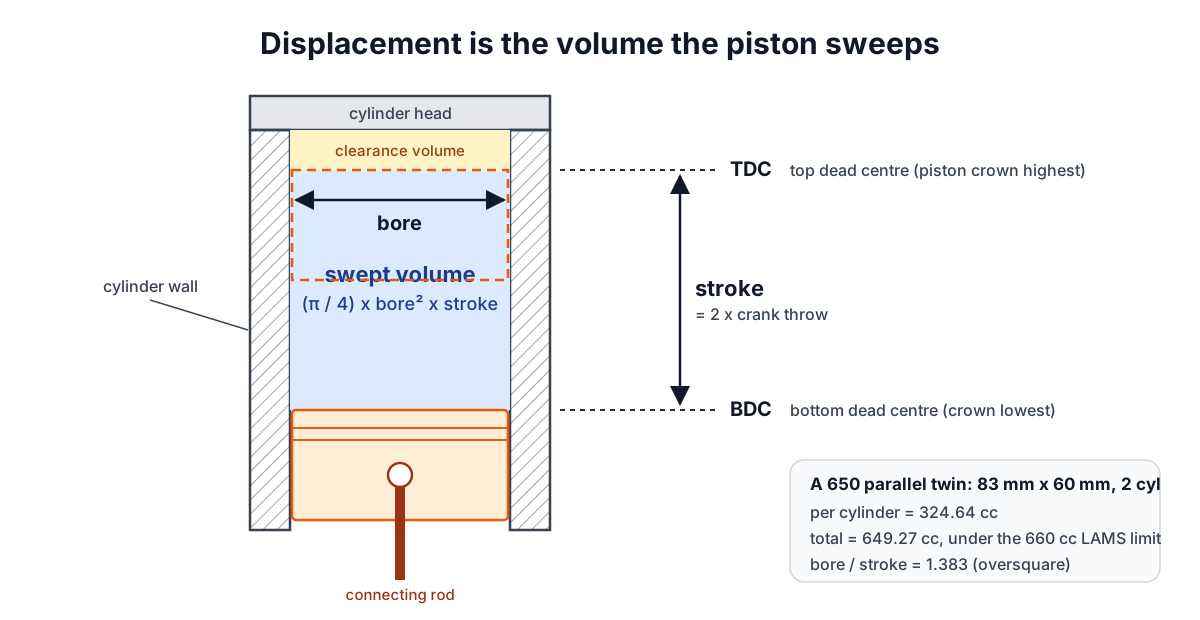
The crankshaft sets the stroke, which is twice the crank throw. Changing connecting rod length changes how the piston moves, not how far.
The LAMS limits riders must meet
Each state runs a learner approved motorcycle scheme (LAMS). In NSW, learner, P1 and P2 riders must ride a motorcycle on the Approved Motorcycles for Novice Riders list, and to be on it a bike needs:
- an engine capacity of 660 cc or less, and
- a power-to-weight ratio of 150 kW per tonne or less, or for an electric motorcycle, power of 25 kW or less.
The NSW Government adds two points that matter for anyone holding a spanner. Approved motorcycles must not be modified from the manufacturer's standard specification, and a bike cannot be modified or restricted to become approved. Optional manufacturer parts and like-for-like replacements are allowed if they do not increase power or reduce tare weight.
Other states run similar schemes; check your own state's list before buying, because the list, not the cc alone, is what decides it.
Worked example 1: a LAMS twin and a 1 mm oversize
Take an illustrative 650 parallel twin of 83 mm × 60 mm (use the figures for your own bike):
- Per cylinder: 0.7854 × 83² × 60 ÷ 1,000 = 324.64 cc.
- Total: 649.27 cc, 10.73 cc under 660.
- Bore/stroke: 83 ÷ 60 = 1.383, strongly oversquare.
- Solve for bore at 660 cc with the 60 mm stroke: 83.68 mm.
So there is 0.68 mm of bore between the standard engine and the limit. A +0.5 mm rebore gives 657.12 cc, still under 660; a +1 mm big-bore kit gives 665.01 cc, over it. But capacity is not the only test. Because NSW says approved bikes must not be modified from standard specification, even the 657 cc rebuild changes the engine from the approved specification. If a learner or P-plater will ride the bike, rebuild it at the standard bore.
Worked example 2: a 2.8 litre diesel four
Take an illustrative 2.8 litre diesel four with a 92 mm bore and a 103.6 mm stroke:
- Per cylinder: 0.7854 × 92² × 103.6 ÷ 1,000 = 688.69 cc.
- Total: 2,754.77 cc, sold as a 2.8.
- Bore/stroke: 0.888, undersquare.
The long stroke suits a diesel that does most of its work under 3,500 rpm: it gives a compact combustion chamber and strong low-speed torque. Its mean piston speed at 3,400 rpm is 2 × 0.1036 × 3,400 ÷ 60 = 11.74 m/s, well below the 19.86 m/s of the 4.0 six in the next example at 6,000 rpm.
Worked example 3: a 4.0 litre inline six
Take an illustrative 4.0 litre inline six of 92.26 mm × 99.31 mm:
- Per cylinder: 663.91 cc.
- Total: 3,983.47 cc, sold as a 4.0.
- Bore/stroke: 0.929, undersquare.
- Mean piston speed at 6,000 rpm: 19.86 m/s.
Builders chasing high rpm on a six like this are working against that stroke. At 7,000 rpm the mean piston speed would pass 23 m/s, which is where forged rods and pistons stop being optional.
Badges round, the calculator does not
| Engine | Bore × stroke | Calculated | Badge |
|---|---|---|---|
| 650 parallel twin | 83 × 60 mm, 2 cyl | 649.27 cc | 650 |
| 2.8 litre diesel four | 92 × 103.6 mm, 4 cyl | 2,754.77 cc | 2.8 |
| 4.0 litre inline six | 92.26 × 99.31 mm, 6 cyl | 3,983.47 cc | 4.0 |
| Square two-litre four | 86 × 86 mm, 4 cyl | 1,998.23 cc | 2.0 |
Cars are badged in litres to one decimal place. Registration papers and LAMS lists use the exact cc, so for a rule or an insurance proposal use the figure from bore and stroke, not the badge.
Rebores: why bore matters more than stroke
Capacity rises with the square of the bore. On the 650 twin, +0.5 mm of bore adds 7.85 cc, and +1 mm adds 15.74 cc. Changing the stroke by the same 1 mm would add only about 10.8 cc, because stroke is not squared. Oversize pistons usually come in steps such as +0.25, +0.50 and +1.00 mm; enter each in the overbore field before you order parts.
Any change of capacity changes the vehicle's description. Rules differ between states, so check with your registration authority and your insurer before a rebuild that changes it.
Oversquare, square, undersquare
- Oversquare (above 1): the 650 twin at 1.383. Big valves, short stroke, a willingness to rev.
- Square (1.000): the 86 × 86 mm two-litre.
- Undersquare (below 1): the 2.8 diesel (0.888) and the 4.0 six (0.929). Long strokes, good low-down torque.
These are tendencies, not rules. Cam timing, porting and turbocharging shape an engine's behaviour as much as its proportions.
Common mistakes
- Using the radius instead of the bore without changing the formula. 0.7854 × bore² is the same as π × radius²; mixing the two is out by a factor of four.
- Entering a bore in mm and a stroke in cm. Keep one unit.
- Counting the chamber volume. That is for compression ratio.
- Assuming a bike under 660 cc is LAMS approved. It must also meet 150 kW per tonne and appear on the approved list, unmodified.
Tools for this job
- Engine Capacity Calculator: capacity from bore and stroke, overbore effect, and solving for bore or stroke at 660 cc or any other target.
- Compression Ratio Calculator: what a rebore, gasket or skimmed head does to compression. See static and dynamic compression ratio.
- Horsepower Calculator: capacity is size; LAMS also limits power-to-weight.
- Unit Converter: cc to cubic inches for imported US parts lists.
Frequently asked questions
What size motorcycle can I ride on my Ls or Ps in NSW?
A motorcycle on the approved list for novice riders, which needs an engine capacity of 660 cc or less and a power-to-weight ratio of 150 kW per tonne or less (or up to 25 kW for an electric bike). Learner, P1 and P2 riders must ride one.
Can I put a big-bore kit on a LAMS bike?
Not if a novice rider will ride it. NSW says approved motorcycles must not be modified from the manufacturer's standard specification. On the 650 twin a 1 mm big-bore kit also takes it to 665.01 cc, over 660 cc.
How many cc is a 2.8 litre engine?
It depends on its bore and stroke. A 92 mm × 103.6 mm four works out to 2,754.77 cc, and it is badged 2.8 because badges round to one decimal place of a litre.
Does a rebore change my rego?
It changes the engine capacity, which is part of the vehicle's description. Rules differ by state, so ask your registration authority and insurer before a rebuild that changes capacity noticeably.
Sources and further reading
- Approved motorcycles for learner and provisional riders, NSW Government. 660 cc, 150 kW per tonne, 25 kW for electric; no modification from standard specification.
- Green Vehicle Guide, Australian Government. Fuel use and CO2 data for new vehicles sold in Australia.
- SI Units: Length, National Institute of Standards and Technology. Exact inch to millimetre conversion for US parts.
- Internal Combustion Engines (course 2.61), MIT OpenCourseWare. Engine geometry and piston speed.
- Engine displacement, Wikipedia. How swept volume is quoted.
Open the Engine Displacement Calculator
More Automotive
Every tool in the Automotive section, free and in your browser.