
Engine Displacement in Litres, cc and Cubic Inches
Work out displacement from bore and stroke, convert between the litres on a window sticker and the cubic inches in parts catalogues, and check Quebec bike classes.
By Redbison Dev · · 9 min read
Canada edition. Canadian edition that moves between litres (NRCan's fuel consumption ratings), cubic inches (North American truck and V8 parts) and cc (motorcycles), with the SAAQ's 125 cc and 400 cc licence classes. US edition
Engine displacement is the volume all the pistons sweep in one stroke, and it comes straight from bore, stroke and cylinder count: π ÷ 4 × bore² × stroke × cylinders. Canadians meet the result in three units at once. Window stickers and Natural Resources Canada's fuel consumption tables give engine size in litres, truck and V8 parts catalogues still talk in cubic inches, and motorcycles are sold in cc. A V8 badged 5.3 litres with a 96 mm bore and a 92 mm stroke is 5,327 cc, which is 325 cubic inches, and the arithmetic below shows how to get from one to the other without guessing.
The examples use engine sizes common in Canada and run through the Engine Displacement Calculator (Canada), which shows all three units for every result. The US version of this article is here.
The formula and the three units
The piston travels from top dead centre (TDC) to bottom dead centre (BDC). The space it sweeps is a cylinder whose diameter is the bore and whose height is the stroke:
volume per cylinder = 0.7854 × bore² × stroke
displacement        = volume per cylinder × cylinders
Use one unit throughout. Millimetres give cubic millimetres (÷ 1,000 for cc, ÷ 1,000,000 for litres); inches give cubic inches. The bridge between them is exact, because an inch is 25.4 mm:
1 cubic inch = 16.387064 cc
1 litre      = 1,000 cc = 61.024 cubic inches
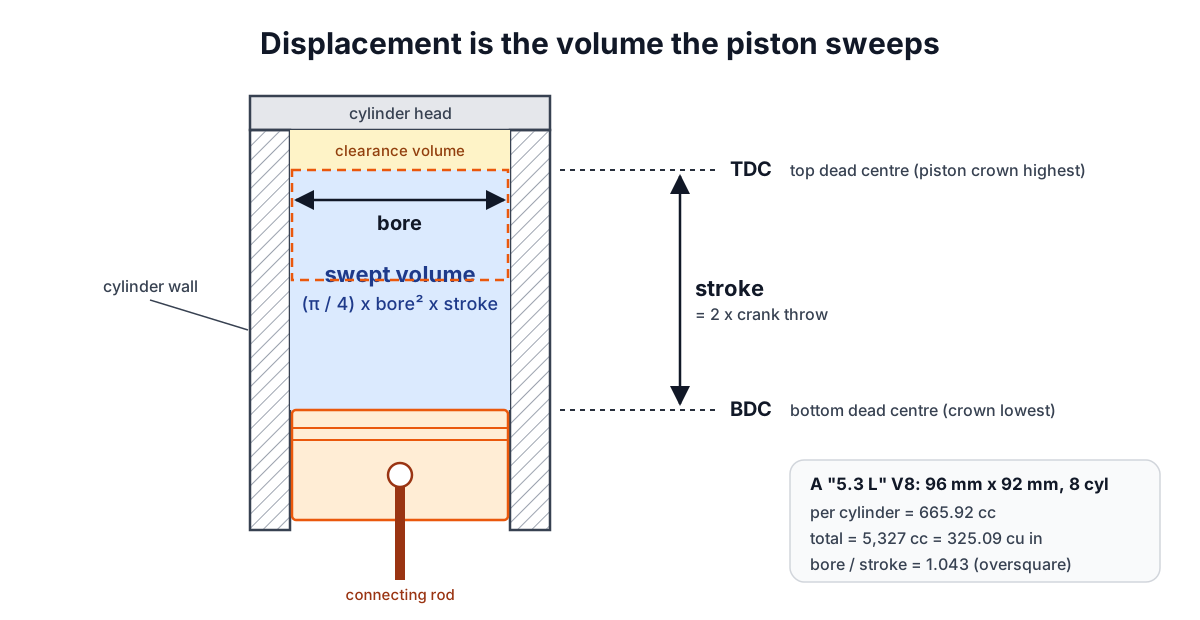
The volume above the piston at TDC, the combustion chamber and gasket, is not part of displacement. It matters for compression ratio, which is a separate calculation.
Where Canadians read engine size
- Buying a vehicle. NRCan's fuel consumption ratings list engine size as the total displacement of all cylinders in litres, beside the number of cylinders and the rating in L/100 km. That is the figure on dealer sites and the EnerGuide label.
- Parts and performance. Domestic V8 heritage means many crankshafts, pistons and gasket kits are listed in inches, and engines are still nicknamed by cubic inches.
- Motorcycles. Bikes are rated in cc. In Quebec the cc rating also decides which licence class you need.
Worked example 1: the truck V8 in three units
Take a pickup V8 sold as a 5.3 litre, with a 96 mm bore and a 92 mm stroke (an illustrative engine; use the figures for your own engine):
- Per cylinder: 0.7854 × 96² × 92 ÷ 1,000 = 665.92 cc.
- Total: 665.92 × 8 = 5,327.34 cc = 5.327 L.
- In cubic inches: 5,327.34 ÷ 16.387064 = 325.09 cu in.
- Bore/stroke: 96 ÷ 92 = 1.043, slightly oversquare.
A V8 of 92.2 mm × 92.7 mm is 4,951.33 cc, or 302.15 cubic inches, and a "5.0" badge on it rounds 4.95 litres up. A badge is a marketing figure; the calculated displacement is the real one, and it is what NRCan lists to the nearest tenth of a litre.
A classic small-block V8 in inches, 4.000 × 3.480 in × 8, gives 349.85 cubic inches, or 5,733 cc. Enter it in inches and the calculator converts it for you.
Worked example 2: Quebec licence classes by cc
The SAAQ issues three motorcycle classes by engine displacement:
| Class | Motorcycles allowed |
|---|---|
| 6A | any motorcycle |
| 6B | engine displacement of 400 cc or less |
| 6C | engine displacement of 125 cc or less |
For the road test, the SAAQ says the bike must match the class you want: over 400 cc for 6A, 126 to 400 cc for 6B and 125 cc or less for 6C.
Three illustrative bikes show where they fall:
- A 125 single, 52 mm × 58.6 mm, 1 cylinder: 124.45 cc. Class 6C.
- A 400 twin, 70 mm × 51.8 mm, 2 cylinders: 398.70 cc. Class 6B.
- A 500 twin, 67 mm × 66.8 mm, 2 cylinders: 471.03 cc. Class 6A.
The edge cases are what the calculator is for. A +0.5 mm overbore on the 400 twin gives 70.5 mm and 404.42 cc, over the 6B limit; the largest bore that keeps the 51.8 mm stroke at 400 cc is 70.11 mm. On the 125 single, a +0.5 mm overbore gives 126.85 cc, over the 6C limit. The class is tied to the motorcycle's rated displacement, so check with the SAAQ and your insurer before a big-bore kit goes on a bike you ride on a 6B or 6C licence.
Worked example 3: solving for a target
Rearranging the formula gives the bore for a target displacement:
bore = √( 4 × displacement / (π × stroke × cylinders) )
A builder planning a 400 cc twin around a 51.8 mm stroke gets 70.11 mm, as above. A 2,000 cc four with a 90 mm stroke needs an 84.1 mm bore. In the calculator, set "Solve for" to Bore, type the target in cc, litres or cubic inches, and read the answer.
Overbores and strokers
Bore is squared, stroke is not, so a small bore increase adds more than you might expect:
- The 5.3 V8 at +0.5 mm (96.5 mm bore): 5,382.97 cc, or 328.49 cubic inches. Half a millimetre adds 55.6 cc, about 1%.
- Small block at +0.030 in (4.030 in bore): 355.12 cubic inches.
- The same block with a 3.750 in stroker crank: 382.67 cubic inches, which rounds to 383.
Rod length does not change displacement. A longer rod changes the piston's motion through the stroke, not the travel.
Bore/stroke ratio and piston speed
The ratio says how an engine is shaped. The 400 twin is strongly oversquare (1.351). The 92.2 × 92.7 mm V8 is almost exactly square (0.995), though the calculator labels it undersquare because its stroke is 0.5 mm longer than its bore. Long-stroke (undersquare) engines tend to favour low-speed torque.
Mean piston speed is 2 × stroke (m) × rpm ÷ 60:
- The 5.3 V8 (92 mm stroke) at 6,000 rpm: 18.40 m/s.
- The 5.0 V8 (92.7 mm stroke) at 7,000 rpm: 21.63 m/s.
- The 400 twin (51.8 mm stroke) at 12,000 rpm: 20.72 m/s.
Road engines mostly stay near or under 20 m/s at redline. Figures well above 25 m/s are race territory.
Common mistakes
- Rounding the litres before converting. 5.3 L × 61.024 is 323.4 cubic inches; the real 5,327 cc is 325.1. Convert from the exact figure.
- Mixing units: a bore in mm with a stroke in inches. Convert one first.
- Adding chamber or gasket volume. That belongs to compression ratio.
- Trusting the badge for a licence class. A "400" can be 398.7 cc or over 400 cc once rebored.
Tools for this job
- Engine Displacement Calculator (Canada): displacement in cc, litres and cubic inches, overbore, and bore or stroke for a target.
- Compression Ratio Calculator: the effect of a rebore, gasket or head change on compression. See static and dynamic compression ratio.
- Unit Converter: cubic inches, cc and litres.
- Horsepower Calculator: displacement is size, not power.
Frequently asked questions
How many cubic inches is a 5.3 litre engine?
About 325 for a 5.3 with a 96 mm bore and 92 mm stroke: 96 mm × 92 mm × 8 cylinders = 5,327.34 cc, and 5,327.34 ÷ 16.387064 = 325.09 cubic inches. Multiplying the rounded 5.3 L by 61.024 gives 323.4, which is why you convert from the exact figure.
Which Quebec motorcycle licence do I need for a 400?
It depends on the exact displacement. A 70 × 51.8 mm twin at 398.70 cc can be ridden on a Class 6B licence, which covers 400 cc or less. A bike over 400 cc needs Class 6A.
Does a big-bore kit change my licence class?
It changes the displacement. A +0.5 mm overbore takes a 398.70 cc twin to 404.42 cc, over the 6B limit. Ask the SAAQ and your insurer before modifying a bike you ride on a 6B or 6C licence.
Why does NRCan list engine size in litres?
Its fuel consumption ratings give engine size as the total displacement of all cylinders in litres, beside cylinder count and L/100 km. Litres to one decimal place is the standard for new vehicles in Canada.
Sources and further reading
- Understanding the tables, Natural Resources Canada. Engine size as total displacement in litres; ratings in L/100 km.
- Obtaining a Motorcycle Driver's Licence (Classes 6A, 6B and 6C), Société de l'assurance automobile du Québec. Class 6B to 400 cc, 6C to 125 cc; road-test bike must match the class.
- SI Units: Length, National Institute of Standards and Technology. The inch is exactly 25.4 mm, so 16.387064 cc per cubic inch.
- Internal Combustion Engines (course 2.61), MIT OpenCourseWare. Engine geometry and piston speed.
- Engine displacement, Wikipedia. How swept volume is quoted.
Open the Engine Displacement Calculator
More Automotive
Every tool in the Automotive section, free and in your browser.