
How to Calculate Your Carbon Footprint in Australia
Your household carbon footprint from Australian bills: your state's electricity factor, gas in megajoules, rooftop solar, L/100 km driving and flights.
By Redbison Dev · · 11 min read

Australia edition. Uses the location-based state electricity factors the Clean Energy Regulator lists for NGER 2025-26, gas in MJ as Australian bills show it, rooftop solar, L/100 km from the fuel consumption label, and examples across six states. US edition
You can work out an Australian household's carbon footprint from a year of electricity and gas bills, your driving, your flights and a diet estimate. The state you live in changes the answer more than most of your choices: a three-person household using 5,000 kWh of electricity and 40,000 MJ of gas a year, with one car, comes to about 14.5 tonnes of CO₂e in Victoria and 11.6 tonnes in Tasmania. The Carbon Footprint Calculator (Australia) lets you pick your state and enter gas in megajoules straight from the bill.
Electricity: your state's factor
The calculator uses the location-based scope 2 factors from the National Greenhouse Accounts, as the Clean Energy Regulator lists them for National Greenhouse and Energy Reporting:
| State or territory | 2023-24 | 2024-25 | 2025-26 (used) | 5,000 kWh a year |
|---|---|---|---|---|
| Victoria | 0.79 | 0.77 | 0.78 | 3.90 t |
| Queensland | 0.73 | 0.71 | 0.67 | 3.35 t |
| NSW and ACT | 0.68 | 0.66 | 0.64 | 3.20 t |
| Northern Territory | 0.54 | 0.56 | 0.56 | 2.80 t |
| WA (South West Interconnected System) | 0.53 | 0.51 | 0.50 | 2.50 t |
| South Australia | 0.25 | 0.23 | 0.22 | 1.10 t |
| Tasmania | 0.12 | 0.15 | 0.20 | 1.00 t |
All figures are kg CO₂e per kWh. Most states have fallen over the three years; the Northern Territory has risen slightly and Tasmania from 0.12 to 0.20, though Tasmania is still the lowest. Each set is labelled by financial year. The Clean Energy Regulator has announced NGER amendments for 2026-27 that include scope 2 emissions, but its factor table still stops at 2025-26, so that is the latest set the calculator can use. Check for a 2026-27 column when the next National Greenhouse Accounts Factors are released.
Gas in megajoules
Australian gas bills are in MJ. The calculator converts at 3.6 MJ per kWh and applies a natural gas combustion factor of about 0.050 kg CO₂e per MJ (from the US EPA), so 40,000 MJ, which is 11,111 kWh of gas, comes to 2.01 t. LPG goes in litres.
Rooftop solar
Enter the share of your own electricity use that your panels supply, and the electricity line falls by that share. Total use is the grid electricity you bought plus the solar you used yourself. Exported solar also displaces grid power, but a household footprint does not credit it.
For the Victorian household, solar covering 40% of its use cuts electricity from 3.90 t to 2.34 t and the total to 12.92 t.
Driving: L/100 km
New cars carry a fuel consumption label under ADR 81/02, and the Green Vehicle Guide explains that it is derived from urban and extra-urban test cycles, and the label shows urban, extra-urban and combined figures. Your own fill-up records are better. 12,000 km at 8 L/100 km is 960 litres of petrol: 2.23 t at the calculator's factor.
Flights
The calculator uses UK DESNZ flight factors per passenger-km, which include an 8% allowance for indirect routing and, by default, radiative forcing for contrails and nitrogen oxides at altitude. When you compare totals with someone else's, check whether both counted it. A return flight of 700 km each way is 1,400 passenger-km for one person: 0.18 t with radiative forcing.
Food
Diet uses Scarborough and colleagues' averages for UK diets: 5.63 kg CO₂e a day on a medium-meat diet, 3.81 vegetarian, 2.89 vegan. Three people on a medium-meat diet come to 6.16 t, the largest single line.
The same household in six states
Three people; 5,000 kWh of electricity; 40,000 MJ of gas; 12,000 km at 8 L/100 km; one return flight of 700 km each way; medium-meat diet.
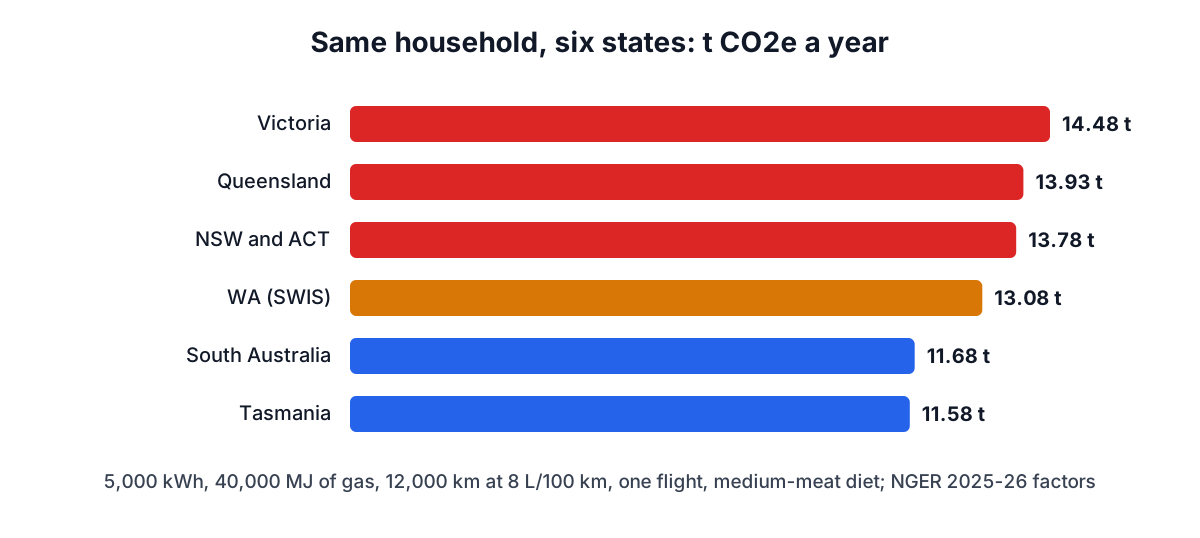
| Line, t CO₂e | Victoria | NSW and ACT | South Australia | Tasmania |
|---|---|---|---|---|
| Electricity | 3.90 | 3.20 | 1.10 | 1.00 |
| Gas, 40,000 MJ | 2.01 | 2.01 | 2.01 | 2.01 |
| Car | 2.23 | 2.23 | 2.23 | 2.23 |
| Flight | 0.18 | 0.18 | 0.18 | 0.18 |
| Food | 6.16 | 6.16 | 6.16 | 6.16 |
| Total | 14.48 | 13.78 | 11.68 | 11.58 |
Going all-electric: it depends on the state
Suppose the household replaced all its gas with a heat pump for space heating and a heat pump hot water system that together used 2,500 kWh of electricity a year. The gas line goes, and the electricity line grows:
| State | With gas | All-electric | Change |
|---|---|---|---|
| Victoria | 14.48 t | 14.42 t | almost none |
| Victoria, with 40% solar | 12.92 t | 12.08 t | -0.84 t |
| South Australia | 11.68 t | 10.22 t | -1.46 t |
On Victoria's 2025-26 factor, 2,500 kWh of grid electricity emits about as much as the 40,000 MJ of gas it replaces, so the switch only cuts emissions once solar or a falling grid factor comes into it. In South Australia the same switch saves about 1.5 t straight away. The 2,500 kWh is an assumption for the example; your installer's estimate of the heat pump's yearly use is the figure to enter.
What the total leaves out
The calculator covers home energy, personal travel and food. It leaves out the goods and services you buy, upstream emissions from producing fuels, public services and waste, so national per-person figures are not comparable with it. Use it to compare your own options.
Frequently asked questions
What is the electricity emission factor in my state?
For NGER 2025-26 the Clean Energy Regulator lists, in kg CO₂e per kWh: NSW and ACT 0.64, Victoria 0.78, Queensland 0.67, South Australia 0.22, WA (SWIS) 0.50, Tasmania 0.20 and the Northern Territory 0.56.
How do I enter gas from an Australian bill?
Choose MJ as the gas unit and enter the year's total from your bills. The calculator converts at 3.6 MJ per kWh; 40,000 MJ is about 2 tonnes of CO₂e.
Does rooftop solar reduce my carbon footprint?
Yes, for the share of your own use it supplies. In Victoria, solar covering 40% of a 5,000 kWh household's use saves about 1.6 tonnes a year at the 2025-26 factor.
Is a heat pump better than gas in Victoria?
On the 2025-26 grid factor, barely, unless you have solar. In the example, replacing 40,000 MJ of gas with 2,500 kWh of electricity leaves the total almost unchanged, but with 40% solar it saves about 0.8 tonnes. In South Australia it saves about 1.5 tonnes.
Sources and further reading
- Amendments to National Greenhouse and Energy Reporting legislation, Clean Energy Regulator. Location-based scope 2 factors by state for 2023-24, 2024-25 and 2025-26.
- NGER legislation amendments for the 2026-27 reporting year, Clean Energy Regulator, July 2026. Amendments covering scope 2 emissions from 2026-27.
- Fuel consumption label, Green Vehicle Guide, Australian Government. ADR 81/02 urban, extra-urban and combined figures.
- GHG Emission Factors Hub, US Environmental Protection Agency. Combustion factors for natural gas, LPG and petrol.
- Greenhouse gas reporting: conversion factors 2026, UK Department for Energy Security and Net Zero. Flight factors.
- Dietary greenhouse gas emissions of meat-eaters, fish-eaters, vegetarians and vegans in the UK, Climatic Change. Scarborough and colleagues, 2014.
Open the Carbon Footprint Calculator
More Energy & Sustainability
Every tool in the Energy & Sustainability section, free and in your browser.