
How to Calculate Your Household Carbon Footprint in Ireland
Work out your household CO2e from Irish bills: electricity at the all-island grid factor, heating oil in litres, driving in km, flights from Dublin and food.
By Redbison Dev · · 11 min read

Ireland edition. Irish edition using the CRU's all-island electricity figure of 223 g CO2 per kWh for 2023 (255 g for electricity generated in Ireland), heating oil in litres, cars in km and L/100 km, flights from Dublin and the EPA's national inventory for scale. US edition
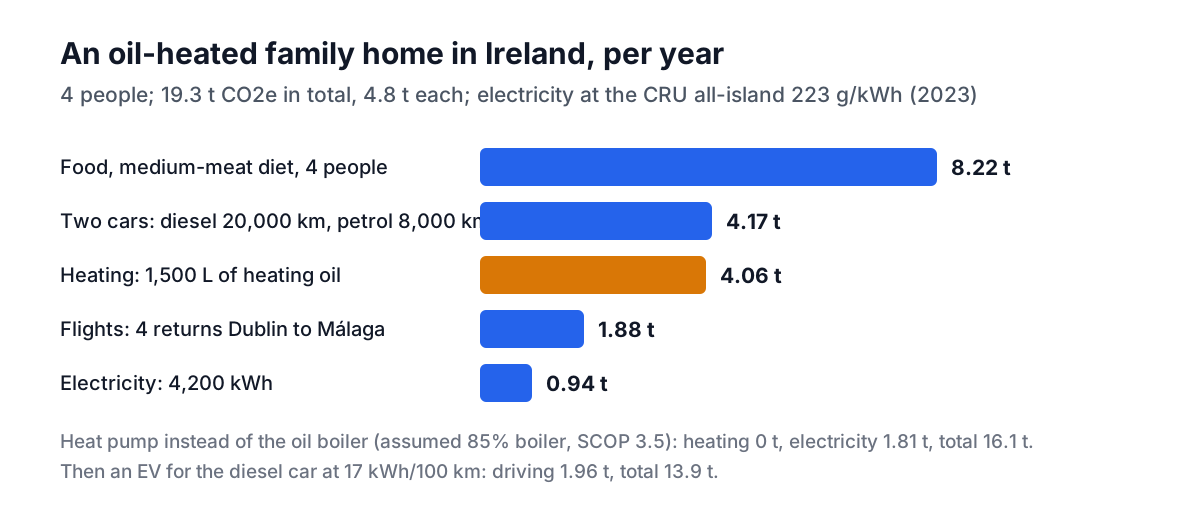
A family of four in an oil-heated house in Ireland, using 4,200 kWh of electricity and 1,500 litres of heating oil a year, driving a diesel car 20,000 km and a petrol car 8,000 km, taking one family holiday to Málaga and eating a medium-meat diet, has a footprint of about 19.3 tonnes of CO2e a year, or 4.8 tonnes each. Food is the biggest share, then the two cars, then the oil boiler. Electricity, at the all-island average of 223 g of CO2 per kWh, is the smallest.
This edition works through that household with the Carbon Footprint Calculator, using the figures on Irish bills and the Irish factors that change the answer, and then shows what a heat pump and an electric car do to it.
Step 1: electricity, and which Irish factor to use
Multiply your annual kWh, on your bills or your supplier's app, by a grid factor in kg CO2 per kWh. Ireland has two published figures, and they answer different questions.
- 223 g/kWh, the all-island average for 2023. The CRU's Fuel Mix Disclosure and CO2 Emissions report for 2023 gives this as the average for electricity supplied in Ireland and Northern Ireland, down from 234 g in 2022, with renewables at 61% of the fuel mix. It includes Guarantees of Origin, the certificates suppliers use to claim renewable electricity, and it is the figure your bill compares your supplier against.
- 255 g/kWh, electricity generated in Ireland in 2023, without Guarantees of Origin. The same report gives this as the physical intensity of Irish generation, 23% lower than the year before, and notes that the 223 g figure "does not reflect the CO2 intensity of the Irish electricity sector in practice".
For the family's 4,200 kWh:
| Factor | Electricity emissions |
|---|---|
| 223 g/kWh (all-island, with GOs) | 0.94 t |
| 255 g/kWh (generated in Ireland) | 1.07 t |
Use 223 g if you want the figure that matches your bill, or 255 g for the physical grid. If your supplier's fuel mix on your bill shows its own g/kWh, you can enter that instead, but then leave the "green tariff" percentage at zero so the renewable share is not counted twice. Solar panels on your own roof can go into that percentage, because they are not in any supplier's figure.
Step 2: heating oil, gas or a heat pump
Many Irish homes are heated by oil, which comes in fills rather than a monthly bill. Add up a year of deliveries in litres. The calculator's oil factor is about 2.71 kg CO2e per litre of distillate heating oil, a US EPA figure; kerosene has its own factor, so treat the oil line as an estimate.
1,500 L x 2.706 kg/L = 4,059 kg = 4.06 t
Gas customers enter the kWh shown on their bill. A house using 11,000 kWh of gas a year emits about 2.0 t.
What a heat pump changes. The calculator takes your actual fuel use, so to model a heat pump you convert the heat into electricity yourself. With two assumptions, an 85% efficient oil boiler and a heat pump averaging a seasonal COP of 3.5:
heat the house uses  = 1,500 L x 10.72 kWh/L x 0.85 = 13,672 kWh
heat pump electricity = 13,672 / 3.5             = 3,906 kWh
Add the 3,906 kWh to the electricity line and set oil to zero. Heating falls from 4.06 t to nothing, electricity rises from 0.94 t to 1.81 t, and the household total drops from 19.3 t to 16.1 t. Your own heat pump's efficiency depends on the insulation, flow temperature and installation, so use the figure from your installer or your BER assessment if you have one.
Step 3: driving in kilometres
Enter each car's annual kilometres (from your NCT certificate history or your service records) and its fuel use in litres per 100 km:
| Car | Distance | Fuel use | CO2 |
|---|---|---|---|
| Diesel | 20,000 km | 5.5 L/100 km | 2.97 t |
| Petrol | 8,000 km | 6.5 L/100 km | 1.21 t |
| Electric, replacing the diesel | 20,000 km | 17 kWh/100 km | 0.76 t |
The electric car's emissions come from the grid factor: 3,400 kWh of charging at 223 g/kWh. Swapping the diesel for it, on top of the heat pump, brings the household to 13.9 t.
Step 4: flights from Dublin
The calculator uses the UK government's DESNZ factors per passenger-km, including the extra warming effect of emissions at altitude. Distances are great-circle:
| Trip | One way | Per person, return | Family of four, return |
|---|---|---|---|
| Dublin to London Heathrow | about 450 km | 0.11 t | 0.45 t |
| Dublin to Málaga | about 1,870 km | 0.47 t | 1.88 t |
| Dublin to New York JFK | about 5,100 km | 1.19 t | 4.78 t |
One family trip to New York instead of Málaga would add almost 2.9 tonnes, more than the family's whole year of electricity three times over.
Step 5: food
Diet is estimated per person from a UK study of diet-related greenhouse gas emissions: 5.63 kg CO2e a day for a medium-meat diet, 3.81 kg for vegetarian and 2.89 kg for vegan. For four people on a medium-meat diet that is 8.22 t a year, the biggest single line for this household. Moving the whole family to a low-meat diet (4.67 kg a day) would save about 1.4 t; that is a bigger cut than replacing the electricity supply with renewables entirely.
The household in full
| Line | Oil-heated today | With a heat pump | Heat pump and EV |
|---|---|---|---|
| Electricity | 0.94 t | 1.81 t | 1.81 t |
| Heating | 4.06 t | 0 | 0 |
| Driving | 4.17 t | 4.17 t | 1.96 t |
| Flights | 1.88 t | 1.88 t | 1.88 t |
| Food | 8.22 t | 8.22 t | 8.22 t |
| Total | 19.27 t | 16.08 t | 13.87 t |
| Per person | 4.82 t | 4.02 t | 3.47 t |
How it compares with Ireland's total
The EPA's provisional greenhouse gas inventory puts Ireland's total emissions in 2025 at 52.65 million tonnes of CO2e, 2.3% lower than 2024. Transport was 22.0% of the total, energy industries 12.5% and the residential sector 9.9%. With the CSO's population estimate of 5,458,600 in April 2025, that is about 9.6 tonnes per person.
That national figure is not comparable with the family's 4.8 tonnes each. It includes agriculture, industry, commercial buildings and public services, which a household calculator only touches through diet, while the household figure includes flights and the full emissions of food, much of which is produced abroad or counted in other countries' inventories.
What this calculation leaves out
- Things you buy. Clothes, electronics, furniture and other goods have their own footprints.
- Services and work. Your share of public services, and anything your employer counts.
- Embodied emissions of the car, the heat pump or the house itself.
Treat the result as a way to compare your own options, not as an exact audit.
Tools for this job
- Carbon Footprint Calculator: household CO2e from electricity, heating fuels, cars, flights and diet, set up for Irish units.
- Electricity Cost Calculator: the cost side of the same kWh.
- EV vs Petrol Calculator: running costs of an electric car against a petrol or diesel one.
- The US carbon footprint guide uses US grid regions and therms.
Frequently asked questions
What is the CO2 per kWh of electricity in Ireland?
The CRU's all-island average for 2023 is 223 g of CO2 per kWh, including Guarantees of Origin, down from 234 g in 2022. Electricity generated in Ireland in 2023, without Guarantees of Origin, averaged 255 g per kWh. Your supplier's own figure is on your bill.
How much CO2 does a litre of heating oil produce?
About 2.7 kg of CO2e per litre on the US EPA factor for distillate heating oil that the calculator uses. A year of 1,500 litres produces about 4.1 tonnes. Kerosene has its own factor, so treat this as an estimate.
How much CO2 does a heat pump save in Ireland?
It depends on your house and the heat pump. Replacing 1,500 litres of heating oil with a heat pump at a seasonal COP of 3.5 adds about 3,900 kWh of electricity, 0.87 tonnes at 223 g per kWh, and removes 4.06 tonnes from oil, a saving of about 3.2 tonnes a year.
What is the average carbon footprint per person in Ireland?
The EPA reports national totals: 52.65 million tonnes of CO2e in 2025 on provisional figures. Divided by the CSO's population of 5,458,600, that is about 9.6 tonnes per person, but it includes farming and industry and leaves out most imported goods and flights.
Should I use the Irish or UK grid factor?
The Irish one for a home in the Republic. The CRU's 223 g per kWh for 2023 covers the all-island market. The UK factor the British version of the calculator uses describes a different grid and would understate an Irish household's electricity emissions.
Sources and further reading
- Annual Fuel Mix Disclosure and CO2 Emissions Report 2023, Commission for Regulation of Utilities, 11 December 2024. All-island 223 g CO2/kWh with Guarantees of Origin (234 g in 2022), 255 g for generation in Ireland, renewables 61% of the fuel mix.
- Greenhouse gas emissions, Environmental Protection Agency. Provisional 2025 total of 52.65 Mt CO2e and sector shares.
- Population and migration estimates, April 2025, Central Statistics Office. Population of 5,458,600.
- Fuel mix and guarantees of origin, Commission for Regulation of Utilities. How supplier fuel mixes are disclosed on bills.
- Greenhouse gas reporting: conversion factors, UK Department for Energy Security and Net Zero. The flight factors per passenger-km.
- Dietary greenhouse gas emissions of meat-eaters, fish-eaters, vegetarians and vegans in the UK, Scarborough et al., Climatic Change (2014). The diet factors.
Open the Carbon Footprint Calculator
More Energy & Sustainability
Every tool in the Energy & Sustainability section, free and in your browser.