
How to Calculate Your Carbon Footprint from UK Bills
Your household carbon footprint from UK energy bills in kWh, miles at UK mpg, kerosene deliveries and flights, using the DESNZ 2026 conversion factors.
By Redbison Dev · · 11 min read

United Kingdom edition. Uses the UK government's DESNZ 2026 greenhouse gas conversion factors for grid electricity, mains gas, kerosene and flights, energy bills in kWh, UK mpg on the imperial gallon, off-gas homes and the Boiler Upgrade Scheme. US edition
A UK household's carbon footprint can be worked out from a year of energy bills, a car's mileage and fuel economy, a list of flights and a diet estimate. For two adults in a gas-heated semi using 2,700 kWh of electricity and 11,500 kWh of gas, driving 7,000 miles at 45 mpg and taking two short-haul return flights, it comes to about 8.9 tonnes of CO₂e a year, 4.5 tonnes each. Electricity is now the smallest part of that, because the UK grid factor fell sharply in the government's 2026 figures. The Carbon Footprint Calculator (UK) applies the same factors to your own numbers.
The factors: DESNZ conversion factors 2026
The Department for Energy Security and Net Zero publishes the UK greenhouse gas conversion factors each year for company reporting. They are the standard UK source for turning energy use into CO₂e. The ones a household needs, from the 2026 set:
| What you use | DESNZ 2026 factor | The calculator uses |
|---|---|---|
| Grid electricity (generated) | 0.13096 kg CO₂e per kWh | 0.13096 |
| Mains gas, per kWh on a gross basis | 0.18231 kg CO₂e per kWh | 0.1812 (US EPA basis) |
| Burning oil (kerosene), per litre | 2.54016 kg CO₂e | 2.706 (US EPA heating oil) |
| LPG, per litre | 1.55713 kg CO₂e | per litre or kg |
| Petrol, average biofuel blend, per litre | 2.07500 kg CO₂e | 2.32 (US EPA gasoline) |
| Short-haul flight, economy, per passenger-km | 0.07435 without RF, 0.12576 with RF | same |
The gas factor matches within 1%. For kerosene and petrol the calculator uses US EPA combustion factors, which are higher than the DESNZ figures: about 6% for kerosene, and about 12% for petrol, mainly because DESNZ's average petrol counts the biofuel blended into UK pump fuel (its factor for 100% mineral petrol is 2.35372 kg per litre). If you want the DESNZ figure exactly, multiply your litres by the factor above; the difference is shown in the examples below.
DESNZ also publishes a separate factor of 0.01299 kg per kWh for electricity lost in transmission and distribution. Company reports list it separately; the household total here leaves it out.
Step 1: electricity and gas from your bills
UK bills give both fuels in kilowatt hours, so the sums are short. Take a full year from your supplier's annual statement or app, not one winter bill.
- 2,700 kWh of electricity x 0.13096 = 354 kg.
- 11,500 kWh of gas x 0.1812 = 2,084 kg.
Gas emits about six times as much as electricity in this home, even though it is cheaper per kWh. That has changed recently: on the DESNZ 2025 factor of 0.177 kg per kWh, the same electricity was 478 kg. DESNZ's major changes report explains the 26% fall partly by a new method: the factor now uses data one year behind the publication year instead of two. Compare years with care.
If your tariff is "100% renewable", the calculator's renewable box gives the market-based figure. The location-based figure, the grid average, is the one DESNZ provides and the one to use when you compare homes.
Step 2: off-gas homes on oil or LPG
Many rural homes are not on mains gas and burn kerosene or LPG. Take the litres from 12 months of delivery notes.
For a home burning 1,800 litres of kerosene a year, the calculator gives 4.87 t of CO₂e (at the EPA factor it uses); at the DESNZ 2026 factor of 2.54016 kg per litre it would be 4.57 t. Either way, in that home the oil is the largest single line, ahead of food. The Boiler Upgrade Scheme currently offers £7,500 towards an air source or ground source heat pump, and until March 2027 an extra £1,500 if the property is heated by oil or LPG and has no mains gas connection.
Step 3: the car, in UK mpg
The UK quotes fuel economy in miles per imperial gallon of 4.546 litres. A US gallon is 3.785 litres, so a US-mpg calculator fed a UK figure understates fuel by about a sixth. The calculator has a UK setting for this.
7,000 miles at 45 UK mpg is 707 litres of petrol. At the EPA factor the calculator uses that is 1.64 t; at the DESNZ 2026 factor of 2.075 kg per litre it is 1.47 t. An electric car using 30 kWh per 100 miles would use 2,100 kWh for the same distance, which is 275 kg on the 2026 grid factor.
Step 4: flights
DESNZ flight factors are per passenger-kilometre and already include an 8% uplift for indirect routing, so enter the great-circle distance. The calculator includes radiative forcing (the extra warming from contrails and nitrogen oxides at altitude) by default; DESNZ publishes factors with and without it.
Two short-haul economy returns of 1,500 km each way are 6,000 passenger-km: 0.76 t with radiative forcing, 0.45 t without. A London to New York economy return, about 5,570 km each way, is 1.30 t with it, which is more than this household's gas and electricity together would be if it switched to a heat pump.
Step 5: food
Diet is estimated from averages, because receipts do not tell you emissions. The calculator uses Scarborough and colleagues' study of UK diets from the EPIC-Oxford cohort: 5.63 kg CO₂e a day for a medium-meat diet (50 to 99 g of meat a day), 3.81 for vegetarian and 2.89 for vegan. For two people on a medium-meat diet that is 4.11 t a year, the largest single line in the example.
The worked example
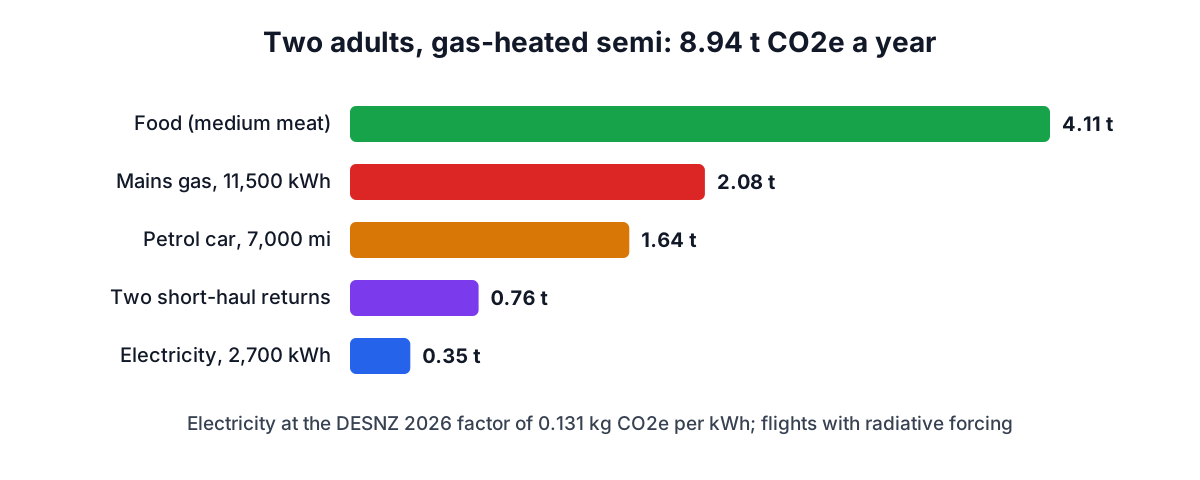
| Two adults, gas-heated semi | t CO₂e a year |
|---|---|
| Electricity, 2,700 kWh | 0.35 |
| Mains gas, 11,500 kWh | 2.08 |
| Petrol car, 7,000 miles at 45 mpg | 1.64 |
| Two short-haul returns, 1,500 km each way, with RF | 0.76 |
| Food, medium meat, two people | 4.11 |
| Total | 8.94 (4.47 each) |
What changes the total most:
- Heat pump instead of the boiler. If a heat pump used 3,500 kWh of electricity a year to replace the 11,500 kWh of gas, the electricity line would rise to 0.81 t and the gas line would disappear: 7.32 t in total, 1.6 t less.
- Electric car. At 30 kWh per 100 miles: 7.58 t, 1.4 t less.
- No flights. 8.19 t.
- Green tariff. It changes the market-based figure only; on the location-based figure the saving is zero.
What the total leaves out
This is the part of your footprint you can read from bills and tickets. It leaves out the goods you buy, upstream emissions from producing fuels, public services and waste. National per-person figures include all of those, so they are not comparable with this total; use it to compare your own choices with each other.
Frequently asked questions
What is the carbon factor for UK electricity in 2026?
DESNZ gives 0.13096 kg CO₂e per kWh for UK grid electricity generated in its 2026 conversion factors, plus 0.01299 kg per kWh for transmission and distribution losses if you count those separately. The 2025 figure was 0.177.
How much CO₂ does a kWh of gas produce in the UK?
DESNZ 2026 gives 0.18231 kg CO₂e per kWh of natural gas on a gross calorific value basis, the basis UK bills use. 11,500 kWh a year is about 2.1 tonnes.
What is the carbon footprint of a litre of heating oil?
DESNZ 2026 gives 2.54016 kg CO₂e per litre of burning oil (kerosene). 1,800 litres a year is about 4.6 tonnes on that factor; the calculator's US EPA factor gives 4.87 tonnes.
Does a heat pump cut my carbon footprint in the UK?
Usually by a lot, because gas emits about 0.18 kg per kWh and grid electricity 0.13, and a heat pump delivers several kWh of heat for each kWh it uses. In the example, swapping 11,500 kWh of gas for 3,500 kWh of electricity cuts the total by 1.6 tonnes.
Sources and further reading
- Greenhouse gas reporting: conversion factors 2026, Department for Energy Security and Net Zero. Electricity, natural gas, burning oil, LPG, petrol and flight factors.
- Greenhouse gas reporting: conversion factors 2025, Department for Energy Security and Net Zero. The 0.177 kg per kWh electricity factor for comparison.
- Boiler Upgrade Scheme: what you can get, GOV.UK. Grants and the extra £1,500 for oil and LPG homes until March 2027.
- GHG Emission Factors Hub, US Environmental Protection Agency. The combustion factors the calculator uses for heating oil and petrol.
- Dietary greenhouse gas emissions of meat-eaters, fish-eaters, vegetarians and vegans in the UK, Climatic Change. Scarborough and colleagues, 2014.
Open the Carbon Footprint Calculator
More Energy & Sustainability
Every tool in the Energy & Sustainability section, free and in your browser.