
How to Calculate Your Carbon Footprint in India
Your household carbon footprint from electricity units, LPG cylinders, car or two-wheeler mileage in km/l and flights, using the CEA grid emission factor.
By Redbison Dev · · 11 min read

India edition. Uses the Central Electricity Authority's CO2 Baseline Database (version 22.0, FY 2025-26) for grid electricity, LPG by the 14.2 kg cylinder, PNG in SCM, vehicle mileage in km/l, rooftop solar and Indian household examples. US edition
You can estimate an Indian household's carbon footprint from 12 months of electricity bills, the number of LPG refills, how far you drive and at what mileage, the flights you take and your diet. For a family of four in a city flat using 250 units of electricity a month, nine LPG refills a year, a petrol car doing 10,000 km at 15 km/l and one domestic return flight, it comes to about 9.8 tonnes of CO₂e a year, or 2.45 tonnes per person. Electricity is the largest energy line, because India's generation is still dominated by fossil fuels. The Carbon Footprint Calculator (India) works it out from your own bills.
Electricity: the CEA grid factor
The standard Indian figure comes from the Central Electricity Authority's CO2 Baseline Database for the Indian Power Sector. Version 22.0 gives, for FY 2025-26, a weighted average of 0.675 tonnes of CO₂ per MWh, including renewable and captive power injected into the grid. One unit on your bill is one kWh, so that is 0.675 kg per unit.
The same report gives three other numbers that are worth knowing:
| CEA, FY 2025-26 | t CO₂ per MWh | What it means |
|---|---|---|
| Weighted average | 0.675 | Average of all stations, weighted by generation |
| Operating margin | 0.963 | Average of stations excluding low-cost and must-run sources |
| Build margin | 0.446 | Average of the newest 20% of capacity |
| Combined margin | 0.705 | Combines the operating and build margins |
For a household footprint, use the weighted average, as the calculator does. The operating margin is a useful second view of savings. Units you save by switching off an AC or adding rooftop solar are often argued to displace the stations running at the margin rather than the average mix, and the CEA's operating margin, which leaves out low-cost and must-run sources, is 0.963 t per MWh. At that rate 1,000 units saved would avoid about 963 kg instead of 675 kg.
The factor is falling. The CEA report shows it down from 0.774 t per MWh in FY 2013-14 to 0.675 in FY 2025-26 as renewable generation grew.
The worked numbers
250 units a month is 3,000 units a year: 3,000 x 0.675 = 2,025 kg. Summer AC use can push bills up sharply, so add up all 12 monthly bills (or six bi-monthly ones) rather than multiplying one month. If the same family used 4,200 units a year, electricity would be 2,835 kg and the total 10.6 t.
Cooking gas: LPG cylinders and PNG
A domestic LPG cylinder holds 14.2 kg (a 5 kg cylinder is also issued, as the PMUY scheme page shows). The calculator takes LPG by the kg and uses the UK DESNZ 2026 factor of 2,939 kg CO₂e per tonne of LPG, which is about 2.94 kg per kg:
- one 14.2 kg cylinder: about 42 kg CO₂e;
- nine refills a year (127.8 kg): 376 kg.
Your refill count is in the booking history on your distributor's app. If you have piped natural gas, choose cubic metres and enter the SCM from your PNG bills.
Driving: mileage in km/l
The calculator takes mileage as km per litre, the way it is quoted in India, and uses 2.32 kg CO₂ per litre of petrol (US EPA combustion factor).
| Vehicle, per year | Fuel or power | t CO₂e |
|---|---|---|
| Petrol car, 10,000 km at 15 km/l | 667 litres | 1.55 |
| Electric car, 10,000 km at 14 kWh per 100 km | 1,400 units at 0.675 | 0.95 |
| Petrol two-wheeler, 8,000 km at 45 km/l | 178 litres | 0.41 |
Use the mileage you actually get in traffic, not the brochure figure. On India's fossil-heavy grid an electric car still emits less than this petrol car, about 95 g per km against 155 g, but the gap is narrower than it would be on a cleaner grid. Charging from your own rooftop solar narrows it further.
Flights
The calculator uses the UK DESNZ flight factors per passenger-km, which include an 8% allowance for indirect routing. A domestic return of 1,150 km each way is 2,300 passenger-km for one person: 0.29 t with radiative forcing (the extra warming effect of contrails and nitrogen oxides). DESNZ also publishes a factor for international flights not touching the UK; for economy it is lower than the short-haul factor the calculator uses, so the calculator's flight figure is on the cautious side for flights within India.
Food
Diet uses averages from Scarborough and colleagues' study of UK diets: 3.81 kg CO₂e a day for a vegetarian diet and 5.63 for a medium-meat diet, per person on a 2,000 kcal basis. Four vegetarians over a year come to 5.56 t, the largest line in the example. Those figures were measured on British diets; Indian vegetarian meals, rice, dairy and cooking methods differ, so treat the food line as a rough guide.
The worked example
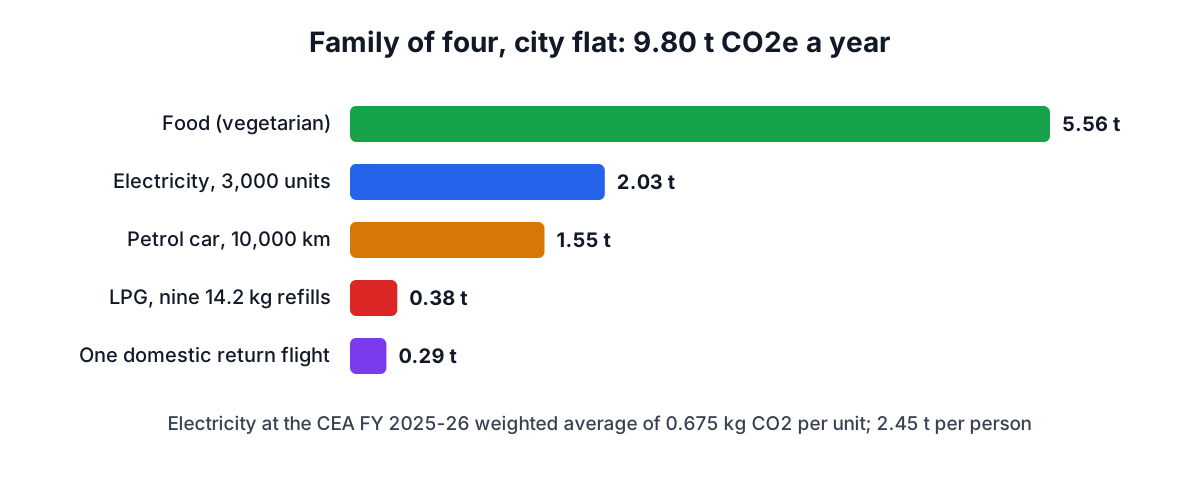
| Family of four, city flat | t CO₂e a year |
|---|---|
| Electricity, 3,000 units | 2.03 |
| LPG, nine 14.2 kg cylinders | 0.38 |
| Petrol car, 10,000 km at 15 km/l | 1.55 |
| One domestic return flight, 1,150 km each way | 0.29 |
| Food, vegetarian, four people | 5.56 |
| Total | 9.80 (2.45 per person) |
What moves it:
- Rooftop solar covering half the units: electricity falls to 1.01 t and the total to 8.79 t.
- Electric car instead of petrol: the total falls to 9.20 t.
- A two-wheeler instead of the car (8,000 km at 45 km/l): 8.66 t.
- More AC: 4,200 units a year takes the total to 10.61 t.
What the total leaves out
The footprint covers what you can read from bills, tickets and the fuel you buy. It leaves out the goods and services you buy, upstream emissions from producing fuels, electricity lost between the power station and your meter, and public services. Use it to compare your own options with each other rather than with national per-person figures.
Frequently asked questions
How much CO₂ does one unit of electricity produce in India?
About 0.675 kg. The CEA's CO2 Baseline Database version 22.0 gives a weighted average of 0.675 t CO₂ per MWh for FY 2025-26, and one unit is one kWh.
How much CO₂ does an LPG cylinder produce?
About 42 kg CO₂e for a 14.2 kg domestic cylinder, at 2.94 kg CO₂e per kg of LPG from the UK DESNZ 2026 factors. Nine refills a year is about 0.38 tonnes.
Is an electric car better for the climate in India?
Yes, though by less than on a cleaner grid. At 14 kWh per 100 km and 0.675 kg per unit, an electric car emits about 95 g per km at the power station, against about 155 g for a petrol car doing 15 km/l.
Does rooftop solar reduce my carbon footprint?
Yes. Enter the share of your units the panels supply, and the electricity line falls by that share. For the family in the example, solar covering half the units saves about 1 tonne a year at the average grid factor.
Sources and further reading
- CO2 Baseline Database for the Indian Power Sector, User Guide version 22.0, Central Electricity Authority. Weighted average, operating, build and combined margins for FY 2025-26 (Table S).
- Pradhan Mantri Ujjwala Yojana, Government of India. 14.2 kg and 5 kg domestic LPG cylinders.
- Greenhouse gas reporting: conversion factors 2026, UK Department for Energy Security and Net Zero. LPG and flight factors.
- GHG Emission Factors Hub, US Environmental Protection Agency. The petrol combustion factor.
- Dietary greenhouse gas emissions of meat-eaters, fish-eaters, vegetarians and vegans in the UK, Climatic Change. Scarborough and colleagues, 2014.
Open the Carbon Footprint Calculator
More Energy & Sustainability
Every tool in the Energy & Sustainability section, free and in your browser.