
How to Calculate Your Carbon Footprint in Canada
Your household carbon footprint from Canadian bills: your province's grid intensity, natural gas in m³ or GJ, heating oil, L/100 km driving and flights.
By Redbison Dev · · 11 min read
Canada edition. Uses Environment and Climate Change Canada's electricity consumption intensities by province and territory (version 4.0, September 2026), gas in cubic metres or gigajoules, heating oil in litres and NRCan fuel consumption ratings in L/100 km. US edition
Your household carbon footprint in Canada can be worked out from a year of utility bills, your driving, your flights and a diet estimate. Where you live matters more than almost anything you do: the same three-person household using 900 kWh of electricity a month, 2,200 m³ of natural gas and one car comes to about 14.6 tonnes of CO₂e a year in Quebec and 21.4 tonnes in Nova Scotia, and the only difference is the grid. The Carbon Footprint Calculator (Canada) lets you pick your province or territory and enter bills in the units they use.
Electricity: your province's intensity
Environment and Climate Change Canada publishes electricity consumption intensities for each province and territory in its emission factors and reference values (version 4.0, September 2026, based on the National Inventory Report 1990-2024). The calculator uses them:
| Province or territory | g CO₂e per kWh | 10,800 kWh a year |
|---|---|---|
| Quebec | 2.6 | 0.03 t |
| Manitoba | 3.0 | 0.03 t |
| Newfoundland and Labrador | 17 | 0.18 t |
| British Columbia | 18 | 0.19 t |
| Ontario | 73 | 0.79 t |
| Yukon | 134 | 1.45 t |
| Prince Edward Island | 265 | 2.86 t |
| Alberta | 346 | 3.74 t |
| New Brunswick | 375 | 4.05 t |
| Northwest Territories | 490 | 5.29 t |
| Saskatchewan | 581 | 6.27 t |
| Nova Scotia | 628 | 6.78 t |
| Nunavut | 760 | 8.21 t |
A kWh in Nova Scotia carries about 240 times the emissions of one in Quebec. That changes which improvements pay off: in Quebec or Manitoba electric heat and an EV cut emissions almost completely, while in Alberta, Saskatchewan or Nova Scotia the electricity itself is a large share of the footprint.
Take the 12-month kWh total from your utility's online account, not a single winter bill.
Heating: gas in m³ or GJ, oil and propane in litres
Natural gas bills show cubic metres in some provinces and gigajoules in others; the calculator takes either. It uses 1.94 kg CO₂e per m³, built from the US EPA combustion factor and a heat content of 1,036 Btu per cubic foot. ECCC's own table of CO₂ from marketable natural gas runs from 1,915 to 1,966 g per m³ depending on the province, so the calculator's figure sits within the Canadian range.
- 2,200 m³ of gas a year: 4.28 t.
- 80 GJ a year (an Alberta-style bill): 4.03 t, at about 50 kg per GJ.
- 2,000 litres of heating oil: 5.41 t.
Heating oil and propane go in litres, from your delivery slips. Wood heat has no factor in the calculator; leave it out and note it.
Driving: L/100 km
Natural Resources Canada's fuel consumption ratings are in L/100 km, with a combined rating that reflects 55% city and 45% highway driving. Your own fill-up records over a year reflect your actual driving.
16,000 km at 9 L/100 km burns 1,440 litres of gasoline, which is 3.34 t at the calculator's factor. An electric car using 20 kWh per 100 km uses 3,200 kWh for the same distance, and its emissions depend entirely on the province:
| Province | EV, 16,000 km at 20 kWh/100 km | Gasoline car, 9 L/100 km |
|---|---|---|
| Quebec | 0.01 t | 3.34 t |
| Ontario | 0.23 t | 3.34 t |
| Alberta | 1.11 t | 3.34 t |
| Nova Scotia | 2.01 t | 3.34 t |
The EV is lower everywhere, but in Nova Scotia the saving is about 1.3 t, against 3.3 t in Quebec. NRCan's ratings use 8.9 kWh of electricity as the energy equivalent of one litre of gasoline when they compare the two.
Flights
The calculator uses the UK government's DESNZ flight factors per passenger-km, which include an 8% allowance for indirect routing and, by default, radiative forcing (the extra warming from contrails and nitrogen oxides at altitude). Flights of roughly 3,700 km or less use the short-haul factor. A Toronto to Vancouver return, about 3,300 km each way, is 6,600 passenger-km: 0.83 t in economy with radiative forcing.
Food
Diet uses averages from Scarborough and colleagues' study of UK diets: 5.63 kg CO₂e a day on a medium-meat diet, 3.81 vegetarian, 2.89 vegan. Three people on a medium-meat diet come to 6.16 t a year.
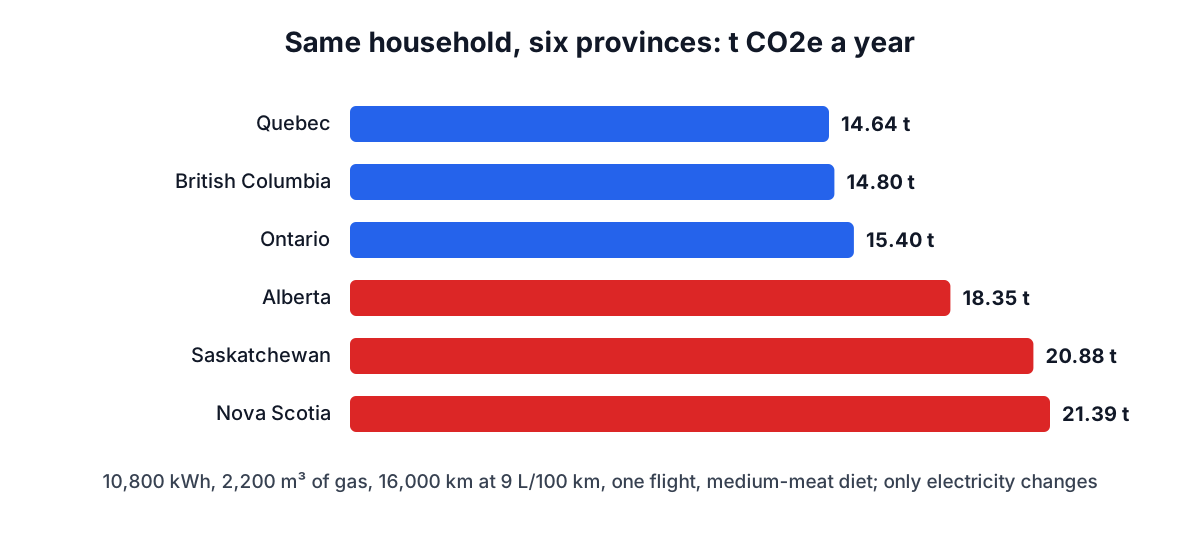
The same household in six provinces
Three people; 900 kWh of electricity a month (10,800 a year); 2,200 m³ of natural gas; 16,000 km at 9 L/100 km; one return flight of 3,300 km each way; medium-meat diet.
| Line | Quebec | Ontario | Alberta | Nova Scotia |
|---|---|---|---|---|
| Electricity | 0.03 | 0.79 | 3.74 | 6.78 |
| Natural gas | 4.28 | 4.28 | 4.28 | 4.28 |
| Car | 3.34 | 3.34 | 3.34 | 3.34 |
| Flight | 0.83 | 0.83 | 0.83 | 0.83 |
| Food | 6.16 | 6.16 | 6.16 | 6.16 |
| Total, t CO₂e | 14.64 | 15.40 | 18.35 | 21.39 |
In Quebec, gas heating is the biggest energy line, and a household that heats with electricity instead (25,000 kWh a year in all, no gas) comes to 10.40 t. In Nova Scotia, swapping the gas car for an EV saves 1.3 t, while the electricity line alone is still 6.8 t.
What the total leaves out
The calculator covers home energy, personal travel and food. It does not include the goods and services you buy, upstream emissions from producing fuels, public services or waste, so it is lower than national per-person figures. Use it to compare your own options.
Frequently asked questions
What is the electricity emission factor in my province?
ECCC's consumption intensities (version 4.0, based on the National Inventory Report 1990-2024) are, in g CO₂e per kWh: BC 18, Alberta 346, Saskatchewan 581, Manitoba 3.0, Ontario 73, Quebec 2.6, New Brunswick 375, Nova Scotia 628, PEI 265, Newfoundland and Labrador 17, Yukon 134, Northwest Territories 490 and Nunavut 760.
How much CO₂ does a cubic metre of natural gas produce?
About 1.94 kg CO₂e in the calculator. ECCC's figures for CO₂ from marketable natural gas range from 1,915 to 1,966 g per m³ by province. A home burning 2,200 m³ a year emits about 4.3 tonnes.
Is an electric car better than a gas car in Alberta?
Yes. At 20 kWh per 100 km and Alberta's 346 g per kWh, 16,000 km is about 1.1 tonnes, against 3.3 tonnes for a car using 9 L/100 km. In Quebec the same EV is about 0.01 tonnes.
My gas bill is in gigajoules. What do I enter?
Choose GJ as the gas unit and enter the year's total. The calculator uses about 50 kg CO₂e per GJ, so 80 GJ is about 4 tonnes.
Sources and further reading
- Emission factors and reference values, Environment and Climate Change Canada. Electricity consumption intensity by province and territory and natural gas CO₂ factors (version 4.0, September 2026).
- Understanding the fuel consumption tables, Natural Resources Canada. L/100 km, the 55/45 combined rating and the 8.9 kWh per litre equivalence.
- GHG Emission Factors Hub, US Environmental Protection Agency. Combustion factors for natural gas, heating oil, propane and gasoline.
- Greenhouse gas reporting: conversion factors 2026, UK Department for Energy Security and Net Zero. Flight factors.
- Dietary greenhouse gas emissions of meat-eaters, fish-eaters, vegetarians and vegans in the UK, Climatic Change. Scarborough and colleagues, 2014.
Open the Carbon Footprint Calculator
More Energy & Sustainability
Every tool in the Energy & Sustainability section, free and in your browser.