
Inflation and Savings in Australia: Goals That Keep Up
How the ABS measures inflation, how to set a home deposit goal in future dollars, the fortnightly saving it needs, and whether a savings account beats CPI after tax.
By Redbison Dev · · 8 min read
Australia edition. Written for Australian savers: ABS CPI figures in A$, the RBA's 2 to 3% target band, a home deposit saved fortnightly with interest paid monthly, tax on interest at your marginal rate plus Medicare levy, the FHSS scheme and the Financial Claims Scheme. US edition
The ABS Consumer Price Index averaged 2.84% higher in 2025 than in 2024. A savings account paying 4.5% p.a. beat that by about 1.6% before tax. For someone on a 32% marginal rate (30% plus the 2% Medicare levy), the after-tax 3.06% stayed only about 0.2% ahead. In Australia, interest is taxed as ordinary income, so whether your savings keep up with prices is decided as much by your tax bracket as by the rate on the app.
This edition explains how Australian inflation is measured, how to put a goal such as a home deposit into the dollars of the year you will need it, and how to check your real return. The figures come from the Australia Inflation Calculator and the Australia Savings Goal Calculator, so you can repeat each one. It covers the arithmetic, not which account to choose; if your plan mixes savings, super and borrowing, a licensed financial adviser can look at the whole picture.
How the ABS measures inflation
The headline measure is the ABS Consumer Price Index, all groups, weighted average of the eight capital cities. For most of its history the ABS published it quarterly; its first complete monthly CPI came with the October 2025 release, and the index reference period is now September 2025 = 100. The calculator takes the mean of each calendar year's four quarters. To restate dollars between years:
Value in year B = Amount × CPI(B) ÷ CPI(A)
The yearly average was 18.298 in 1980 and 99.045 in 2025, so A$100 of 1980 spending needs A$541.29 in 2025, an average of 3.82% a year. A 1980 dollar buys about 18 cents of what it did then. From 2000 the answer is A$199.57: prices roughly doubled in 25 years.
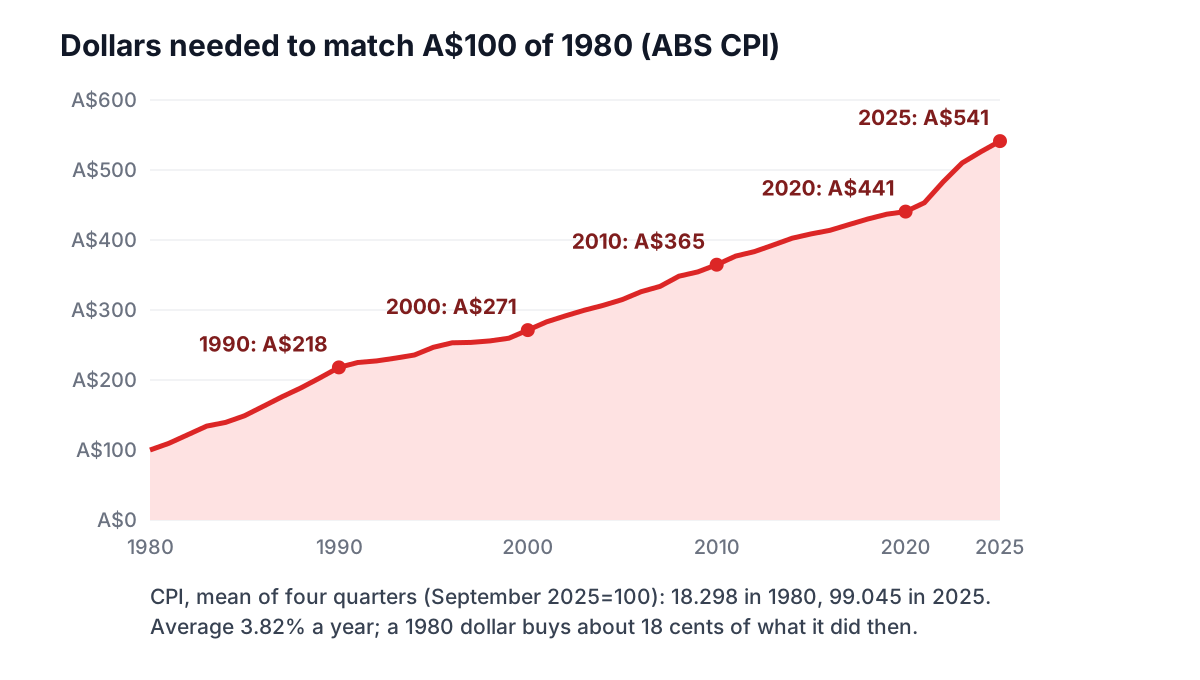
The last five years stand out: from 2020 to 2025 prices rose 22.84%, about 4.20% a year, well above the RBA band. Three things to keep in mind:
- Calendar years, not financial years. Budgets and pay rises often run 1 July to 30 June; a calendar-year comparison is close but not exact.
- Capital cities only. The CPI covers households in the eight capitals, and your own costs (rent, fuel, childcare) can move differently.
- Before 1966 prices were in pounds. For pre-decimal amounts use the RBA's inflation calculator, which handles the change of currency.
Projecting forward: the RBA band
The Reserve Bank's goal is annual consumer price inflation between 2 and 3% (RBA inflation overview), so 2.5%, the middle of the band, is a natural central case and 3% a cautious one.
Future cost = Today's cost × (1 + r)^years
At 2.5%, A$100 of shopping today costs A$128.01 in ten years, and prices double in about 28 years. At 3% they double in about 23.
Worked example: a home deposit in five years
A couple in Brisbane want a A$100,000 home deposit in present-day dollars, buying in five years. They have A$10,000 saved, are both paid fortnightly, and expect a savings account at 4.5% p.a. with interest paid monthly.
| Goal used in the plan | Goal in 5 years | Saving each fortnight |
|---|---|---|
| A$100,000 (today's dollars, no inflation) | A$100,000.00 | A$600.72 |
| Inflated at 2.5% a year | A$113,140.82 | A$690.95 |
| Inflated at 3% a year | A$115,927.41 | A$710.09 |
The plan that ignores inflation reaches A$100,000 on time and is about A$13,100 short if prices rise 2.5% a year, or A$15,900 at 3%. Property prices do not follow the CPI, so treat the inflated figure as a minimum for a home goal. The two-step fix:
- In the Australia Inflation Calculator, choose Assumed inflation rate and turn today's A$100,000 into the figure for the purchase year.
- Enter that figure as the goal in the Australia Savings Goal Calculator, pick Fortnightly, and read the amount to transfer each payday.
Many online accounts pay the advertised rate only as a bonus, in months when you meet conditions such as a minimum deposit and no withdrawals, and a much lower base rate otherwise. Run the plan at the base rate as well: missing the bonus for a few months adds weeks to the goal.
The First Home Super Saver scheme
The First Home Super Saver scheme lets you make voluntary super contributions of up to A$15,000 a financial year towards a first home, and withdraw up to A$50,000 in total with the associated earnings. Salary-sacrificed or tax-deducted contributions are taxed at 15% in the fund rather than at your marginal rate, which can help a saver in the 32% bracket or above. The ATO runs the release and the rules have conditions, so the savings calculator does not model it; use it to size the part of the plan you keep in a bank.
Real returns: is your account keeping up?
Real rate = (1 + rate after tax) ÷ (1 + inflation) − 1
Interest from a bank account goes in your tax return as gross interest and is taxed at your marginal rate plus the Medicare levy. In 2026-27 the 30% rate applies to taxable income from A$45,001 to A$135,000, so 32% is the rate most full-time workers pay on extra interest.
| Inflation | 4.5% p.a. before tax | 4.5% after 32% tax (3.06%) |
|---|---|---|
| 2.84% (2025 average rise) | +1.61% | +0.21% |
| 2.5% (middle of the RBA band) | +1.95% | +0.55% |
| 3% (top of the band) | +1.46% | +0.06% |
At the 39% rate (37% plus Medicare levy) the after-tax return is 2.745%: about 0.24% ahead at 2.5% inflation, but behind both the 2025 rise of 2.84% and the 3% top of the band. Give your bank your tax file number: without it, the bank withholds tax from your interest at the top marginal rate plus Medicare levy, 47%, until you claim it back in your return.
Money left for ten years
A$20,000 left for ten years at 4.5% p.a. with interest paid monthly grows to A$31,339.86 before tax. At 2.5% inflation that buys what A$24,482.65 buys today. Super projections work the same way: a balance quoted in future dollars overstates what it will buy, which is why the retirement calculator shows results in present-day dollars.
Safety: the Financial Claims Scheme
The government's Financial Claims Scheme protects deposits up to A$250,000 per account holder at each authorised bank, building society or credit union, covering savings accounts and term deposits. Some brands operate under one banking licence, so check before splitting a large deposit across them.
A short checklist
- State the goal in the dollars of the year you need it, at 2.5% and 3%.
- Save fortnightly if you are paid fortnightly: 26 transfers a year, two more than twice a month.
- Plan at the base rate as well as the bonus rate.
- Compare the after-tax rate with inflation, using your marginal rate plus the Medicare levy.
- Rerun the plan each July, when the new financial year starts and the ABS has published more quarters, and raise the saving rather than shrinking the goal.
Frequently asked questions
What is an old amount of money worth today in Australia?
On the ABS CPI, A$100 of 1980 spending needs A$541.29 in 2025, an average of 3.82% a year. A 1980 dollar buys about 18 cents of what it did then.
Does a savings account beat inflation in Australia?
Before tax, a 4.5% p.a. account beat the 2.84% rise in the 2025 average CPI by about 1.6%. After tax at 32% it kept 3.06% and stayed only about 0.2% ahead. At the 39% rate it fell slightly behind.
What inflation rate should I use for an Australian savings goal?
The RBA aims for annual inflation between 2 and 3%, so 2.5% is a reasonable central case and 3% a cautious one. For a home deposit, remember that property prices do not follow the CPI, so treat the result as a minimum.
How do I include inflation in a home deposit plan?
Multiply today's deposit by (1 + inflation) raised to the number of years, then save towards that figure. A$100,000 in five years at 2.5% becomes A$113,140.82, which needs A$690.95 a fortnight at 4.5% p.a. with A$10,000 already saved, rather than A$600.72.
Why does the calculator use calendar years and not financial years?
It takes the mean of each calendar year's four quarterly CPI figures. The RBA's own calculator also offers financial-year comparisons, which can differ slightly because the years cover different quarters.
Sources and further reading
- Consumer Price Index, Australia, Australian Bureau of Statistics. Reference period September 2025 = 100 and the monthly CPI.
- Inflation overview, Reserve Bank of Australia. The 2 to 3% target.
- Inflation Calculator, Reserve Bank of Australia. Calendar, financial-year and pre-decimal comparisons.
- First Home Super Saver scheme, Australian Government. A$15,000 a year and A$50,000 in total.
- 10 Gross interest, Australian Taxation Office. Interest is assessable income.
- Financial Claims Scheme, Australian Prudential Regulation Authority. A$250,000 per account holder per institution.
Open the Savings Goal Calculator
More Calculators
Every tool in the Calculators section, free and in your browser.
- Investment Calculator
- Compound Interest Calculator
- Simple Interest Calculator
- Interest Calculator
- EMI Calculator
- Retirement Calculator
- Time-Weighted Return Calculator
- Savings Goal Calculator
- Inflation Calculator
- CAGR Calculator
- ROI Calculator
- Present and Future Value Calculator
- NPV and IRR Calculator
- 401(k) Calculator
- Roth IRA Calculator
- APY and CD Calculator
- SIP Calculator
- Annuity Calculator
- Bond Price and Yield Calculator
- Currency Converter
- Dividend Calculator
- Stock Average Calculator
- RMD Calculator