
Inflation and Savings in India: Plan Goals in Rupees
How CPI inflation is measured in India, how to inflate a goal such as college fees, the RD instalment it needs, and whether an FD or PPF beats inflation after tax.
By Redbison Dev · · 8 min read
India edition. Written for Indian savers: MoSPI's CPI (Combined) in rupees, the RBI's 4% target with its 2% to 6% band, RD instalments with quarterly compounding, FD and PPF real returns after tax, and DICGC cover. US edition
On MoSPI's CPI (Combined), ₹100 of spending in 2012 needed ₹194.77 in 2025. A rupee saved in 2012 buys about 51 paise of what it did then. Any goal you save for, a down payment, a child's college fees, a car, is priced in those shrinking rupees, so a plan that targets today's price will reach its number on time and still fall short. The second half of the problem is tax: a 7% fixed deposit taxed at the 30% slab keeps less than 5%, and inflation takes its share from that.
This edition shows how Indian inflation is measured, how to inflate a goal and work out the monthly RD instalment for it, and how to check whether an FD or PPF is beating inflation. The numbers come from the India Inflation Calculator and the RD and Savings Goal Calculator, so you can repeat each one. It is about the arithmetic, not which product to buy; for a plan mixing debt and equity, a SEBI-registered investment adviser can look at the whole picture.
How inflation is measured in India
The headline measure is the Consumer Price Index (Combined), All India, General, compiled by the National Statistics Office under the Ministry of Statistics and Programme Implementation. "Combined" means rural and urban India together; MoSPI also publishes the rural and urban indices separately. Three points matter before you use it:
- The base changed in 2026. The series with base 2012 = 100 was published monthly until December 2025. From January 2026 data MoSPI publishes a new series on base 2024 = 100. The calculator uses the 2012 series, with calendar-year averages from 2011 to 2025, so it does not mix two baskets.
- It is not the Cost Inflation Index. The CII that CBDT notifies for capital gains runs by financial year and is a separate figure. Never put a CPI result into a tax computation.
- Monthly headlines are 12-month rates. The figure in the news compares one month with the same month a year earlier. The calculator compares yearly averages, which suits salaries and balances held across whole years.
To restate rupees from one year in another:
Value in year B = Amount × CPI(B) ÷ CPI(A)
The annual average index was 100.16 in 2012 and 195.08 in 2025, a rise of 94.77%, or 5.26% a year on average.
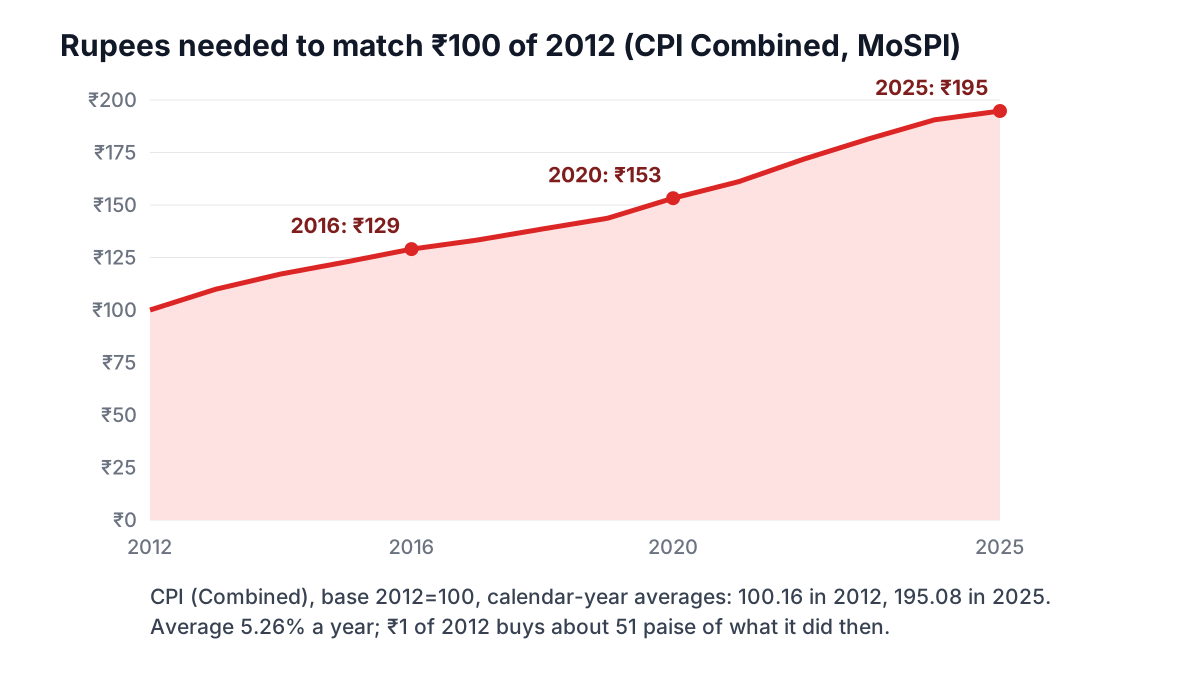
The pace varies. From 2020 to 2025 prices rose 27.11%, or 4.92% a year. From 2024 to 2025 the yearly average rose only 2.20%. A ₹1,00,000 monthly budget in 2015 needs ₹1,58,459.91 in 2025 to buy the same basket.
Projecting forward: the RBI band
For the future you assume a rate. The Central Government's target for the RBI is 4% CPI inflation with a tolerance band of 2% to 6%, retained for April 2026 to March 2031 (RBI monetary policy overview). The target is a sensible central case and 6%, the top of the band, a cautious one.
Future cost = Today's cost × (1 + r)^years
At 6%, ₹1 lakh of spending today costs ₹1,79,084.77 in ten years. The rule of 72 says prices double in 72 ÷ 6 = 12 years at 6%, close to the exact 11.9. Some costs follow their own trend. School and college fees, hospital bills and big-city rent do not have to move with the CPI basket and can rise faster, so for those goals test a higher assumption as well. The 10% used below is a planning assumption, not an official index.
Worked example: college fees in ten years
A family in Pune wants to fund a course that costs ₹15 lakh at today's fees, starting in ten years. They have ₹2 lakh set aside and will save monthly in a bank recurring deposit, assumed at 7% a year compounded quarterly, with instalments paid at the start of each month, the way an RD works.
| Goal used in the plan | Goal in 10 years | Monthly RD instalment |
|---|---|---|
| ₹15,00,000 (today's fees, no inflation) | ₹15,00,000 | ₹6,330.86 |
| Fees rising 6% a year | ₹26,86,271.54 | ₹13,160.21 |
| Fees rising 10% a year | ₹38,90,613.69 | ₹20,093.61 |
The plan that ignores inflation asks for about ₹6,300 a month and hands over ₹15 lakh when the fees have become ₹27 lakh to ₹39 lakh. The fix takes two steps:
- In the India Inflation Calculator, switch to Assumed inflation rate and turn today's ₹15 lakh into the fee in the target year.
- Enter that figure as the goal in the RD and Savings Goal Calculator, with quarterly compounding and start-of-month instalments, and read the instalment.
Two cautions for Indian savers. An RD locks its rate only for its own tenure, so a ten-year plan may run through two or three RDs at different rates; rerun it at each renewal. And the India Post RD runs for five years at 6.7% (October to December 2026 quarter), so a longer goal there means a fresh account after five years. For goals this long, many families also look at mutual fund SIPs, whose returns are not fixed; the SIP calculator shows that side.
The PPF route
The Public Provident Fund pays a tax-free 7.1% for October to December 2026 (National Savings Institute), with a ₹1,50,000 yearly limit and a 15-year term; the compound interest guide works through its yearly compounding and the 5 April rule. The lock-in and the yearly cap make it a better fit for retirement than for a fee due in year ten.
Real returns after tax: does your FD beat inflation?
The real return is what is left after inflation:
Real rate = (1 + rate after tax) ÷ (1 + inflation) − 1
FD interest is added to your income and taxed at your slab rate. Take a 7% FD for someone whose interest falls in the 30% slab, plus the 4% health and education cess: 31.2% tax leaves 4.816%.
| Inflation | FD 7%, 30% slab (4.816% after tax) | PPF 7.1% (tax-free) |
|---|---|---|
| 2.20% (2025 average rise) | +2.56% | +4.79% |
| 4% (RBI target) | +0.78% | +2.98% |
| 6% (top of the band) | −1.12% | +1.04% |
So at the top of the RBI band a fully taxed FD loses purchasing power every year even though the balance grows. For someone in a lower slab, or with total income below the taxable limit, the FD fares much better. TDS on FD interest, and Form 121 for people with no tax to pay, are covered in the compound interest guide.
A deposit left for five years
₹5,00,000 in a five-year FD at 7% compounded quarterly matures at ₹7,07,389.10. At 4% inflation that is worth ₹5,81,422.27 in present-day rupees, and at 6% ₹5,28,602.28, before any tax on the interest. The passbook gains over ₹2 lakh; the buying power gains far less.
Safety: DICGC cover
A large education corpus held in one bank can sit above the ₹5 lakh DICGC deposit insurance limit per depositor per bank, so spread it across banks or use post office schemes and PPF, which are backed by the Government of India.
A short checklist
- State the goal in the rupees of the year you need it, at 4% and 6%, and higher for fees and medical costs.
- Use the rate locked in for the RD or FD tenure, and the quarterly compounding banks use.
- Compare the after-tax rate with inflation, not the card rate.
- Keep deposits within the DICGC limit per bank where you can.
- Rerun the plan every year, when MoSPI's figures and your RD rates change, and raise the instalment rather than lowering the goal.
Frequently asked questions
What is an old amount of rupees worth today?
On the CPI (Combined) annual averages, ₹100 of 2012 spending needs ₹194.77 in 2025, a rise of 94.77% or 5.26% a year. A rupee of 2012 buys about 51 paise of what it did then.
Does a fixed deposit beat inflation in India?
Before tax, usually yes at today's rates. After tax it depends on your slab. A 7% FD taxed at 30% plus cess leaves 4.816%, a real return of 0.78% at 4% inflation and minus 1.12% at 6%.
Which index measures inflation in India?
The Consumer Price Index (Combined), All India, from MoSPI's National Statistics Office. The base 2012 = 100 series ran until December 2025, and a new base 2024 = 100 series starts with January 2026 data. The RBI's 4% target is measured on CPI inflation.
How do I calculate an inflation-adjusted savings goal?
Multiply today's cost by (1 + inflation) raised to the number of years, then save towards that figure. ₹15 lakh of fees in ten years at 6% becomes ₹26,86,271.54, which needs an RD instalment of ₹13,160.21 a month at 7% with ₹2 lakh already saved.
Is the Cost Inflation Index the same as CPI?
No. The Cost Inflation Index is notified by CBDT for each financial year for capital gains indexation. CPI (Combined) measures consumer prices by month and calendar year and is the right figure for cost-of-living and savings goals.
Sources and further reading
- Ministry of Statistics and Programme Implementation, Government of India. CPI releases and the move to base 2024 = 100.
- MoSPI data API, Ministry of Statistics and Programme Implementation. Monthly CPI (Combined) index, base 2012 = 100.
- Monetary Policy: overview, Reserve Bank of India. The 4% target with the 2% to 6% band to March 2031.
- Public Provident Fund, National Savings Institute. PPF rules and the current rate.
- Post office savings schemes, India Post. RD rate and tenure.
- Guide to deposit insurance, DICGC. Cover of ₹5 lakh per depositor per bank.
- Form 121: frequently asked questions, Income Tax Department. The declaration that replaced Forms 15G and 15H.
Open the Savings Goal Calculator
More Calculators
Every tool in the Calculators section, free and in your browser.
- Investment Calculator
- Compound Interest Calculator
- Simple Interest Calculator
- Interest Calculator
- EMI Calculator
- Retirement Calculator
- Time-Weighted Return Calculator
- Savings Goal Calculator
- Inflation Calculator
- CAGR Calculator
- ROI Calculator
- Present and Future Value Calculator
- NPV and IRR Calculator
- 401(k) Calculator
- Roth IRA Calculator
- APY and CD Calculator
- SIP Calculator
- Annuity Calculator
- Bond Price and Yield Calculator
- Currency Converter
- Dividend Calculator
- Stock Average Calculator
- RMD Calculator