
Pet Care Records in Australia: Vaccines, Ticks, Registration
Keep an Australian pet's records in one place: C3 and F3 vaccine dates, paralysis tick season, NSW registration and cat permits, weight and a budget in A$.
By Redbison Dev · · 7 min read

Australia edition. Written for Australian pet owners: the C3, C5 and F3 vaccine schedules the RSPCA describes, no rabies vaccine for pets that stay here, paralysis tick season on the east coast, NSW Pet Registry deadlines and annual cat permits, and a budget in Australian dollars. US edition
A kitten brought home in a Sydney spring has four deadlines in its first few months: the rest of its F3 vaccine course, registration on the NSW Pet Registry by 12 weeks, an annual permit if it is not desexed by four months, and, for the dog already in the house, paralysis tick prevention at the worst time of year. This edition sets up one record system for an Australian dog or cat with the Australian pet care reminder, the Pet Weight Tracker and the Pet Expense Calculator. It keeps your dates and numbers together; your vet sets the schedule.
Australian vaccine schedules
The RSPCA's knowledgebase describes the schedules most Australian vets work from:
| Pet | Core vaccine | First course | After that |
|---|---|---|---|
| Dog | C3: distemper, adenovirus, parvovirus | From 6 to 8 weeks, then every 2 to 4 weeks until at least 16 weeks; a booster at about 6 months (or a blood test instead) | Core every 1 to 3 years by vaccine; non-core yearly |
| Dog, mixing with other dogs | C5: C3 plus parainfluenza and Bordetella (kennel cough) | Given with the core vaccines | Generally yearly |
| Cat | F3: panleukopaenia, calicivirus, herpesvirus | From 6 to 8 weeks, then every 3 to 4 weeks until 16 to 20 weeks; a booster at 6 months | Every 1 to 3 years; yearly is generally advised for cats that board |
Leptospirosis is a non-core vaccine for dogs in at-risk areas, and adult dogs starting it generally need two doses. Feline leukaemia (FeLV) is non-core; in areas where FeLV is endemic, the WSAVA guidelines the RSPCA cites highly recommend it for cats under one year and for cats that go outdoors or live with cats that do. Australia is rabies-free, so a dog that stays here does not need a rabies vaccine.
Paralysis tick season
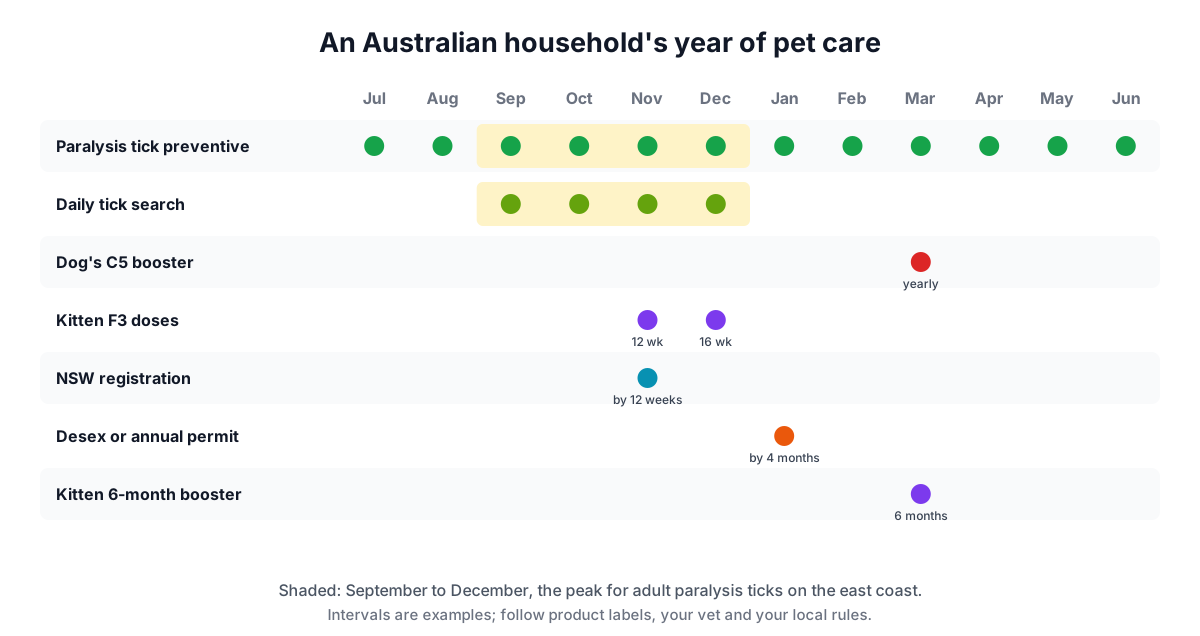
NSW Health Pathology describes the paralysis tick as an east-coast species, often met in moister coastal forests. Larvae are most active in autumn, nymphs in winter and adults in spring, and from September to December you are most likely to meet the adult, its most dangerous stage, which can harm pets as well as people. For a dog on the east coast that makes November the month when an overdue preventive matters most. Ask your vet which product suits your dog or cat and whether to use it all year where you live, and enter the label's interval as the reminder.
NSW registration and permits
The NSW Office of Local Government says all pet cats and dogs in NSW must be registered on the NSW Pet Registry, either by 12 weeks of age or immediately on transfer, whichever comes first. The fee is paid once and covers the pet for its lifetime in NSW, whatever changes of owner follow. Until it is paid the pet is not registered, and you may be liable for fines including a fixed penalty notice of $330; a late payment fee also applies if registration is not paid when due.
On top of that, NSW owners pay an annual permit fee for cats not desexed by 4 months of age, for restricted dog breeds and for dogs declared dangerous, currently through the local council. For a kitten, the four-month mark is the date to desex or pay. Other states and territories run their own systems, so check with your council.
A worked reminder list
Today is 9 November 2026. A household has a dog and a kitten born on 1 September 2026, which had its first F3 dose at 8 weeks:
| Reminder | Due | What the page shows |
|---|---|---|
| Dog: paralysis tick preventive | 1 Nov 2026 | Overdue: 8 days overdue |
| Dog: daily tick search after walks | 9 Nov 2026 | Upcoming: Due today |
| Kitten: F3 second dose (12 weeks) | 24 Nov 2026 | Later: Due in 15 days |
| Kitten: register on the NSW Pet Registry (12 weeks) | 24 Nov 2026 | Later: Due in 15 days |
| Kitten: F3 third dose (16 weeks) | 22 Dec 2026 | Later: Due in 43 days |
| Kitten: desex or annual permit (4 months) | 1 Jan 2027 | Later: Due in 53 days |
| Kitten: 6-month booster | 1 Mar 2027 | Later: Due in 112 days |
The second F3 dose falls on 24 November, four weeks after the first and the same day the kitten turns 12 weeks and must be on the NSW Pet Registry, so both move into the seven-day upcoming window together on 17 November. The overdue tick preventive stays at the top until you tick it off. The page does not send alerts, so put the registration and permit dates in your phone calendar too.
A weight log in kilograms
Set an ideal weight with your vet from a body condition check, then log weights by date. The tracker reports the change between the last two entries and the gap from ideal: within 5% is ideal, 5 to 15% "slightly" off, beyond 15% "significantly".
A dog with an ideal of 14.5 kg goes from 14.2 kg to 13.4 kg in a month: −0.8 kg, a 5.6% fall, now 7.6% under ideal. Unplanned weight loss of that size is worth raising at the next visit, sooner if the dog is off its food. Weigh at the same time of day, before a meal, on the same scale.
A budget in Australian dollars
The Pet Expense Calculator converts each cost through a yearly figure (daily × 365, monthly × 12, quarterly × 4) and divides by 12, and adds one-time costs once. An example budget for a one-year-old dog on the east coast, with figures to replace from your own receipts:
| Item | Amount | Frequency | Per year | Per month |
|---|---|---|---|---|
| Food | A$85 | Monthly | A$1,020 | A$85.00 |
| Pet insurance | A$48 | Monthly | A$576 | A$48.00 |
| Paralysis tick and flea preventive | A$30 | Monthly | A$360 | A$30.00 |
| C5 booster and health check | A$160 | Yearly | A$160 | A$13.33 |
| Grooming | A$70 | Quarterly | A$280 | A$23.33 |
| Bed, lead and crate | A$180 | One-time | (once) | (none) |
That is A$199.67 a month and A$2,396 a year, plus A$180 once. With the default 13-year lifespan and 12 years to go, the projection is A$28,932 at today's prices. Add the NSW lifetime registration fee as a one-time line for a new pet, and an annual permit line for an undesexed cat. Keep insurance or a savings line for emergencies; a tick paralysis case is exactly the kind of bill a monthly budget does not show.
Naming the newcomer
The Pet Name Generator offers ten names at a time by style. One or two syllables, a clear first sound, and nothing that rhymes with a cue ("Kit" and "sit") make a name easier to train with.
Tools for this job
- Australian pet care reminder: vaccine, tick, registration and permit dates in one list.
- Pet Weight Tracker: a dated weight log against the ideal.
- Pet Expense Calculator: monthly, yearly and lifetime costs.
- Pet Name Generator: shortlists for a new pet.
- Related reading: how much to feed a dog or cat and dog and cat ages in human years.
Frequently asked questions
When does a kitten need to be registered in NSW?
By 12 weeks of age or immediately on transfer to a new owner, whichever comes first, on the NSW Pet Registry. The registration fee is paid once and covers the cat for life in NSW.
Do I need a permit for a cat that is not desexed?
In NSW, yes: owners pay an annual permit fee for cats not desexed by 4 months of age, currently through the local council. Desexing before that date avoids the permit.
What is the F3 vaccine schedule for kittens?
The RSPCA describes a first F3 dose at 6 to 8 weeks, repeated every 3 to 4 weeks until 16 to 20 weeks, a booster at 6 months, then core vaccination every 1 to 3 years depending on the vaccine and the cat.
When is paralysis tick season?
Each life stage has its own season, but NSW Health Pathology says adults, the most dangerous stage, are most likely from September to December. Ask your vet whether to use prevention year-round where you live.
Does my dog need a rabies vaccine in Australia?
No, not if it stays in Australia, which the RSPCA describes as rabies-free. Dogs travelling overseas need advice from a vet.
Sources and further reading
- What vaccinations should my dog receive?, RSPCA Australia knowledgebase. C3 and C5, the puppy course, boosters, leptospirosis and rabies.
- What vaccinations should my cat receive?, RSPCA Australia knowledgebase. F3, the kitten course, boosters and non-core vaccines.
- Ticked off: the tiny terror of the bush, NSW Health Pathology. Paralysis tick habitat, life stages and the September to December peak.
- Registration and permit fees, NSW Office of Local Government. Registration by 12 weeks, the once-only fee, the $330 fixed penalty and annual permits.
- Register a pet, NSW Office of Local Government. Registering on the NSW Pet Registry and the late payment fee.
More Pet Care
Every tool in the Pet Care section, free and in your browser.