
Dog and Cat Care Records in the UK: Boosters, Chips, Costs
Keep a UK pet's records in one place: yearly lepto and three-yearly core boosters, microchip law, pet travel dates, a weight log in kg and a budget in pounds.
By Redbison Dev · · 7 min read

United Kingdom edition. Written for UK pet owners: the split booster card UK vets use (leptospirosis yearly, distemper, parvovirus and hepatitis every three years), the microchipping law for dogs and for cats in England, rabies and tapeworm dates for travel, and a budget in pounds. US edition
The booster card from a UK vet often shows two different dates for the same dog: one for leptospirosis next year and one for distemper, parvovirus and hepatitis three years away. Add a flea and worm product with its own interval, a microchip database that has to follow you when you move house, and the rabies and tapeworm dates for a summer in France, and it is easy to lose track. This edition sets up a simple record system for a UK dog or cat with the UK pet care reminder, the Pet Weight Tracker and the Pet Expense Calculator. None of it replaces your vet; it gets the right dates and numbers to the appointment.
The UK care calendar
Most UK pet care runs on a handful of repeating dates. These are the ones PDSA and GOV.UK set out:
| Task | Interval | What sets it |
|---|---|---|
| Leptospirosis booster (dogs) | Every year | PDSA: usually yearly after the primary course |
| Distemper, parvovirus, infectious hepatitis (dogs) | Every three years | PDSA: usually every three years after the primary course |
| Kennel cough (dogs) | Each year the dog is at risk | Boarding, day care, mixing with many dogs |
| Cat flu and feline parvovirus (cats) | First booster after a year, then every one to three years | PDSA; feline leukaemia too for cats that go outside |
| Flea and worm treatment | As the product label says | Your vet's product choice |
| Microchip database details | Whenever you move or change number | Owner's legal duty |
| Rabies vaccination | Only for travel, every one to three years by vaccine | GOV.UK pet travel rules |
A puppy should start its vaccines at around 6 to 8 weeks, with two injections 2 to 4 weeks apart (some need a third), and is fully protected 2 to 4 weeks after the last one. A kitten with no vaccines usually has two injections 3 to 4 weeks apart, around 9 and 12 weeks old. In both cases protection from the first course lasts a year, so the first booster is due 12 months later, and it is the date people most often miss.
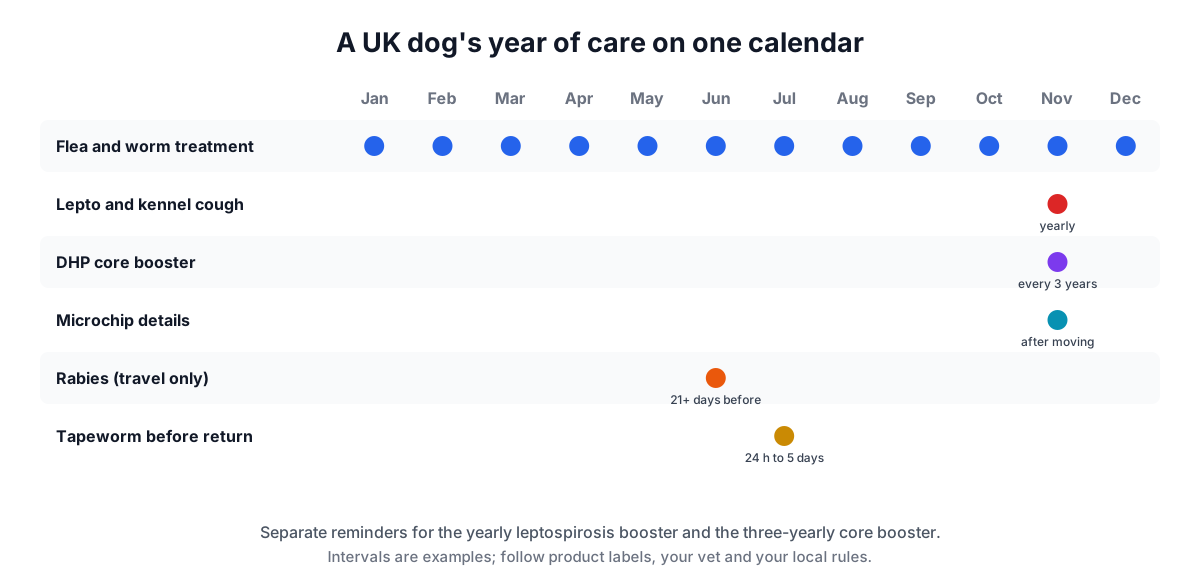
Enter the leptospirosis and the core booster as separate reminders. Entered as one "annual booster", the yearly visit is easily mistaken for a full set, and the three-yearly part slips.
The microchip law
GOV.UK says all dogs in the UK must be microchipped and registered by the time they are 8 weeks old, and that in England cats must be microchipped and registered by 20 weeks old. In Scotland, Wales and Northern Ireland chipping a cat is optional. The fine for a dog or cat that is not chipped when it should be is up to £500. You are responsible for keeping the details on the database up to date, for example after moving house, and the database may charge a fee to change them. A puppy should already be chipped when you collect it at 8 weeks or older, so ask the breeder which database it is on.
A worked reminder list
Today is 9 November 2026. A two-year-old dog's list holds:
| Reminder | Due | What the page shows |
|---|---|---|
| Flea and worm treatment | 5 Nov 2026 | Overdue: 4 days overdue |
| Microchip details: new address after moving | 9 Nov 2026 | Upcoming: Due today |
| Leptospirosis booster | 16 Nov 2026 | Upcoming: Due in 7 days |
| Kennel cough booster | 16 Nov 2026 | Upcoming: Due in 7 days |
| Rabies vaccination for a summer trip | 1 Jun 2027 | Later: Due in 204 days |
| Tapeworm treatment before returning | 31 Jul 2027 | Later: Due in 264 days |
| Distemper, parvovirus and hepatitis booster | 16 Nov 2028 | Later: Due in 738 days |
The upcoming window is seven days, so the two boosters on 16 November sit right at its edge today and already show under Upcoming.
Travel dates that matter
For a trip abroad, GOV.UK requires proof that the pet is at least 12 weeks old, a microchip fitted before or at the same time as the rabies vaccine (otherwise it must be vaccinated again), and a wait of at least 21 full days after the first vaccination before travelling. Coming back, a dog must be treated for tapeworm no less than 24 hours and no more than 5 days before you arrive in Great Britain. For a return on 2 August, a vet visit on 31 July falls inside that window. Put the tapeworm date in as a reminder the day you book the trip, because it has to be done abroad.
The reminder does not send notifications and a monthly task does not roll itself forward: when you tick off this month's flea treatment, add next month's date.
A weight log in kilograms
Weight is the cheapest early warning you have. The tracker works in kg (or lb) and reports the change between the last two entries and the gap from the ideal weight your vet gives you: within 5% is ideal, 5 to 15% off is "slightly" over or under, beyond 15% "significantly".
- A Labrador with an ideal of 30 kg goes from 31.5 kg to 33.2 kg in a month: +1.7 kg, a 5.4% rise, and 10.7% over ideal. That is worth mentioning at the booster visit.
- A cat with an ideal of 4.2 kg goes from 4.6 kg to 4.4 kg: −0.2 kg, a 4.3% fall, and now 4.8% over ideal, inside the "ideal" band. On a diet that is the right direction; without one, unexplained weight loss in an older cat is a reason to see the vet.
Weigh on the same scale, at the same time of day, before a meal. A kitchen scale with a box suits a cat better than weighing yourself with and without it.
A budget in pounds
The Pet Expense Calculator converts each cost to a yearly figure first (daily × 365, weekly × 52, monthly × 12, quarterly × 4) and divides by 12 for the month, so the totals agree. One-time costs are added once. An example budget for a two-year-old dog, with figures you should replace with your own receipts:
| Item | Amount | Frequency | Per year | Per month |
|---|---|---|---|---|
| Food | £42 | Monthly | £504 | £42.00 |
| Treats | £1.20 | Daily | £438 | £36.50 |
| Pet insurance | £31 | Monthly | £372 | £31.00 |
| Flea and worm treatment | £14 | Monthly | £168 | £14.00 |
| Booster and health check | £95 | Yearly | £95 | £7.92 |
| Grooming | £45 | Quarterly | £180 | £15.00 |
| Crate and bed | £120 | One-time | (once) | (none) |
The calculator shows £146.42 a month and £1,757 a year, with £120 of one-time costs, so £1,877 in the first year. With the default 13-year dog lifespan it projects 11 more years: £1,757 × 11 + £120 = £19,447, at today's prices. Two lessons: the daily treats cost almost as much as the food, and there is no line for an emergency. Insurance, or a savings pot for the vet, belongs in every pet budget; the UK emergency fund calculator helps size a household buffer that covers it.
Choosing a name
If you are still naming a new puppy or kitten, the Pet Name Generator gives ten names at a time by style. Keep it to one or two syllables, avoid names that sound like a cue ("Kit" and "sit", "Bo" and "no"), and say it next to the names of everyone in the house before you decide.
Tools for this job
- UK pet care reminder: boosters, flea and worm dates, the microchip check and travel dates in one list.
- Pet Weight Tracker: a dated weight log with the gap from ideal.
- Pet Expense Calculator: monthly, yearly and lifetime costs.
- Pet Name Generator: shortlists for a new pet.
- Related reading: how much to feed a dog or cat and dog and cat ages in human years.
Frequently asked questions
How often does my dog need a booster in the UK?
PDSA says leptospirosis is usually boosted every year and distemper, parvovirus and infectious hepatitis every three years after the puppy course. Kennel cough is yearly if your dog is at risk. Use the dates on your vet's card, entered as separate reminders.
Does my cat have to be microchipped?
In England, yes: cats must be microchipped and registered by 20 weeks old, and the fine is up to £500. In Scotland, Wales and Northern Ireland it is optional. All dogs in the UK must be chipped by 8 weeks.
When should my dog have tapeworm treatment before coming back to the UK?
No less than 24 hours and no more than 5 days before you arrive in Great Britain, by a vet abroad. For a return on 2 August, a treatment on 31 July fits.
How much does a dog cost per month in the UK?
It depends on your own costs, so add them up: in the example budget above, food, treats, insurance, flea and worm treatment, a yearly booster and grooming come to £146.42 a month. Add a line for emergencies or keep insurance.
Does my dog need a rabies vaccine if we never travel?
No. PDSA lists rabies as necessary only for dogs that travel in and out of the UK. For travel, the vaccine must come after or with the microchip, and you wait at least 21 full days before leaving.
Sources and further reading
- Dog vaccines, PDSA. Core vaccines, booster intervals, the puppy course, kennel cough and rabies.
- Cat vaccines, PDSA. Core cat vaccines, the kitten course and boosters.
- Get your dog or cat microchipped, GOV.UK. Ages, the £500 fine and keeping details up to date.
- Taking your pet dog, cat or ferret abroad, GOV.UK. Minimum age, microchip first and the 21-day wait.
- Bringing your pet dog, cat or ferret to Great Britain, GOV.UK. The 24-hour to 5-day window.
More Pet Care
Every tool in the Pet Care section, free and in your browser.