
Privacy Act and APPs: Software Compliance in Australia
Which Australian rules your product triggers: the Privacy Act and its A$3 million line, the 13 APPs as engineering tasks, Notifiable Data Breaches and penalties.
By Redbison Dev · · 6 min read
Australia edition. Written for Australian product teams: who the Privacy Act 1988 covers below A$3 million turnover, the 13 Australian Privacy Principles mapped to engineering work, the Notifiable Data Breaches scheme and section 13G penalties, plus WCAG and PCI DSS. US edition
A Brisbane start-up with A$800,000 of revenue builds an appointment app for physiotherapists. The founders assume the Privacy Act does not apply because they are under the A$3 million small business line. That assumption needs checking: health service providers are covered whatever their turnover, and an app that stores clinical notes for physiotherapists has to work out whether it is one, or is handling health information on their behalf. Compliance in Australian software usually turns on a few questions like that one: are you covered, which of the 13 Australian Privacy Principles turn into tickets, and what happens when a breach is likely to cause serious harm. This edition answers them from the Office of the Australian Information Commissioner's pages and scopes a worked example with the Software Compliance Checklist (Australia). It is a map for engineers, not legal advice; a privacy lawyer should confirm anything that affects launch.
Start from what your product does
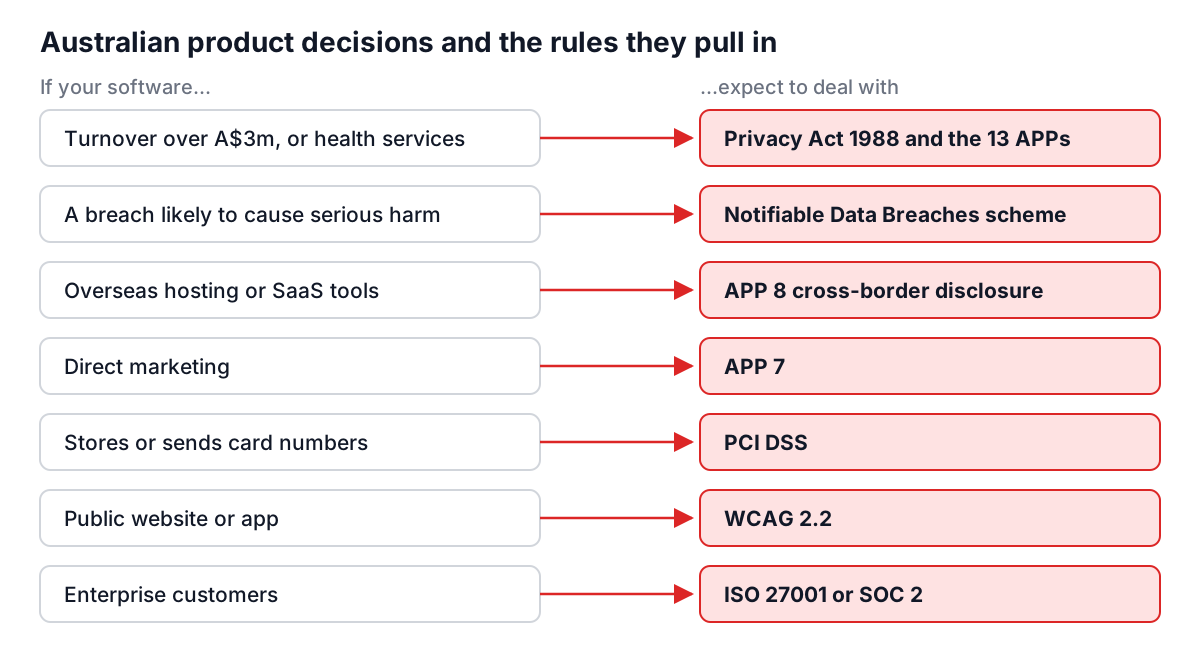
| Product decision | Australian rule it pulls in | Who enforces it |
|---|---|---|
| Annual turnover over A$3 million, or a business in a covered category | Privacy Act 1988 and the 13 APPs | OAIC |
| A data breach likely to result in serious harm | Notifiable Data Breaches (NDB) scheme | OAIC |
| Sending personal information to an overseas host or tool | APP 8, cross-border disclosure | OAIC |
| Direct marketing using personal information | APP 7 | OAIC |
| Card payments | PCI DSS | Card schemes and your acquirer, by contract |
| Public website or app | WCAG 2.2 | Customer contracts |
| Enterprise customers | ISO 27001, SOC 2 | Customers, not law |
Are you covered? The A$3 million line and its exceptions
The Privacy Act regulates Australian Government agencies, organisations with an annual turnover of more than A$3 million, and some other organisations (OAIC, the Privacy Act). The "some other" list is where start-ups get caught. Regardless of turnover, the Act covers any business that is (OAIC, small business):
- a health service provider;
- a business that trades in personal information;
- a contractor providing services under a Commonwealth contract;
- an operator of a residential tenancy database, or a credit reporting body;
- a reporting entity under the Anti-Money Laundering and Counter-Terrorism Financing Act 2006;
- a business accredited under the Consumer Data Right system;
- a business related to a covered business, prescribed by regulation, or one that has opted in;
- a registered or recognised employee association, or a business that conducts protection action ballots.
For product teams, three entries matter most. Health service providers are covered from day one, so health apps should check this first. Fintech products in the Consumer Data Right or AML/CTF regimes are covered. And a start-up selling to a Commonwealth agency is covered for that contract. Being related to a covered business counts too, so a small subsidiary of a large group does not escape.
The 13 APPs as engineering work
The Act's 13 Australian Privacy Principles apply to every organisation and agency it covers (OAIC, APPs quick reference). Most map to something you build:
| APP | Name | What engineers build |
|---|---|---|
| 1 | Open and transparent management of personal information | A privacy policy that matches what the code actually collects |
| 2 | Anonymity and pseudonymity | Let people use the service without identifying themselves where practical |
| 3 and 4 | Collection of solicited and unsolicited personal information | Collect only what each feature needs; handle data you did not ask for |
| 5 | Notification of collection | Collection notices at the point a form asks for data |
| 6 | Use or disclosure | Purpose tags on data, so it is not reused for unrelated features |
| 7 | Direct marketing | Opt-outs that work across every channel |
| 8 | Cross-border disclosure | A list of overseas hosts, support desks and analytics tools |
| 9 | Government related identifiers | Do not adopt a government identifier, such as a Medicare number, as your own customer ID |
| 10 | Quality | Ways for users to keep details up to date |
| 11 | Security | Access control, encryption, logging, and deletion or de-identification when data is no longer needed |
| 12 and 13 | Access and correction | Self-service export and edit, plus a request process |
APP 1 changes on 10 December 2026. From that day, if a computer program makes, or does something substantially and directly related to making, a decision that could reasonably be expected to significantly affect someone's rights or interests, and personal information about them is used to do it, the privacy policy must say what kinds of personal information the programs use and what kinds of decisions they make or support (Privacy and Other Legislation Amendment Act 2024, Schedule 1, Part 15). For a software team that means listing the kinds of automated approvals, refusals and access decisions in the privacy policy, not only the data collected.
APP 8 is the one that changes architecture. Before personal information goes to a cloud region or SaaS tool overseas, you need to know where it goes and what the recipient will do with it, which means the vendor list belongs in the compliance work, not only in procurement.
Notifiable Data Breaches
Under the NDB scheme, an organisation or agency must notify affected individuals and the OAIC when a data breach is likely to result in serious harm to someone whose personal information is involved. The notice to individuals must include recommendations about the steps they should take, and the OAIC is notified through its online form (OAIC, about the NDB scheme). An entity that suspects an eligible breach must quickly assess whether serious harm is likely (OAIC, when to report), and must take all reasonable steps to complete that assessment within 30 calendar days after the day it becomes aware of the grounds for suspicion (OAIC, quick reference guide for responding to data breaches).
In the incident runbook, that becomes three steps: contain, assess serious harm with the reasoning written down, then notify with the protective steps people should take (reset passwords, watch for phishing, contact their bank). Recommendations depend on what leaked, so prepare templates per data type: a leaked email list needs different advice from leaked clinical notes.
Penalties
For a serious interference with privacy by a body corporate, section 13G of the Privacy Act sets the maximum civil penalty at the greatest of (OAIC, guide to privacy regulatory action, chapter 7):
- A$50 million;
- three times the benefit obtained that is reasonably attributable to the conduct; or
- if the court cannot determine the benefit, 30% of adjusted turnover over the relevant period.
For a company with A$400 million of turnover in that period and no benefit the court can measure, 30% is A$120 million, so the turnover limb sets the cap; for one with A$100 million, 30% is A$30 million and the A$50 million floor applies instead. These are maximums the court can order, not standard fines.
Worked example: a physio booking app
The Brisbane start-up's app books appointments, stores session notes for the physiotherapists, takes card payments and uses an overseas customer-support tool.
- Open the Software Compliance Checklist (Australia). It starts on Geography: Australia and shows two cards: WCAG (eight requirements, from perceivable content to screen reader compatibility) and the Privacy Act 1988 with the APPs (seven requirements, from the APP 1 privacy policy to the NDB scheme). Add both.
- Confirm coverage. The business is under A$3 million, but as a provider of health services through the app, and handling health information for providers, it should plan on being covered.
- Turn APP 8 into a vendor list. The support tool is overseas, so record what personal information it receives and where it is stored.
- Switch Geography to Global and Domain to Payments. PCI DSS appears. Hosted payment fields keep card numbers off the app's servers and the assessment small.
- Write the NDB runbook, with notification templates for leaked contact details and for leaked session notes.
- Download the checklist as Markdown and turn each
- [ ]line into a ticket.
The shared controls then serve several duties at once: a data inventory with purposes (APPs 1, 3, 5 and 6), access control and logs (APP 11), deletion jobs (APP 11), export and edit screens (APPs 12 and 13), and an accessible design system for WCAG.
Mistakes Australian teams make
- Stopping at the A$3 million test. Health, data-trading, Commonwealth contract and Consumer Data Right businesses are covered whatever their turnover.
- Ignoring APP 8 until a customer asks. Overseas hosting and SaaS support tools are cross-border disclosures.
- Using government identifiers as keys. APP 9 deals with adopting, using or disclosing government related identifiers, so do not make one your own customer ID.
- Notifying without advice. NDB notices must tell people what steps to take, so write those for each data type in advance.
- Keeping data forever. APP 11 covers destroying or de-identifying information you no longer need, not only protecting it.
Tools for this job
- Software Compliance Checklist (Australia): the Privacy Act, APPs, WCAG and global standards, filterable, downloadable as Markdown.
- Security Checklist: the controls behind APP 11.
- Contrast Checker: WCAG colour contrast ratios.
- Risk Matrix: rank breach scenarios and gaps before planning the work.
The US edition of this guide covers HIPAA, CCPA and COPPA for teams selling into the US.
Frequently asked questions
Does the Privacy Act apply to my small business?
Usually not if annual turnover is A$3 million or less, but the OAIC lists businesses covered regardless of turnover, including health service providers, businesses that trade in personal information, Commonwealth contractors, credit reporting bodies, AML/CTF reporting entities and Consumer Data Right accredited businesses.
What are the 13 Australian Privacy Principles?
APP 1 open and transparent management, 2 anonymity and pseudonymity, 3 and 4 collection of solicited and unsolicited information, 5 notification of collection, 6 use or disclosure, 7 direct marketing, 8 cross-border disclosure, 9 government related identifiers, 10 quality, 11 security, 12 access and 13 correction.
When must a data breach be reported in Australia?
When it is likely to result in serious harm to someone whose personal information is involved. Assess a suspected breach quickly, taking all reasonable steps to finish within 30 calendar days of becoming aware of the grounds for suspicion, then notify the affected people, with recommended steps they should take, and the OAIC through its online form.
What is the maximum penalty under the Privacy Act?
For a serious interference with privacy by a body corporate, the greatest of A$50 million, three times the benefit obtained, or 30% of adjusted turnover over the relevant period when the benefit cannot be determined.
Does hosting data overseas breach the Privacy Act?
Not by itself, but sending personal information to an overseas recipient is a cross-border disclosure under APP 8, which carries its own duties. Know which vendors receive the data and where they store it.
Sources and further reading
- The Privacy Act, Office of the Australian Information Commissioner. Who the Act covers and the 13 APPs.
- Small business, OAIC. Businesses covered regardless of turnover.
- Australian Privacy Principles quick reference, OAIC.
- About the Notifiable Data Breaches scheme, OAIC.
- When to report a data breach, OAIC.
- Quick reference guide for responding to data breaches, OAIC. The 30-calendar-day assessment period for a suspected eligible breach.
- Privacy and Other Legislation Amendment Act 2024, Federal Register of Legislation. Schedule 1, Part 15: privacy policies must cover automated decisions from 10 December 2026.
- Guide to privacy regulatory action, chapter 7, OAIC. Civil penalties under section 13G.
- Web Content Accessibility Guidelines (WCAG) 2.2, W3C.
Open the Software Compliance Checklist
More Business Analysis
Every tool in the Business Analysis section, free and in your browser.