
DPDP Act and CERT-In: Software Compliance Map for India
Which Indian rules your product triggers: the DPDP Act and Rules with their phased dates and crore penalties, children's data, and CERT-In's 6-hour reporting.
By Redbison Dev · · 6 min read
India edition. Written for Indian product and engineering teams: the Digital Personal Data Protection Act 2023 and Rules 2025 with the eighteen-month phase-in, parental consent for users under 18, penalties in crore, and the CERT-In Directions on 6-hour incident reporting, 180-day logs and NTP time. US edition
An Indian edtech start-up adds a sign-up form for Class 10 students, stores the data on a cloud server in Mumbai and sends progress reports to parents. Three Indian rules now apply before a single line of policy is written: the Digital Personal Data Protection Act 2023 for the students' data, its stricter rules for anyone under 18, and the CERT-In Directions for the servers that hold it. This edition maps Indian product decisions to the rules they trigger, gives the dates and penalties from the official texts, and scopes a worked example with the Software Compliance Checklist (India). It is a map for engineers, not legal advice; a lawyer who works on data protection should confirm anything that affects launch.
Start from what your product does
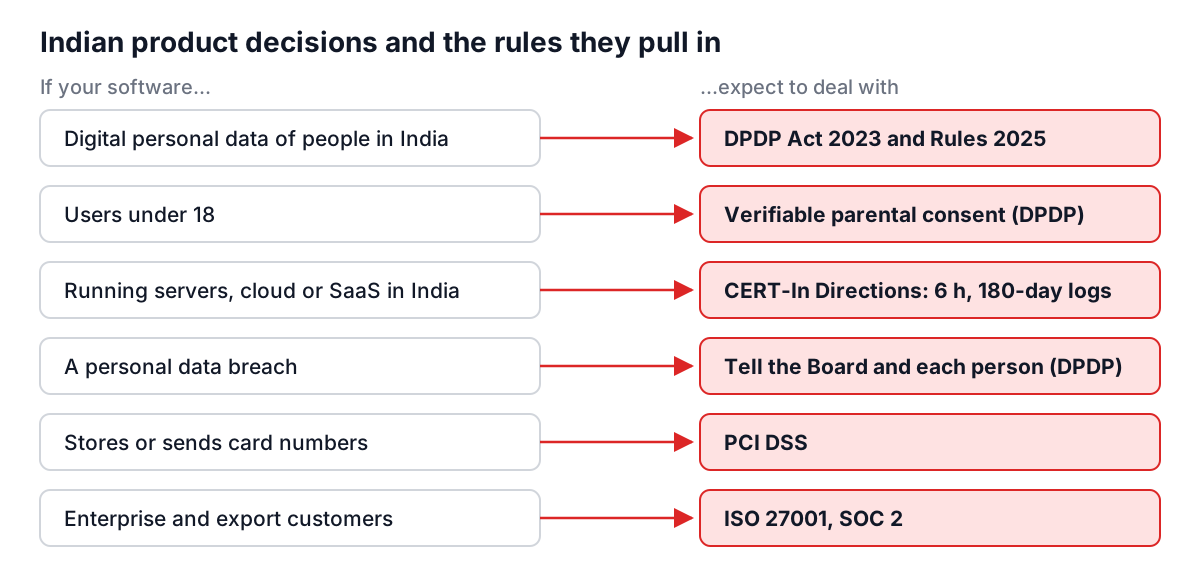
| Product decision | Indian rule it pulls in | Who enforces it |
|---|---|---|
| Collecting digital personal data of people in India | DPDP Act 2023 and DPDP Rules 2025 | Data Protection Board of India |
| Users under 18 | DPDP Act section 9: verifiable parental consent, no tracking or targeted advertising directed at children | Data Protection Board |
| Running servers, cloud, data centres or SaaS in India | CERT-In Directions under section 70B(6) of the IT Act | CERT-In |
| Selling from abroad to people in India | DPDP Act, through section 3 | Data Protection Board |
| Card payments | PCI DSS | Card networks and your acquirer, by contract |
| Enterprise or export customers | ISO 27001, SOC 2 | Customers, not law |
The DPDP Act and Rules: what applies when
The DPDP Act was passed in 2023, and the DPDP Rules were notified on 14 November 2025. The government's backgrounder says the Rules introduce "an eighteen-month period for phased compliance", which runs to May 2027 (PIB, DPDP Rules backgrounder). That is the window to build the product changes, not to start reading the law.
The duties that turn into engineering work:
- Notice and consent. Every Data Fiduciary must give a separate, clear consent notice that explains the specific purpose of collection, and people can withdraw consent at any time. Consent Managers, the platforms that let people manage consent, must be companies based in India.
- Rights requests. People can ask to access, correct, update or erase their data and nominate someone to act for them. The Rules give Data Fiduciaries a maximum of ninety days to respond.
- Breaches. Affected individuals must be told without delay, in plain language, with what happened, the likely impact, the steps taken and a contact for help; the Board must be notified too.
- Contact point. Every Data Fiduciary must display contact details for privacy queries, a designated officer or a Data Protection Officer.
- Significant Data Fiduciaries. Those the government notifies face independent audits and impact assessments.
Reach outside India. Section 3 applies the Act to processing outside India where it is connected with offering goods or services to people in India (DPDP Act, 2023). A Singapore or US company selling to Indian users is in scope.
Children: under 18, not under 13
The DPDP Act defines a child as an individual who has not completed eighteen years (section 2(f)). Section 9 then requires verifiable consent of a parent or lawful guardian before processing a child's personal data, forbids processing likely to have a detrimental effect on a child's well-being, and bans "tracking or behavioural monitoring of children or targeted advertising directed at children". Exemptions can be prescribed for classes of Data Fiduciaries or purposes; the backgrounder mentions healthcare, education and real-time safety.
For a product team this is the biggest difference from the US, where COPPA draws the line at 13. An Indian app used by 16-year-olds needs an age gate, a parental consent flow and analytics that do not profile those users. These are product decisions to make before launch, because retrofitting consent into an existing user base is much harder.
Penalties in crore
The Schedule to the DPDP Act sets maximum penalties per breach:
| Breach | Penalty may extend to |
|---|---|
| Failing to take reasonable security safeguards to prevent a personal data breach | ₹250 crore |
| Failing to notify the Board or affected Data Principals of a breach | ₹200 crore |
| Breaching the additional obligations for children (section 9) | ₹200 crore |
| Breaching the additional obligations of a Significant Data Fiduciary (section 10) | ₹150 crore |
| Breach of any other provision of the Act or Rules | ₹50 crore |
| A Data Principal breaching their own duties (section 15) | ₹10,000 |
Note what the top line punishes: not the breach itself but failing to take reasonable security safeguards. Encryption, access control and logging are therefore both good engineering and the evidence that you took reasonable safeguards.
The CERT-In Directions: 6 hours, 180 days, NTP
The CERT-In Directions of 28 April 2022, issued under section 70B(6) of the IT Act, apply to service providers, intermediaries, data centres, body corporates and government organisations (CERT-In Directions). They are already in force, unlike much of the DPDP framework. The text sets four duties most software teams meet:
- Report listed incidents within 6 hours of noticing them or being told about them, by email, phone or fax to CERT-In.
- Keep logs of all ICT systems for a rolling 180 days, securely and within Indian jurisdiction, and provide them with an incident report or when CERT-In asks.
- Synchronise clocks to the NTP servers of the National Informatics Centre or the National Physical Laboratory, or to sources traceable to them.
- Name a Point of Contact to deal with CERT-In.
Data centres, VPS, cloud and VPN providers also keep specified subscriber records for 5 years or longer.
The 6-hour CERT-In clock and the DPDP breach notice are separate duties with separate recipients. One incident can trigger both, so a single runbook should start both clocks at the moment the team notices the incident.
Worked example: scoping an edtech app
A Bengaluru start-up builds a learning app for Classes 9 to 12, hosted on a cloud provider in India, with UPI and card payments for subscriptions and plans to sell to schools in the Gulf.
- Open the Software Compliance Checklist (India). It starts on Geography: India and shows two cards: the DPDP Act and Rules (eight requirements, from the consent notice to Significant Data Fiduciary duties) and the CERT-In Directions (five requirements: 6-hour reporting, 180-day logs in India, NTP, a Point of Contact, and the 5-year records for infrastructure providers). Add both.
- Mark the children's duties as launch blockers. Every user is under 18, so the sign-up flow needs verifiable parental consent, and the analytics and marketing stack must not track, behaviourally monitor or target ads at those students unless an exemption applies.
- Switch Geography to Global and Domain to Payments. PCI DSS appears. Using the payment gateway's hosted checkout keeps card numbers off the start-up's servers and the assessment small.
- Add ISO 27001 from Global if school groups abroad will send security questionnaires.
- Download the checklist as Markdown and file each
- [ ]line as a ticket.
The shared controls then cover several duties at once: a data inventory with a purpose for each field (DPDP notices), access control with logs kept 180 days in India (DPDP safeguards and CERT-In), NTP time on every server, a breach runbook with the 6-hour CERT-In step and the DPDP notices, and a rights-request process that answers within ninety days.
Mistakes Indian teams make
- Treating DPDP as a 2027 problem. The phase-in ends in May 2027, but the CERT-In duties apply now, and consent flows can take months to redesign.
- Using COPPA's age of 13. Under the DPDP Act a child is anyone under 18.
- Keeping logs abroad only. The CERT-In Directions want 180 days of logs within Indian jurisdiction.
- Leaving server clocks on default pools. Time sources must be NIC, NPL or traceable to them, which also makes incident timelines line up.
- Assuming a foreign entity is outside the Act. Section 3 reaches processing outside India linked to offering goods or services in India.
Tools for this job
- Software Compliance Checklist (India): DPDP Act, CERT-In and global standards, filterable, downloadable as Markdown.
- Security Checklist: application security items behind "reasonable security safeguards".
- Contrast Checker: WCAG colour contrast for accessible screens.
- Risk Matrix: rank the gaps by likelihood and impact before planning the work.
The US edition of this guide covers GDPR, HIPAA and COPPA for teams selling abroad.
Frequently asked questions
When does the DPDP Act apply to my company?
The Rules were notified on 14 November 2025 with an eighteen-month period for phased compliance, which runs to May 2027. Plan the consent, notice, rights and breach processes before then; the CERT-In Directions already apply.
What is the maximum penalty under the DPDP Act?
Up to ₹250 crore for failing to take reasonable security safeguards to prevent a personal data breach. Failing to notify a breach and breaching the children's duties can each cost up to ₹200 crore, Significant Data Fiduciary breaches up to ₹150 crore, and other breaches up to ₹50 crore.
How fast must a cyber incident be reported to CERT-In?
Within 6 hours of noticing it or being told about it, for the incident types listed in Annexure I of the Directions. This is separate from telling the Data Protection Board and affected people under the DPDP framework.
Who counts as a child under the DPDP Act?
Anyone who has not completed eighteen years. Processing their data needs verifiable consent from a parent or lawful guardian, and tracking, behavioural monitoring and targeted advertising directed at children are not allowed unless an exemption applies.
How long must logs be kept in India?
The CERT-In Directions require logs of all ICT systems for a rolling 180 days, kept securely within Indian jurisdiction. Data centres, VPS, cloud and VPN providers keep certain subscriber records for 5 years or longer.
Sources and further reading
- The Digital Personal Data Protection Act, 2023, Ministry of Electronics and Information Technology. Sections 2(f), 3 and 9, and the Schedule of penalties.
- DPDP Rules, 2025 notified: backgrounder, Press Information Bureau, 17 November 2025. Notification on 14 November 2025, the eighteen-month phase-in, ninety-day responses.
- Directions under section 70B(6) of the IT Act, 2000, CERT-In. The Directions of 28 April 2022 and FAQs.
- Document library: PCI DSS, PCI Security Standards Council.
- Web Content Accessibility Guidelines (WCAG) 2.2, W3C.
Open the Software Compliance Checklist
More Business Analysis
Every tool in the Business Analysis section, free and in your browser.