
UK Software Compliance: UK GDPR, PECR and More Mapped
Which UK rules your product triggers: UK GDPR and the DPA 2018, PECR cookie consent and its new exemptions, the Children's code, the Online Safety Act and WCAG 2.2.
By Redbison Dev · · 6 min read
United Kingdom edition. Written for UK product teams: UK GDPR read with the Data Protection Act 2018, PECR cookie rules as amended by the Data (Use and Access) Act 2025, the age-appropriate design code, the Online Safety Act, public sector accessibility rules and Cyber Essentials, with fines in pounds. US edition
A UK team adds an analytics script to its marketing site, a chat feature to its app and a sign-up path for 15-year-olds. Each of those is a product decision, and each pulls in a different UK rule: PECR for the analytics cookie, the Online Safety Act for the chat, and the age-appropriate design code for the teenagers, all on top of the UK GDPR that covers the personal data underneath. This edition maps UK product decisions to the rules they trigger, shows what changed when most of the Data (Use and Access) Act 2025 took effect on 5 February 2026, and scopes a worked example with the Software Compliance Checklist (UK). It is a map for engineers, not legal advice; confirm anything that affects launch with a data protection specialist or solicitor.
Start from what your product does
| Product decision | UK rule it pulls in | Who enforces it |
|---|---|---|
| Any personal data of people in the UK | UK GDPR with the Data Protection Act 2018 | The ICO |
| Cookies, local storage, pixels or device fingerprinting | Privacy and Electronic Communications Regulations (PECR), regulation 6 | The ICO |
| Marketing emails and texts | PECR | The ICO |
| A service likely to be accessed by children | Age-appropriate design code (Data Protection Act 2018, section 123) | The ICO |
| Users can post content or message each other, or you run search | Online Safety Act 2023 | Ofcom |
| Selling a website or app to a council or other public body | Public sector accessibility regulations: WCAG 2.2 AA plus a published accessibility statement | Applies to the public body, which passes it to suppliers by contract |
| Card payments | PCI DSS | Card schemes and your acquirer, by contract |
| Supplier security questionnaires | Cyber Essentials, ISO 27001 | Customers, not law |
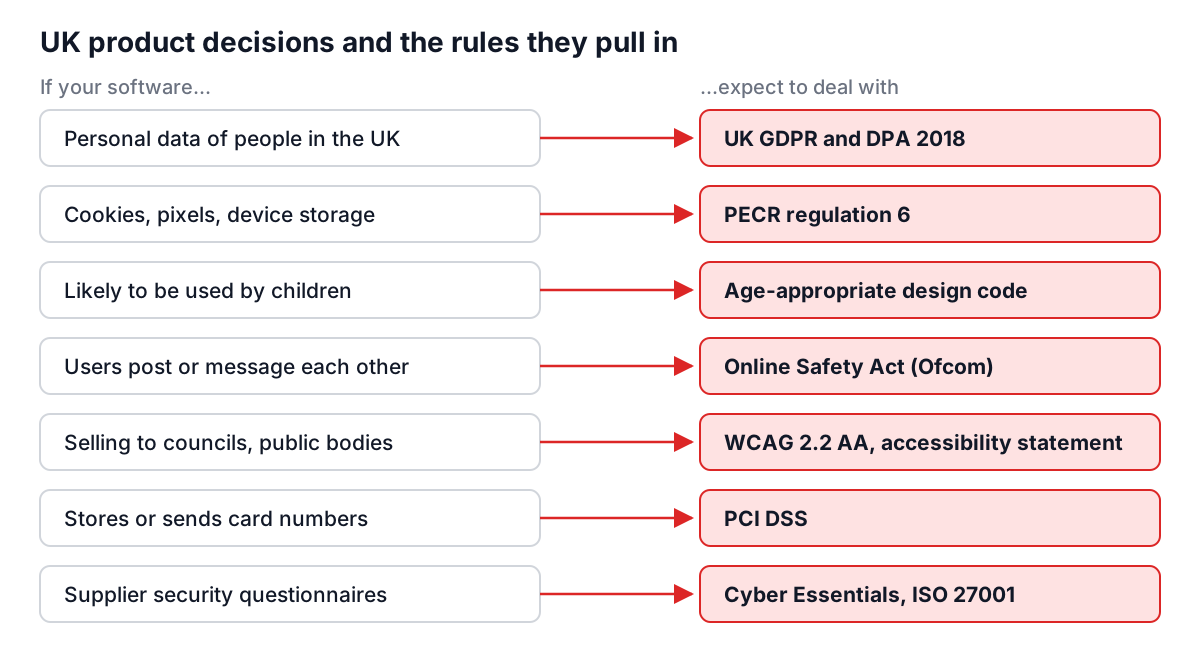
The first two rows apply to almost every UK product. The others switch on with a feature, a customer type or a user group, which is why scoping should be repeated whenever the product changes.
UK GDPR and the Data Protection Act 2018
The UK GDPR is the version of the GDPR kept in UK law and read with the Data Protection Act 2018. For engineers the parts that turn into work are the lawful basis for each purpose, privacy information, rights requests, security, processor contracts, international transfers and breach handling.
Breaches. Article 33 of the UK GDPR requires notifying the regulator without undue delay and, where feasible, within 72 hours of becoming aware of a personal data breach, unless the breach is unlikely to result in a risk to people. Every breach must be documented, including the ones you do not report, with the facts, effects and remedial action (UK GDPR, Article 33). Build the 72-hour clock and the breach register into the incident runbook, not into a policy document nobody opens.
Fines. Section 157 of the Data Protection Act 2018 sets two maximums for an undertaking (DPA 2018, section 157):
| Tier | Maximum |
|---|---|
| Higher maximum | £17,500,000 or 4% of total annual worldwide turnover in the preceding financial year, whichever is greater |
| Standard maximum | £8,700,000 or 2% of that turnover, whichever is greater |
The "whichever is greater" matters only for large firms. At £300 million of turnover, 4% is £12 million, so the higher maximum stays at £17.5 million; at £600 million, 4% is £24 million and becomes the cap. These are maximums, not tariffs.
PECR and cookies after 5 February 2026
PECR is the rule many UK teams meet first, through the cookie banner. Regulation 6 says you must not store information on, or gain access to information stored on, a user's device unless an exception in Schedule A1 applies. "Gaining access" includes collecting information the device emits automatically. That version of regulation 6 was substituted on 5 February 2026 by the Data (Use and Access) Act 2025 (PECR, regulation 6).
Schedule A1 now lists six routes (PECR, Schedule A1):
- Consent, after clear and comprehensive information about the purpose; consent can be given through browser settings or another application.
- Transmitting a communication over a network.
- Strictly necessary for a service the user asked for, such as security, fraud prevention, fault detection, authentication and remembering choices.
- Statistics, where the sole purpose is to collect statistics on how the service is used in order to improve it, the user gets clear information, the data is not shared except to make those improvements, and the user has a simple, free way to object and does not.
- Appearance and functionality, adapting the site to the user's preferences, with clear information and a simple, free way to object.
- Emergency assistance, locating a device that has asked for help.
The statistics route is the one product teams ask about. It does not cover advertising or cross-site tracking, and it does not cover information automatically emitted by the device, so fingerprinting still needs consent. A first-party analytics setup used only to improve the site, with a visible opt-out, can now fit; a third-party tag whose provider uses the data for its own purposes does not.
Fines went up on the same date. PECR's enforcement schedule, substituted on 5 February 2026, applies section 157 of the Data Protection Act 2018 so that breaches of the main rules, including regulation 6 on cookies and the marketing rules in regulations 19 to 23, carry the higher maximum: £17.5 million or 4% of total annual worldwide turnover, whichever is higher, the same as the UK GDPR (PECR, Schedule 1, paragraph 18).
The government's commencement plan says most of Part 5 of the Act, the data protection changes, commenced on 5 February 2026, but it treats the new duty on controllers to handle data protection complaints (section 103) separately. The plan, last updated on 12 October 2026, still says it is expected about 12 months after Royal Assent on 19 June 2025 and gives no commencement date, so check the plan before relying on it (GOV.UK, DUAA commencement).
Children, chat and public sector buyers
The age-appropriate design code. Section 123 of the Data Protection Act 2018 requires a code of practice on age-appropriate design for information society services likely to be accessed by children (DPA 2018, section 123). The test is "likely to be accessed", not "aimed at", so a general-audience game or social app can be in scope. Treat the code as a design spec: the settings and defaults it asks for are product decisions, not policy wording.
The Online Safety Act. The Act covers search services and services where users post content or interact with each other, including social media, video sharing, forums, dating and messaging, and it can reach overseas companies with UK links. Ofcom is the regulator, and fines can reach £18 million or 10% of qualifying worldwide revenue, whichever is greater (GOV.UK, Online Safety Act explainer). Adding comments or direct messages to a product can be enough to bring in the Act's risk assessments.
Public sector accessibility. Public sector bodies' websites and apps must meet WCAG 2.2 AA unless an exemption applies, and must publish an accessibility statement (GOV.UK, accessibility requirements). If you sell software to councils or other public sector bodies, expect the buyer to pass that requirement to you.
Cyber Essentials. The NCSC describes Cyber Essentials as the minimum standard of cyber security the government recommends for organisations of all sizes, with five controls: firewalls, secure configuration, security update management, user access control and malware protection; Cyber Essentials Plus adds independent technical testing (NCSC, Cyber Essentials). It is a certification customers ask for, not a legal duty.
Worked example: a booking app for youth sports clubs
A Manchester start-up builds a web app where sports clubs take bookings and payments, players aged 12 to 17 sign up, and parents and coaches message each other. It wants to sell to councils that run leisure centres.
- Open the Software Compliance Checklist (UK). It starts on Geography: United Kingdom and shows two cards: the UK GDPR with the Data Protection Act 2018 (nine requirements, from a recorded lawful basis to the ICO data protection fee) and PECR (four requirements: cookie consent with the new exemptions, marketing consent, Telephone Preference Service screening and sender identification). Add both.
- Switch Geography to Global and Domain to Payments. PCI DSS appears. Hosted payment fields from the payment provider keep card numbers off the start-up's servers, which keeps the PCI assessment small.
- Add what the filters do not list. The players are children, so the age-appropriate design code applies, and its standards become design requirements for settings, defaults and what data the app collects. The messaging feature brings the Online Safety Act's risk assessments. Council customers will ask for WCAG 2.2 AA and, often, Cyber Essentials.
- Download the checklist as Markdown and turn each
- [ ]line into a ticket.
The shared controls then cover several rules at once: a data inventory (UK GDPR records and the children's code), access control and logs (UK GDPR security and Cyber Essentials), a 72-hour breach runbook, a cookie set that uses consent for anything beyond strictly necessary and first-party statistics, and an accessible design system.
Mistakes UK teams make
- Treating the UK and EU GDPR as one text. They started identical, but UK changes from the Data (Use and Access) Act mean a UK-only checklist and an EU checklist now differ. Keep both cards if you serve both.
- Assuming the new statistics exemption covers every analytics tool. It needs a sole statistics purpose, clear information, a simple objection route and no onward sharing except to improve the service.
- Ignoring "likely to be accessed". A product not aimed at children can still fall under the children's code if children use it in practice.
- Shipping chat without thinking about Ofcom. User-to-user features bring the Online Safety Act with them.
- Quoting EU fine figures in pounds. The UK caps are £17.5 million and £8.7 million, set in section 157.
Tools for this job
- Software Compliance Checklist (UK): UK GDPR, PECR and global standards, filterable, downloadable as Markdown.
- Security Checklist: application security items that map to UK GDPR security and Cyber Essentials.
- Contrast Checker: WCAG colour contrast ratios for the accessibility statement.
- Risk Matrix: rank the gaps by likelihood and impact before you plan the work.
The US edition of this guide covers HIPAA, CCPA, COPPA and FedRAMP for teams selling into the US.
Frequently asked questions
Do I still need a cookie banner for analytics in the UK?
Not always. Since 5 February 2026, PECR allows storage or access whose sole purpose is collecting statistics to improve the service, if users get clear information, can object simply and for free, and the data is not shared except to make improvements. Advertising, cross-site tracking and fingerprinting still need consent.
What is the maximum UK GDPR fine?
Under section 157 of the Data Protection Act 2018, the higher maximum is £17.5 million or 4% of total annual worldwide turnover in the preceding financial year, whichever is greater, and the standard maximum is £8.7 million or 2%.
How fast must a UK data breach be reported?
Without undue delay and, where feasible, within 72 hours of becoming aware of it, unless it is unlikely to result in a risk to people. Every breach must be documented either way, and a late notification must give reasons for the delay.
Does the Online Safety Act apply to a small app with a chat feature?
It covers services that let users post content or interact with each other, as well as search services, and it is not limited to large platforms. A messaging or comment feature can bring a small service into scope, so check the duties and Ofcom's codes for your type of service.
Is Cyber Essentials a legal requirement?
No. The NCSC recommends it as a minimum standard for organisations of all sizes, and a growing number of organisations ask suppliers to be certified before they bid. Check each contract.
Sources and further reading
- UK GDPR, Article 33: notification of a personal data breach, legislation.gov.uk. The 72-hour clock and the duty to document every breach.
- Data Protection Act 2018, section 157: maximum amount of penalty, legislation.gov.uk. £17.5 million or 4%, and £8.7 million or 2%.
- Privacy and Electronic Communications Regulations 2003, regulation 6 and Schedule A1, legislation.gov.uk. Cookie rules as substituted on 5 February 2026.
- Privacy and Electronic Communications Regulations 2003, Schedule 1, legislation.gov.uk. Paragraph 18: the higher maximum penalty for breaches of regulations 5 to 8, 14, 19 to 24 and 32B, from 5 February 2026.
- Data (Use and Access) Act 2025: plans for commencement, GOV.UK. Stages and dates.
- Data Protection Act 2018, section 123: age-appropriate design code, legislation.gov.uk.
- Online Safety Act: explainer, GOV.UK. Which services are covered, Ofcom's role and fines.
- Understanding accessibility requirements for public sector bodies, GOV.UK. WCAG 2.2 AA and accessibility statements.
- Cyber Essentials overview, National Cyber Security Centre.
Open the Software Compliance Checklist
More Business Analysis
Every tool in the Business Analysis section, free and in your browser.