
PIPEDA, Law 25 and CASL: Software Compliance in Canada
Which Canadian rules your product triggers: PIPEDA and breach records, Quebec Law 25 impact assessments and penalties, CASL consent and Ontario's AODA web rules.
By Redbison Dev · · 6 min read
Canada edition. Written for Canadian product teams: PIPEDA and its breach reporting and record-keeping duties, Quebec Law 25 with privacy impact assessments before data leaves Quebec, CASL for commercial email, Ontario's AODA website standard, and fines in Canadian dollars. US edition
A Toronto SaaS company signs its first customer in Montreal, hosts on a US cloud region and starts a monthly newsletter. Each of those choices adds a Canadian rule: PIPEDA for the personal information it handles across borders, Quebec's Law 25 the moment Quebec residents' data leaves the province, and Canada's anti-spam legislation (CASL) for the newsletter. This edition maps Canadian product decisions to the rules they trigger, sets out the breach and penalty rules from the official pages, and scopes a worked example with the Software Compliance Checklist (Canada). It is a map for engineers, not legal advice; a privacy lawyer should confirm anything that affects launch.
Start from what your product does
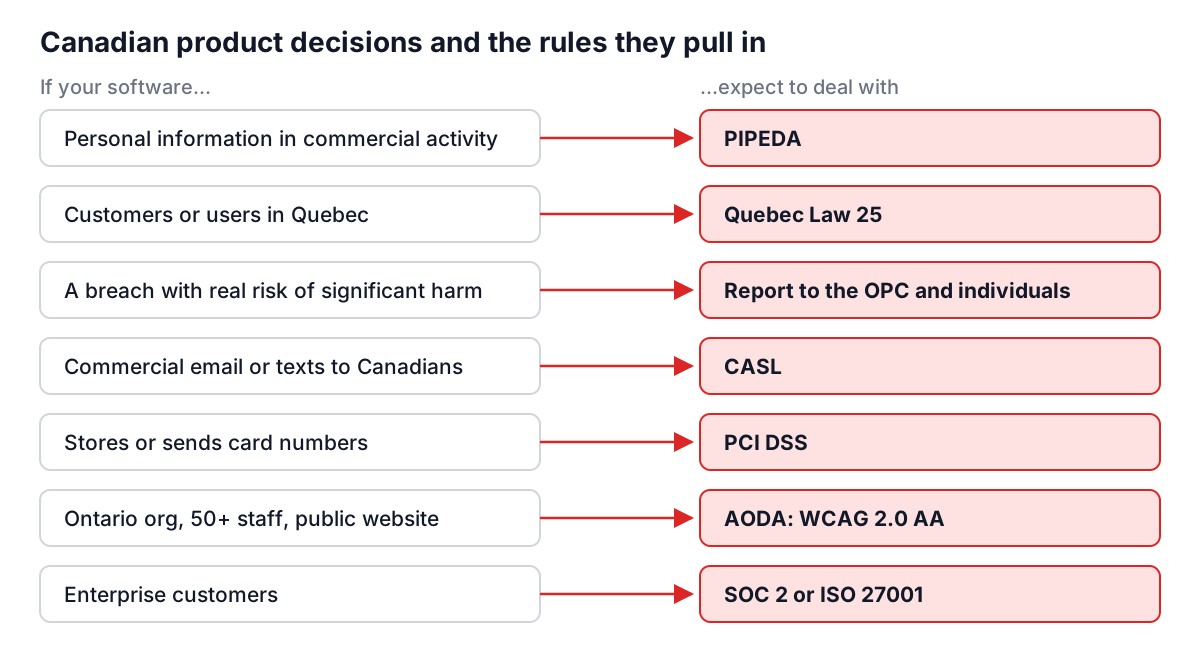
| Product decision | Canadian rule it pulls in | Who enforces it |
|---|---|---|
| Personal information in commercial activity, or crossing provincial or national borders | PIPEDA | Office of the Privacy Commissioner (OPC) |
| Users or customers in Quebec | Quebec's private-sector privacy act as amended by Law 25 | Commission d'accès à l'information (CAI) |
| Activity entirely within Alberta or British Columbia | Those provinces' own private-sector laws | The province's regulator |
| Commercial email, texts or messages | CASL | Federal regulators |
| A public website, for an Ontario organization with 50 or more employees | AODA: WCAG 2.0 Level AA | Ontario |
| Card payments | PCI DSS | Card networks and your acquirer, by contract |
| Enterprise customers | SOC 2, ISO 27001 | Customers, not law |
PIPEDA: who it covers
PIPEDA applies to private-sector organizations across Canada that collect, use or disclose personal information in commercial activities. Alberta, British Columbia and Quebec have private-sector laws deemed substantially similar, and organizations covered by those are generally exempt from PIPEDA for activity within the province. But any business is subject to PIPEDA when the personal information crosses provincial or national borders in the course of commercial activity, and federally regulated organizations such as banks, airlines and telecom companies are always covered (OPC, PIPEDA in brief).
For a SaaS product that means PIPEDA usually applies: hosting in another country or serving users in more than one province is enough.
PIPEDA is built on ten fair information principles: accountability, identifying purposes, consent, limiting collection, limiting use, disclosure and retention, accuracy, safeguards, openness, individual access, and challenging compliance. Each maps to engineering work: a data inventory with purposes, consent records, retention schedules, access controls, and a working access-request path.
Breaches: report, notify, record
Under PIPEDA, an organization must report a breach of security safeguards to the OPC when it is reasonable to believe the breach creates a real risk of significant harm to an individual, and must notify the affected individuals "as soon as feasible" after deciding that it does. It must also notify other organizations or government institutions that could reduce the harm (OPC, mandatory breach reporting).
Two details matter more to engineers than the headline:
- The test is sensitivity and probability of misuse, not the number of people affected. One leaked health record can pass it; a thousand leaked newsletter preferences may not.
- Every breach is recorded, reportable or not, and the records are kept for two years. The OPC can ask to see them. That means the incident tool needs a breach register with the risk assessment written down.
Knowingly failing to report, notify or keep records is an offence. Section 28 of PIPEDA sets fines of up to CA$10,000 on summary conviction and up to CA$100,000 for an indictable offence (PIPEDA, section 28). The OPC does not prosecute; it can refer offences to the Attorney General of Canada.
Quebec Law 25: the stricter layer
Law 25 modernized Quebec's private-sector privacy law in stages from September 2022 to September 2024. The CAI's summary lists the changes that land on product teams (CAI, main changes under Law 25):
- A privacy officer whose title and contact details are published on the website.
- Confidentiality incidents that present a risk of serious injury are reported to the CAI and the people concerned, and every incident goes in a register.
- A privacy impact assessment before acquiring, developing or redesigning an information system or electronic service that involves personal information, and before communicating personal information outside Quebec (since September 2023). The transfer may go ahead if the assessment shows adequate protection, under a written agreement.
- Highest privacy settings by default for technology products offered to the public (the CAI notes this does not apply to cookie settings).
- Automated decisions: tell people when a decision about them is based exclusively on automated processing.
- Portability: since 22 September 2024, people can ask for their computerized information in a structured, commonly used format.
The CAI can impose administrative monetary penalties on businesses of up to CA$10 million or 2% of worldwide turnover.
The cross-border rule is the one that changes architecture. Hosting Quebec customers' data in a US region needs an assessment and a contract first, so put it in the procurement checklist for every new vendor.
CASL and accessibility
CASL covers commercial electronic messages, those that encourage participation in a commercial activity, whether or not the sender expects to profit, and it requires consent before you send them (ISED, Canada's anti-spam legislation). A newsletter sign-up needs a consent record that stores when and how the person agreed.
Ontario's AODA website rule. Designated public sector organizations, and businesses and non-profits with 50 or more employees, must make public websites and web content posted after 1 January 2012 meet WCAG 2.0 Level AA, as of 1 January 2021, except live captions and pre-recorded audio descriptions (Ontario, how to make websites accessible). The organization that controls the site must meet it, directly or through a contract, so your Ontario customers may write it into theirs with you. Building to WCAG 2.2 AA covers 2.0 AA as well.
Worked example: a Toronto HR app with Quebec customers
A 60-person Toronto company sells shift-scheduling software to restaurants in Ontario and Quebec. Data is hosted in a US cloud region, managers get a monthly product newsletter, and staff pay a small fee by card for premium features.
- Open the Software Compliance Checklist (Canada). It starts on Geography: Canada and shows three cards: WCAG (eight requirements), PIPEDA (eleven requirements, from accountability to breach reporting and records) and Quebec Law 25 (seven requirements). Add all three.
- Act on Law 25's cross-border rule first. Before Quebec restaurants' staff data goes to the US region, run the privacy impact assessment and sign a written agreement with the cloud provider. Publish the privacy officer's contact details.
- Build one breach process for both laws. Assess each incident for a real risk of significant harm (PIPEDA) and a risk of serious injury (Law 25), record every incident in one register kept at least two years, and notify the OPC, the CAI and the people affected when the tests are met.
- Add what the filters do not list: CASL consent records for the newsletter, and AODA's WCAG 2.0 AA for the public website, since the company has more than 50 employees.
- Switch Geography to Global and Domain to Payments for PCI DSS, and use hosted payment fields so card numbers never reach the app.
- Download the checklist as Markdown and turn each
- [ ]line into a ticket.
Mistakes Canadian teams make
- Assuming provincial law replaces PIPEDA everywhere. It does so only for activity within Alberta, BC or Quebec; cross-border information stays under PIPEDA.
- Recording only reportable breaches. PIPEDA wants a record of every breach of security safeguards, kept for two years.
- Moving Quebec data before the assessment. Law 25 puts the privacy impact assessment before the transfer, not after.
- Sending the first newsletter before asking. CASL needs consent before commercial electronic messages; keep evidence of it.
- Testing accessibility only before launch. AODA applies to content posted since 2012, so new pages need the same checks.
Tools for this job
- Software Compliance Checklist (Canada): PIPEDA, Law 25, WCAG and global standards, filterable, downloadable as Markdown.
- Security Checklist: the safeguards behind PIPEDA's safeguards principle.
- Contrast Checker: WCAG colour contrast for the AODA website standard.
- Risk Matrix: rank incidents and gaps before deciding what to fix first.
The US edition of this guide covers HIPAA, CCPA and COPPA for Canadian teams selling into the US.
Frequently asked questions
Does PIPEDA apply if my company is in Alberta, BC or Quebec?
For activity entirely within those provinces, their own substantially similar laws generally apply instead. PIPEDA still covers personal information that crosses provincial or national borders in commercial activity, and federally regulated organizations are always covered.
When must a privacy breach be reported in Canada?
Under PIPEDA, when it is reasonable to believe the breach creates a real risk of significant harm: report to the OPC, notify affected individuals as soon as feasible, and notify organizations that can reduce the harm. Record every breach for two years either way.
What are the penalties under PIPEDA and Law 25?
Knowingly failing to report, notify or record breaches under PIPEDA can bring fines of up to CA$10,000 on summary conviction or CA$100,000 on indictment. Under Law 25, the CAI can impose administrative penalties of up to CA$10 million or 2% of worldwide turnover.
Do I need a privacy impact assessment to host Quebec data outside Quebec?
Yes. Since September 2023, Law 25 requires an assessment before personal information is communicated outside Quebec, and the transfer must be covered by a written agreement when the assessment shows adequate protection.
Which accessibility standard applies to websites in Ontario?
WCAG 2.0 Level AA, for designated public sector organizations and for businesses and non-profits with 50 or more employees, as of 1 January 2021. Live captions and pre-recorded audio descriptions are excepted.
Sources and further reading
- PIPEDA in brief, Office of the Privacy Commissioner of Canada. Who is covered and the ten principles.
- What you need to know about mandatory reporting of breaches of security safeguards, OPC. Real risk of significant harm, notification and two-year records.
- PIPEDA, section 28: offence and punishment, Justice Laws Website.
- Principaux changements apportés par la Loi 25, Commission d'accès à l'information du Québec. Dates, impact assessments, portability and penalties.
- Canada's anti-spam legislation, Innovation, Science and Economic Development Canada.
- How to make websites accessible, Government of Ontario. AODA and WCAG 2.0 Level AA.
Open the Software Compliance Checklist
More Business Analysis
Every tool in the Business Analysis section, free and in your browser.