
PDPA and Software Compliance in Singapore: A Map
Which rules apply to a Singapore app or SaaS: PDPA obligations, the PDPC breach clock, DNC checks, PCI DSS, ISO 27001 and SOC 2, and where MAS and CSA rules come in.
By Redbison Dev · · 6 min read
Singapore edition. Written for engineers building in Singapore: the PDPA's obligations as product work, the PDPC's 30-day and 3-day breach deadlines, the DNC Registry, and where MAS TRM and the Cybersecurity Act sit beside the global standards. US edition
A Singapore start-up adds SMS promotions to its booking app, moves its database to an overseas cloud region and signs its first bank as a customer, all in one quarter. None of those decisions says "compliance" on the ticket, yet each one pulls in a rule: the Do Not Call Registry for the SMS, the PDPA's transfer limitation obligation for the overseas region, and the bank's own technology risk requirements for the contract. For most software sold in Singapore, the Personal Data Protection Act 2012 is the baseline, and the global standards (PCI DSS, ISO 27001, SOC 2, WCAG) arrive through payments and enterprise buyers. This edition maps those triggers for a Singapore team and turns them into engineering work. It is a map, not legal advice. If you handle NRIC numbers, health or financial data, or are told you are a CII owner or a provider of foundational digital infrastructure, have a Singapore lawyer or your data protection officer confirm the obligations.
The Singapore compliance checklist opens on the Singapore filter, which shows the PDPA card with nine checklist lines. Switch the geography to Global for the standards, and add each card to a checklist you can download as Markdown.
From product decision to rule
| Product decision | What it pulls in | Who enforces it |
|---|---|---|
| Collecting names, NRIC-linked bookings, phone numbers or emails of individuals | PDPA data protection obligations | PDPC |
| Sending marketing SMS or calls to Singapore numbers | DNC Registry checks under the PDPA | PDPC |
| Storing or sending personal data to a server outside Singapore | PDPA transfer limitation | PDPC |
| Taking card payments | PCI DSS | Card brands, through your acquirer |
| Selling to a bank, insurer or payment institution | That customer's MAS technology risk obligations, passed to you by contract | MAS (on the customer) |
| Running a cloud service or data centre that the economy relies on | Cybersecurity Act, as amended in 2024 | CSA |
| Selling to enterprises in general | ISO 27001 or SOC 2 | Customers, not law |
| Public website or app | WCAG 2.2 | Customer contracts and procurement |
The checklist covers the PDPA, PCI DSS, ISO 27001, SOC 2, WCAG and other global frameworks. It does not have cards for the MAS guidelines or the Cybersecurity Act; read those from the regulator's pages below if your product or customers fall under them.
The PDPA as engineering work
The PDPA card lists the obligations as checklist lines. Read as product tasks:
- Accountability. Name a data protection officer, publish how to reach them, and make your policies and complaints process available on request. One owner, one public contact address, one policy page.
- Notification, consent and purpose limitation. State purposes before you collect, collect for those purposes only, and stop when consent is withdrawn. In practice: a purpose field in the design of every form, and a withdrawal path that actually stops processing.
- Accuracy and protection. Reasonable security arrangements for the data you hold: access control, logging, encryption, patching.
- Retention limitation. A retention period per data type and a deletion job that runs.
- Transfer limitation. Personal data sent overseas only under the prescribed requirements, so protection stays comparable. This belongs in your cloud and sub-processor contracts, and in a list of which regions hold what.
- Access and correction. A way to tell someone what you hold about them and how it was used or disclosed in the past year, and to correct it.
- Data breach notification. A runbook built around the PDPC clock below.
- Do Not Call. Check Singapore numbers against the DNC Registry before telemarketing messages.
Two scope rules in the PDPC's Advisory Guidelines on Key Concepts in the PDPA shape how much of this applies. The data protection provisions do not apply to business contact information, such as a work email and title, so a B2B tool holding only that has a lighter load until it stores personal data such as a home address. And public agencies are excluded, though the guidelines say an organisation providing services to one may still have obligations as a controller or a data intermediary.
The breach clock: 30 days, then 3 days
The PDPC's Guide on Managing and Notifying Data Breaches, revised on 15 March 2021, sets out two deadlines. Once an organisation has credible grounds to believe a breach has occurred, it must take reasonable and expeditious steps to assess whether the breach is notifiable within 30 calendar days. If it is, the organisation notifies the PDPC within 3 calendar days of that determination, and notifies affected individuals as soon as practicable, at the same time as or after the PDPC.
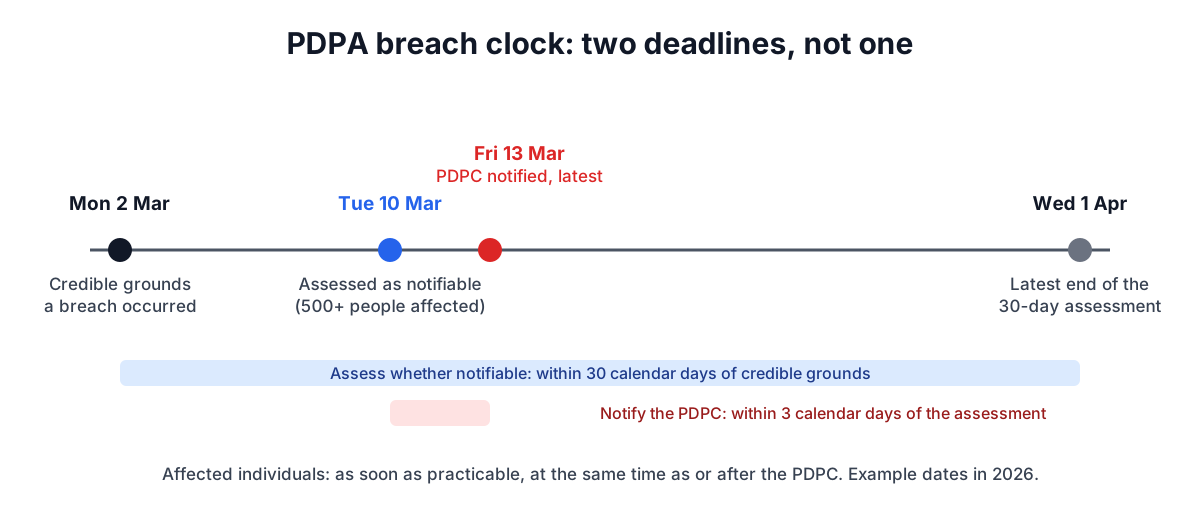
A breach is notifiable when it is likely to result in significant harm to individuals or is of significant scale. The guide defines significant scale as the personal data of 500 or more individuals, and says the PDPC must be notified at that scale even if no prescribed personal data is involved. The classes of data deemed to cause significant harm are prescribed in the Personal Data Protection (Notification of Data Breaches) Regulations 2021. If you cannot tell how many people are affected, the guide says to notify when you have reason to believe it is at least 500.
| Example, 2026 | PDPA | GDPR, for comparison |
|---|---|---|
| Credible grounds or awareness | Monday 2 March | Monday 2 March |
| Assessment must be complete | by Wednesday 1 April | no separate step |
| Regulator notified | within 3 calendar days of the assessment: by Friday 13 March if assessed on 10 March | within 72 hours of awareness: by Thursday 5 March |
The PDPA clock is longer at the start and very short at the end, so the runbook needs to make the assessment step fast and well documented. Logs that show which records a compromised account could read are what let you count affected individuals quickly. The guide structures the response as Contain, Assess, Report and Evaluate, and reminds organisations of sector regulators' own reporting rules, naming MAS, the Ministry of Health and CSA.
If you are a data intermediary processing data for a client, the guide has you notify the client, which then runs the assessment and any notification. Your contract and logs decide how fast it can do that.
Financial services customers: MAS technology risk
Selling to a Singapore bank, insurer, fund manager or payment institution brings their regulator into the deal. MAS's Guidelines on Risk Management Practices: Technology Risk, published on 18 January 2021, apply to entities across banking, insurance, capital markets, payments, trust business and financial advisory. They are addressed to the financial institution, not to you, but the institution will ask its vendors for evidence that supports its own compliance: access control, change management, resilience testing, incident reporting into its process. An ISO 27001 certificate or SOC 2 report, plus a clear incident notification commitment, answers much of that questionnaire. MAS's page also links its instructions on incident notification and reporting, which your customer will want you to support.
Cloud and infrastructure providers: the Cybersecurity Act
The Cybersecurity Act regulates owners of critical information infrastructure, the computer systems directly involved in providing essential services. Amendments passed in Parliament in May 2024 keep CII owners responsible for cybersecurity when they adopt cloud and other outsourced models, extend incident reporting to their supply chains, and bring in foundational digital infrastructure providers such as cloud service providers and data centres, entities of special cybersecurity interest, and systems of temporary cybersecurity concern. Most application vendors are not regulated directly, but a vendor in a CII owner's supply chain should expect incident reporting duties in its contract.
For smaller organisations, CSA also runs the Cyber Essentials mark, aimed at fundamental cybersecurity measures against common threats and designed for businesses of all sizes. It can be a first step before ISO 27001.
Worked example: a booking app with payments and a bank customer
A Singapore team runs a consumer booking app with card payments and SMS reminders, hosted in a cloud region outside Singapore, and is signing a bank as an enterprise customer for its staff booking module.
- Singapore filter. The PDPA card comes up. All nine lines apply: customer names, phone numbers and booking history are personal data. Add the card to the checklist.
- SMS. The DNC duty is about telemarketing messages, so the check belongs in the promotional flow: screen Singapore numbers against the Registry before any marketing SMS.
- Overseas region. The transfer limitation line becomes a contract task (comparable protection with the cloud provider) and an engineering task (a data map of which region holds what).
- Global filter, Payments domain. PCI DSS is the one card. Hosted payment fields or a redirect keep card numbers off your servers and shrink the assessment.
- Global filter, Security domain. Five cards: PCI DSS, ISO 27001, NIST CSF, CIS Controls and SOC 2 Type II. Pick ISO 27001 or SOC 2 for the bank's due diligence; NIST CSF and the CIS Controls are useful as control catalogues.
- Outside the tool. Note MAS TRM for the bank's vendor questionnaire, and the Cybersecurity Act only if a customer is a CII owner.
Name the checklist "Booking app SG" and download it. The PDPA section exports like this:
## 1. Personal Data Protection Act 2012 (Singapore) (PDPA)

**Type:** Regulation
**Severity:** Critical
**Domains:** UI, Data Management, User Authentication, Analytics
**Geography:** Singapore

**Key Requirements:**
- [ ] Accountability: data protection policies and a complaints process available on request, and a designated data protection officer (DPO) whose business contact information is public
- [ ] Transfer limitation: send personal data overseas only under the prescribed requirements so protection stays comparable
- [ ] Check Singapore numbers against the DNC Registry before sending telemarketing messages
(The real file lists all nine lines, the description, applicability, penalties and links.)
Mistakes Singapore teams make
- Starting the breach clock at "confirmed". The 30 days start from credible grounds to believe a breach occurred, and slow triage is itself a breach of the obligation.
- Assuming B2B means out of scope. Business contact information is excluded; the moment you store an individual's personal phone or address, you are in.
- Treating overseas hosting as a technical choice only. It is a transfer under the PDPA, so it needs the contractual protections.
- Waiting for a bank customer to ask. MAS-regulated buyers send long questionnaires; an existing ISO 27001 or SOC 2 report and a breach runbook shorten them.
Pair the checklist with the security checklist for application security items and the contrast checker for WCAG colour ratios. The US edition of this guide maps GDPR, CCPA, HIPAA and the other US and EU regimes in more depth.
Frequently asked questions
When must a data breach be reported to the PDPC?
First assess whether it is notifiable, within 30 calendar days of having credible grounds to believe a breach occurred. If it is likely to cause significant harm or affects 500 or more people, notify the PDPC within 3 calendar days of that assessment, and affected individuals as soon as practicable.
Does a breach affecting 500 people need notification even without sensitive data?
Yes. The PDPC's guide says a breach affecting 500 or more individuals is of significant scale and must be notified to the Commission even if it involves none of the personal data prescribed in the 2021 notification regulations.
Do MAS technology risk guidelines apply to a software vendor?
Not directly. They apply to financial institutions across banking, insurance, capital markets, payments and advisory. In practice, the institution passes many of the expectations to its vendors through due diligence and contracts.
Does the Cybersecurity Act apply to my SaaS?
Usually not directly. It regulates owners of critical information infrastructure and, since the 2024 amendments, providers such as cloud services and data centres treated as foundational digital infrastructure. If your customer is a CII owner, expect incident reporting duties in your contract.
Is ISO 27001 or SOC 2 required by law in Singapore?
No. Both are asked for by customers, especially financial institutions and larger enterprises. CSA's Cyber Essentials mark is a smaller first step for organisations building their basic controls.
Sources and further reading
- Guide on Managing and Notifying Data Breaches under the PDPA, Personal Data Protection Commission, revised 15 March 2021. The 30-day and 3-day deadlines and the 500-person threshold.
- Advisory Guidelines on Key Concepts in the PDPA, Personal Data Protection Commission, revised 29 April 2026. Business contact information and public agencies excluded, the access obligation covering use or disclosure in the past year, and the Do Not Call provisions.
- Guidelines on Risk Management Practices: Technology Risk, Monetary Authority of Singapore, 18 January 2021.
- Cybersecurity Act, Cyber Security Agency of Singapore. CII, the 2024 amendments, FDI providers.
- Cyber Essentials, Cyber Security Agency of Singapore.
- Document library: PCI DSS, PCI Security Standards Council.
- Web Content Accessibility Guidelines (WCAG) 2.2, W3C.
Open the Software Compliance Checklist
More Business Analysis
Every tool in the Business Analysis section, free and in your browser.