
How Much Does a Portable Heater Cost to Run in Australia?
A 2.4 kW heater uses 2.4 kWh an hour, about 66c at a 27.35 c/kWh Victorian rate. Costs per hour, month and winter quarter, reverse-cycle air con and safety.
By Redbison Dev · · 9 min read
Australia edition. Written for Australia: costs in A$ from c/kWh usage rates, worked with the 2026-27 Victorian Default Offer flat tariffs, 2.4 kW heaters on 230 V, a winter quarterly bill, reverse-cycle air conditioning and Energy Safe Victoria's heater advice. US edition
A plug-in electric heater costs its rating in kilowatts times your usage rate for every hour it runs flat out. A 2,400 W portable heater on full power uses 2.4 kWh an hour. At 27.35 c/kWh, the 2026-27 Victorian Default Offer flat usage charge in the United Energy zone, that is about 66 cents an hour, A$79.86 a month at four hours a night, and A$241.56 over a 92-day winter quarter. Your bill shows your own rate in cents per kWh; this guide shows how to plug it in, why the thermostat matters more than the heater type, and when a reverse-cycle air conditioner is the cheaper heater.
The figures come from the Australian Electricity Cost Calculator, which takes the rate in dollars: 27.35 c/kWh is 0.2735.
Your usage rate
Australian bills charge a usage rate in cents per kWh and a daily supply charge. Only the usage rate changes with how long the heater runs. As an official example, here are the Essential Services Commission's Victorian Default Offer flat tariffs for domestic customers from 1 July 2026 to 30 June 2027, including GST:
| Distribution zone | Usage charge (general) | Supply charge |
|---|---|---|
| CitiPower | 25.96 c/kWh | A$1.2114 a day |
| Jemena | 27.47 c/kWh | A$1.2713 a day |
| United Energy | 27.35 c/kWh | A$1.1912 a day |
| Powercor | 28.22 c/kWh | A$1.3805 a day |
| AusNet Services | 31.98 c/kWh | A$1.2824 a day |
AusNet's tariff is split into a first block of 1,020 kWh a quarter and a second block above it, both at 31.98 c in 2026-27. Outside Victoria, use the rate on your bill; Energy Made Easy, a free government comparison service, covers New South Wales, Queensland, South Australia, Tasmania and the ACT. The ESC notes the default offer will not necessarily be the lowest price available. If your plan is time of use, use the peak or shoulder rate for the hours the heater runs; the controlled load rate applies only where a controlled load or dedicated circuit is available, so it is not the rate for a heater plugged into an ordinary power point.
Cost per hour, month and winter quarter
In the electricity cost calculator, enter the heater's watts, the hours a day, 7 days a week and 0.2735:
| Heater and use at 27.35 c/kWh | kWh a day | Cost a day | Cost a month |
|---|---|---|---|
| 2.4 kW for 1 hour | 2.40 | A$0.66 | A$19.97 |
| 2.4 kW for 4 hours | 9.60 | A$2.63 | A$79.86 |
| 2 kW for 4 hours | 8.00 | A$2.19 | A$66.55 |
| 1.5 kW oil column for 6 hours, flat out | 9.00 | A$2.46 | A$74.87 |
| 1.5 kW averaging 750 W for 6 hours | 4.50 | A$1.23 | A$37.44 |
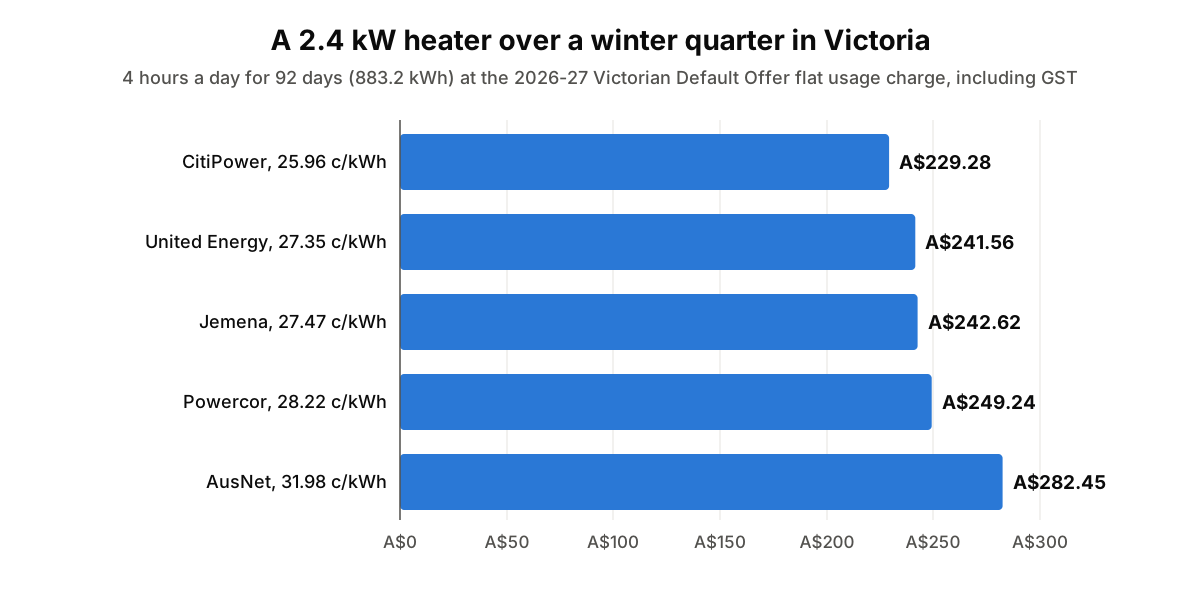
A month here is a twelfth of a year. Most Australian bills are quarterly, so the number that lands in the letterbox is closer to a 92-day June to August quarter: the 2.4 kW heater for four hours a night uses 883.2 kWh, which is A$229.28 at CitiPower's 25.96 c, A$241.56 at United Energy's 27.35 c and A$282.45 at AusNet's 31.98 c. The zone you live in moves the quarterly cost by more than A$50 for the same heater.
The thermostat sets the bill, not the heater type
Those costs assume the element never switches off. Most heaters have a thermostat: once the room is warm the element cycles off and on, and its average draw falls to roughly the rate the room loses heat. In a well-sealed bedroom a 1.5 kW oil column heater might hold temperature on half power or less; in a draughty weatherboard room with single glazing it may run almost continuously. The 750 W row in the table shows the half-power case. To estimate your own room, the Heat Loss Calculator works out how many watts a wall or window loses at a given inside and outside temperature.
Oil column, fan, panel, convection and radiant heaters all turn one kWh of electricity into one kWh of heat; Natural Resources Canada calls plug-in electric heaters 100% efficient at the point of use. None is cheaper per unit of heat. Choose by the room: a fan heater for quick warmth in a bathroom, an oil column heater for steady warmth in a bedroom, a radiant heater for warming a person at a desk without heating the whole room.
Portable heater or reverse-cycle air conditioner?
A reverse-cycle split system is an air-source heat pump: it moves heat in from outside rather than making it from electricity. Natural Resources Canada's electric heaters page puts numbers on the principle for a ground-source (geothermal) heat pump, three units of heat for each unit of electricity against one for a resistance heater. An air-source split system works on the same principle, though its ratio differs by model, so check the heating figures for yours. So if you already have a reverse-cycle unit in the living area, it will usually heat that space for a fraction of the electricity a portable heater would use at the same usage rate. The portable heater makes sense for a room the split system does not reach, for short bursts, or when you only need to warm one person.
If you heat with gas, Energy Safe Victoria's advice is to have gas heaters serviced by a licensed gasfitter at least every two years, because they can emit carbon monoxide that cannot be seen or smelled.
Heater safety
Energy Safe Victoria's winter safety check for 2026 asks households to:
- check electric heaters and blankets for damage and stop using them if cords, plugs or wiring are damaged;
- avoid overloading power boards with several heating appliances;
- look for the Regulatory Compliance Mark when buying new appliances and avoid products from unknown overseas suppliers;
- never use outdoor gas appliances such as patio heaters indoors.
A 2.4 kW heater draws about 10.4 A at 230 V, so it is a heavy load on its own: plug it straight into a wall power point, keep it clear of curtains, bedding and clothes, and switch it off when you leave the room or go to sleep.
Tools for this job
- Australian Electricity Cost Calculator: cost per day, month and year from the heater's watts, your hours and your c/kWh rate.
- Heat Loss Calculator: watts lost through a wall or window, which is roughly what a thermostat heater averages once the room is warm.
For R-values and heat loss through Australian walls, read U-value, R-value and heat loss.
Frequently asked questions
How much does a 2400 W heater cost per hour?
It uses 2.4 kWh an hour on full power, so multiply 2.4 by your usage rate. At 27.35 c/kWh that is about 66 cents an hour; at 31.98 c/kWh about 77 cents. The thermostat cycling off once the room is warm brings the real hourly cost down.
How much will a heater add to my quarterly bill?
A 2.4 kW heater used four hours a night through a 92-day winter quarter uses 883.2 kWh. Under the 2026-27 Victorian Default Offer that is between A$229.28 and A$282.45 depending on the distribution zone, before any thermostat cycling.
Are oil column heaters cheaper to run?
Not per unit of heat. Every plug-in resistance heater turns a kWh of electricity into a kWh of heat. Oil column heaters keep radiating after the thermostat cuts out, which can make a room feel steadier, but at the same average watts they cost the same as a fan heater.
Is reverse-cycle air conditioning cheaper than a portable heater?
Usually, for the room it serves, because a heat pump delivers several units of heat for each unit of electricity while a portable heater delivers one. A portable heater is better for a room the split system does not reach or for a short burst of heat.
Sources and further reading
- Victorian Default Offer, Essential Services Commission. 2026-27 flat tariffs by distribution zone, including GST.
- Energy Made Easy, Australian Government. Free plan comparison for NSW, Queensland, SA, Tasmania and the ACT.
- Warm up to winter with a home heating safety check, Energy Safe Victoria. Heater, electric blanket and power board safety for 2026.
- Electric heaters, Natural Resources Canada. Electric heaters give one unit of heat per unit of electricity; geothermal heat pumps can give three.
- Heating your home with gas, Energy Safe Victoria. How a gas heater can spill carbon monoxide.