
How Much Does an Electric Heater Cost to Run UK?
A 2 kW heater uses 2 kWh an hour, about 53p at the Ofgem price cap. Costs for 2 kW and 3 kW heaters and oil radiators, gas central heating and 13 A plug safety.
By Redbison Dev · · 9 min read
United Kingdom edition. Written for the UK: pence per kWh at the Ofgem price cap for October to December 2026, 2 kW and 3 kW heaters on 230 V and 13 A plugs, the comparison with gas central heating, and Electrical Safety First advice on extension leads. US edition
A plug-in electric heater in the UK costs its power rating in kilowatts times your unit rate for every hour it runs flat out. At the Ofgem price cap average for 1 October to 31 December 2026, 26.32p per kWh for Direct Debit customers in England, Scotland and Wales, a 2 kW fan heater costs about 53p an hour and a 3 kW convector about 79p. Used four hours a day for a month, that is £64 and £96. Gas for central heating is capped at 7.97p per kWh over the same period, so a plug-in heater is the dearer way to warm a home and makes sense mainly for one room for a short time.
The figures come from the UK Electricity Cost Calculator, so you can rerun them with the unit rate on your bill.
Your unit rate: the price cap figure
Ofgem sets the price cap every three months. It caps the unit rate and the daily standing charge, not your total bill, and it applies to standard variable tariffs, not fixed deals. For 1 October to 31 December 2026 the averages for Direct Debit are:
| Fuel | Unit rate | Daily standing charge |
|---|---|---|
| Electricity | 26.32p per kWh | 54.83p |
| Gas | 7.97p per kWh | 29.68p |
Ofgem notes these figures include 5% VAT on gas, and that there is no VAT on electricity from 1 October 2026 to 31 March 2027. Your rate depends on your region and how you pay, and fixed tariffs have their own rates, so use the unit rate on your bill if you have it.
Only the unit rate matters for a heater: the standing charge is paid whether the heater is on or not. In the calculator, enter pence as pounds, so 26.32p is 0.2632.
Cost per hour, day and month
In the electricity cost calculator, enter the heater's watts, hours a day, 7 days a week and 0.2632:
| Heater and use | kWh a day | Cost a day | Cost a month |
|---|---|---|---|
| 2 kW for 1 hour | 2.00 | £0.53 | £16.01 |
| 3 kW for 1 hour | 3.00 | £0.79 | £24.02 |
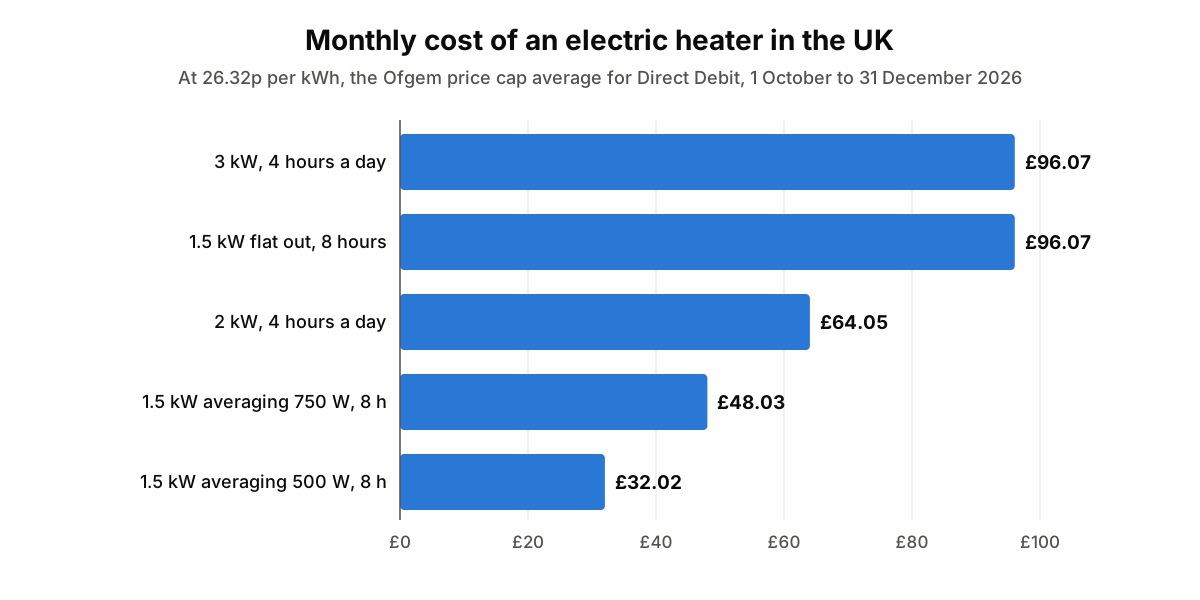
| 2 kW for 4 hours | 8.00 | £2.11 | £64.05 |
| 3 kW for 4 hours | 12.00 | £3.16 | £96.07 |
| 1.5 kW for 8 hours, flat out | 12.00 | £3.16 | £96.07 |
A month here is a twelfth of a year, 30.4 days. These figures assume the element is on for every minute you run the heater, which is the worst case.
Why the thermostat matters more than the heater
Most heaters have a thermostat. Once the room is warm, the element switches off and only comes back on as the room cools, so over an hour the heater's average draw equals the rate the room loses heat, not the number on the label. A 1.5 kW oil-filled radiator in a well-insulated bedroom may only average a few hundred watts; the same radiator in a draughty room with a single-glazed window may run most of the time.
| 8 hours a day at 26.32p | Average draw | Cost a month |
|---|---|---|
| Running flat out | 1,500 W | £96.07 |
| Thermostat holding it on half the time | 750 W | £48.03 |
| Thermostat holding it on a third of the time | 500 W | £32.02 |
The half and third are illustrations, not measurements. To estimate your own room, the Heat Loss Calculator works out how many watts a wall or window loses at a given inside and outside temperature, and that is roughly what the heater must average.
Oil-filled, fan, convector or halogen: is any cheaper?
Not per unit of heat. Every plug-in resistance heater turns each kWh of electricity into a kWh of heat (Natural Resources Canada calls them 100% efficient at the point of use), so at the same average watts they cost the same. What differs is how the heat arrives: a fan heater warms the air quickly, an oil-filled radiator warms up slowly and keeps radiating after the thermostat clicks off, and a halogen or infrared heater warms the people and objects in front of it. Choose by how you use the room, then control the cost with the thermostat and the hours.
Plug-in heater or gas central heating?
At the cap, electricity costs 26.32p per kWh and gas 7.97p, so a kWh of electricity costs 3.3 times as much as a kWh of gas. A gas boiler would have to turn less than 30% of its gas into useful heat before a plug-in heater matched it on cost per unit of heat. So heating the whole house with plug-in heaters costs far more than with the boiler.
A plug-in heater still saves money in one case: heating one room for an hour or two while the rest of the house stays cool, instead of running the boiler for every radiator. If you have a heat pump, nidirect (the Northern Ireland government site) says heat pumps typically produce three or more units of heat for every unit of electricity used, while a plug-in heater gives one, so the heat pump wins on the same tariff; the heat pump vs gas comparison works through that.
Storage heaters on Economy 7 or similar tariffs charge overnight at a cheaper rate and release heat during the day. They are a different system with their own rates, so use the night unit rate on your bill for the hours they charge.
Using a heater safely on a 13 A plug
A UK heater runs on 230 V. A 3 kW heater draws about 13 A, which is the full rating of a standard 13 A plug and socket; a 2 kW heater draws about 8.7 A. Electrical Safety First's advice on overloading sockets applies directly:
- Most extension leads are rated at 13 A, but some older ones and many cable reels are 10 A or less, so a 3 kW heater on its own can overload them.
- A cable reel's rating can fall to 3 or 4 A when it is wound up, so unwind it fully if you must use one.
- Never plug one extension lead into another.
- Watch for burn marks, buzzing or crackling, blown fuses or a plug that feels hot, and stop using it.
- Use an RCD in your consumer unit, or an RCD plug if you have none, and keep at least one working smoke or heat alarm on every floor.
The best rule for a heater is to plug it straight into a wall socket and keep it clear of curtains, bedding and furniture.
Tools for this job
- UK Electricity Cost Calculator: cost per hour, day, month and year from the heater's watts, your hours and your unit rate in pence.
- Heat Loss Calculator: watts lost through a wall or window, which tells you what the heater will average once the room is warm.
For U-values and heat loss in UK walls, read U-value, R-value and heat loss.
Frequently asked questions
How much does a 2 kW heater cost per hour in the UK?
About 53p at the Ofgem price cap average of 26.32p per kWh for 1 October to 31 December 2026: 2 kW for one hour uses 2 kWh, and 2 × 26.32p is 52.64p. On a different tariff, multiply 2 by your own unit rate.
Is it cheaper to use an electric heater or the central heating?
For the whole house, the gas central heating, because gas is capped at 7.97p per kWh against 26.32p for electricity. A plug-in heater is cheaper only when you heat one room for a short time and leave the boiler off.
Are oil-filled radiators cheaper to run?
No more than any other electric heater of the same average wattage, because every resistance heater turns a kWh of electricity into a kWh of heat. They feel gentler and hold heat after switching off, which can help the thermostat keep the average draw down.
Can I plug a heater into an extension lead?
Only if the lead's rating covers it, and ideally not at all. Electrical Safety First says most extension leads are rated at 13 A, some older ones and many cable reels at 10 A or less, and a 3 kW heater draws about 13 A on its own. Plug it straight into a wall socket where you can.
Sources and further reading
- Energy price cap unit rates and standing charges, Ofgem. 26.32p per kWh electricity and 7.97p gas for 1 October to 31 December 2026, and the VAT note.
- Energy price cap and standing charges explained, Ofgem. What the cap limits and who it protects.
- Overloading sockets, Electrical Safety First. Extension lead and cable reel ratings and warning signs.
- Electric heaters, Natural Resources Canada. Electric space heaters are 100% efficient at the point of use; geothermal heat pumps can give three units of heat per unit of electricity.
- Heat pumps, nidirect. Heat pumps typically produce three or more units of heat for every unit of electricity used.
- How your electricity or gas bill is calculated, Ofgem. Unit rates, standing charges and reading your bill.