
Steps to Kilometres: Steps in 30 Minutes, 10,000 and kJ
How many steps make a kilometre for your height, why healthdirect puts 30 minutes of walking at 3,000 to 4,000 steps, and the kilojoules 10,000 steps burn.
By Redbison Dev · · 9 min read
Australia edition. Written for Australia: kilometres and kilojoules, healthdirect's 3,000 to 4,000 steps per 30 minutes, the weekly guideline of 2 hours 30 minutes to 5 hours of moderate activity, and energy compared with the 8,700 kJ average daily intake. US edition
For adults between about 155 and 180 cm tall, a kilometre of walking is about 1,300 to 1,600 steps, so 10,000 steps is roughly 6.5 to 7.5 km. healthdirect puts 30 minutes of walking at around 3,000 to 4,000 steps, and the national guideline is written in time, not steps: 2 hours 30 minutes to 5 hours of moderate activity a week for adults. This edition shows where your own walk sits in that range, why the same 30 minutes can be 2,700 or 4,400 steps, and how much energy a walk uses in kilojoules, the unit on Australian food labels. Try each example in the Steps to Kilometres Calculator (Australia).
Why 30 minutes is "3,000 to 4,000 steps"
healthdirect's walking for exercise page says 30 minutes of walking is equal to around 3,000 to 4,000 steps, and recommends that Australian adults do at least 30 minutes of moderate activity on most days. It describes a moderate pace as faster than you would normally walk while still being able to speak comfortably.
The range is wide because two things change the count: your step length (mostly height) and your speed. The calculator estimates step length as 0.413 x height for women and 0.415 x height for men, and steps follow from distance:
| 30 minutes of walking | 165 cm woman (68.1 cm step) | 180 cm man (74.7 cm step) |
|---|---|---|
| Easy, 4 km/h (2 km) | 2,935 steps | 2,677 steps |
| Moderate, 5 km/h (2.5 km) | 3,669 steps | 3,347 steps |
| Brisk, 6 km/h (3 km) | 4,402 steps | 4,016 steps |
So a shorter walker at a brisk pace can pass 4,000 steps in half an hour, and a tall walker strolling may not reach 3,000. The count describes the walk, not the effort: what counts toward the weekly minutes is walking at a moderate pace, however many steps that takes you.
Steps per kilometre by height
| Height | Steps per km, women | Steps per km, men |
|---|---|---|
| 155 cm | 1,562 | 1,555 |
| 160 cm | 1,513 | 1,506 |
| 165 cm | 1,467 | 1,460 |
| 170 cm | 1,424 | 1,417 |
| 175 cm | 1,384 | 1,377 |
| 180 cm | 1,345 | 1,339 |
The height rule is an average, and step length changes with speed, slope and surface. Measure your own step by walking a known 20 m (a marked stretch of footpath, or part of a 400 m athletics track) at your usual pace and counting: 20 m in 27 steps is a 74.1 cm step. Enter that as a measured step length and the calculator uses it everywhere.
The weekly guideline in steps
healthdirect's cardiovascular exercise page gives the adult guideline as 2 hours 30 minutes to 5 hours of moderate activity each week, or 1 hour 15 minutes to 2 hours 30 minutes of intense activity. Walked at 5 km/h by the 165 cm woman:
- 150 minutes is 12.5 km, about 18,300 steps a week;
- 300 minutes is 25 km, about 36,700 steps a week.
Spread over seven days, that is roughly 2,600 to 5,200 purposeful steps a day on top of ordinary moving about. A daily step count of 6,000 made up of trips around the house and office can still miss the guideline, while a 30-minute walk on most days meets it.
10,000 steps in kilometres and kilojoules
The 10,000 target is common, and healthdirect says many people will not reach it and that is fine. For those who do, at 5 km/h:
| 10,000 steps | Distance | Time | Gross | Net |
|---|---|---|---|---|
| 165 cm woman, 70 kg | 6.81 km | 82 min | 339 kcal (1,422 kJ) | 239 kcal (1,002 kJ) |
| 180 cm man, 85 kg | 7.47 km | 90 min | 451 kcal (1,893 kJ) | 317 kcal (1,333 kJ) |
The calculator works in kilocalories; healthdirect's kilojoules page gives the conversion, one kilocalorie being the same energy as 4.2 kilojoules. It also notes that food labels must list kilojoules per 100 g (or 100 mL), and that the average adult needs about 8,700 kJ a day to maintain a healthy weight. Against that average, the woman's 10,000 steps add about 1,000 kJ net, around 11.5%.
Use the net figure when comparing with food. Gross includes the energy you would have burnt sitting still anyway.
Per kilometre, the net cost of walking on the flat is almost the same at any normal pace, about 0.5 kcal per kg per km. Hills and running roughly double it:
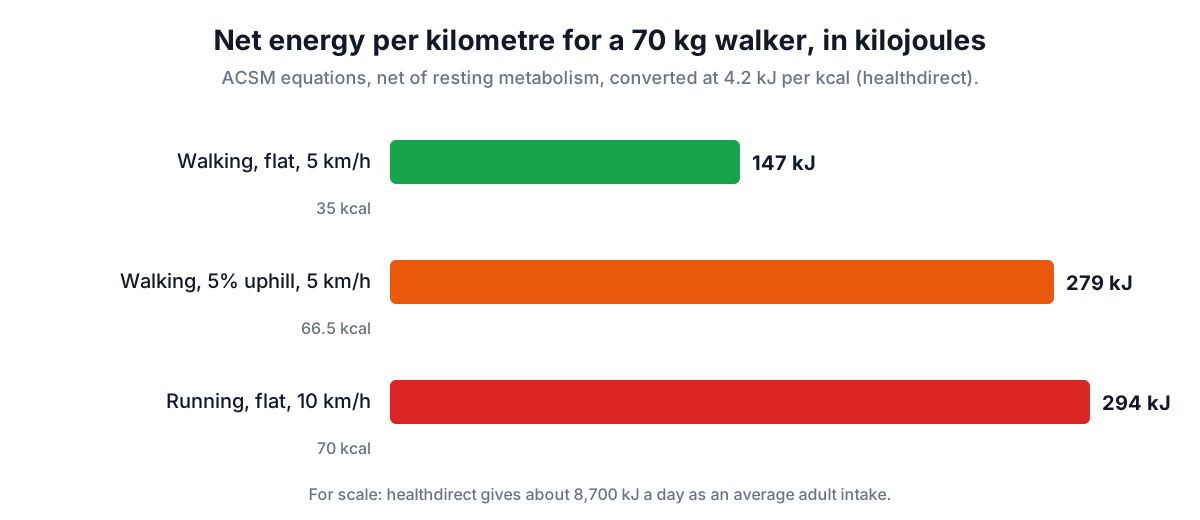
These figures come from the American College of Sports Medicine equations: walking oxygen use = 3.5 + 0.1 x speed in m/min + 1.8 x speed x slope, in mL per kg per minute, at about 5 kcal per litre of oxygen. The walking equation is validated for about 3 to 6 km/h; the running equation is meant for speeds above about 8 km/h.
Worked example: a coastal walk
A 165 cm, 70 kg woman does a 6 km coastal track on a Sunday morning at 5 km/h. In the calculator, choose distance to steps and enter 6 km, female, 165 cm, 70 kg, 5 km/h:
- Step length 165 x 0.413 = 68.1 cm (68.145 cm unrounded), so 6,000 m / 0.68145 m = 8,805 steps.
- Time: 6 / 5 h = 72 minutes, almost half of the weekly 150-minute minimum in one outing.
- Energy: about 298 kcal gross, 210 kcal net, or roughly 1,250 kJ gross and 882 kJ net.
If the track has sustained climbs, enter an average grade: at 5% the net energy roughly doubles. Soft sand and steep sections change both speed and step length, so a step measured on the actual surface is the best guide.
Sun, heat and devices
- healthdirect advises suitable clothing, a hat and sunscreen outdoors, and a water bottle, and notes that a treadmill can be more comfortable when it is hot or raining.
- The energy estimate does not change with temperature, but your comfort and fluid needs do.
- A phone in a bag misses steps. Keep it in a pocket, or use a watch, and calibrate the step length once on a measured route.
If you have a heart condition, diabetes or joint problems, or are starting after a long break, talk to your GP before increasing your walking a lot.
Tools for this job
- Steps to Kilometres Calculator (Australia): steps to km or km to steps, with time and energy for your height and weight.
- Calories Burned Calculator: compare walking with swimming, cycling and other activities.
- Pace Calculator: minutes per kilometre for a walk or run.
Frequently asked questions
How many steps is 30 minutes of walking?
healthdirect says around 3,000 to 4,000. With the calculator, a 165 cm woman at 5 km/h takes 3,669 steps in 30 minutes and a 180 cm man 3,347; at a brisk 6 km/h they take 4,402 and 4,016.
How many kilojoules does walking 10,000 steps burn?
For a 165 cm, 70 kg woman at 5 km/h, about 1,422 kJ in total or 1,002 kJ above resting. A heavier person uses more, in proportion to weight.
Do I need 10,000 steps a day?
No. healthdirect notes that many people will not reach it and that is fine. A 2022 meta-analysis in The Lancet Public Health of 47,471 adults found mortality risk kept falling with more steps up to about 6,000 to 8,000 a day for adults 60 and over and 8,000 to 10,000 for younger adults.
What speed is a moderate walk?
There is no fixed number; healthdirect describes it as faster than you would normally walk while still being able to speak comfortably. A cadence of about 100 steps a minute, the threshold from the CADENCE-Adults study, is another check.
Sources and further reading
- Walking for exercise, healthdirect Australia. 30 minutes of walking is around 3,000 to 4,000 steps; moderate pace; 10,000 steps not reachable for everyone; sun and water advice.
- Cardiovascular exercise, healthdirect Australia. 2 hours 30 minutes to 5 hours of moderate activity, or 1 hour 15 minutes to 2 hours 30 minutes of intense activity, a week.
- Kilojoules, healthdirect Australia. 1 kcal is 4.2 kJ; labels list kJ per 100 g; average adult intake about 8,700 kJ a day.
- Walking cadence (steps/min) and intensity in 21-40 year olds: CADENCE-adults, International Journal of Behavioral Nutrition and Physical Activity (2019). 100 and 130 steps a minute for moderate and vigorous intensity.
- Daily steps and all-cause mortality: a meta-analysis of 15 international cohorts, The Lancet Public Health (2022). Where the benefit of more steps levels off by age.
Open the Steps to Distance and Calories Calculator
More Fitness Calculators
Every tool in the Fitness Calculators section, free and in your browser.
- BMI Calculator
- Calorie Calculator
- Protein Calculator
- Hydration Calculator
- Calorie Deficit Planner
- Body Fat Calculator
- Ideal Weight Calculator
- Running Pace Calculator
- Target Heart Rate Calculator
- One Rep Max Calculator
- Barbell Plate Calculator
- RPE Calculator
- Interval Timer
- Calories Burned Calculator
- Body Surface Area Calculator
- Waist-to-Hip Ratio Calculator
- VO2 Max Calculator
- Steps to Distance & Calories Calculator