
How Many Steps in a Mile? Step Length and Brisk Walking
Steps per mile by height in feet and inches, what the NHS 3 mph brisk pace means in steps, 10,000 steps in miles and the calories a walk really adds.
By Redbison Dev · · 9 min read
United Kingdom edition. Written for UK walkers: distances in miles with kilometres alongside, heights in feet and inches, the NHS brisk pace of about 3 mph and its talk test, the 150-minute weekly guideline, and the Active 10 app's minutes rather than steps. US edition
For adults between 5 ft 1 in and 6 ft 1 in tall, a mile of walking is between about 2,100 and 2,500 steps. The number depends on your step length, which depends mostly on your height: a 5 ft 5 in woman takes about 2,360 steps a mile, a 5 ft 11 in man about 2,150. That makes 10,000 steps roughly 4 to 4.8 miles. The NHS, though, sets its advice in minutes of brisk walking, not steps, so this edition also shows how many steps a brisk walk at the NHS pace of about 3 mph takes and how much energy it adds. Every figure here comes from the Steps to Miles and Kilometres Calculator (UK), so you can put in your own height and weight.
Steps per mile by height
The calculator estimates walking step length from height: 0.413 x height for women and 0.415 x height for men. A step is heel strike of one foot to heel strike of the other, half a stride. Converted to feet and inches:
| Height | Step, women | Steps per mile, women | Step, men | Steps per mile, men |
|---|---|---|---|---|
| 5 ft 1 in (155 cm) | 64.0 cm | 2,515 | 64.3 cm | 2,503 |
| 5 ft 3 in (160 cm) | 66.1 cm | 2,435 | 66.4 cm | 2,423 |
| 5 ft 5 in (165 cm) | 68.2 cm | 2,360 | 68.5 cm | 2,349 |
| 5 ft 7 in (170 cm) | 70.3 cm | 2,290 | 70.6 cm | 2,279 |
| 5 ft 9 in (175 cm) | 72.4 cm | 2,223 | 72.7 cm | 2,213 |
| 5 ft 11 in (180 cm) | 74.5 cm | 2,161 | 74.8 cm | 2,150 |
| 6 ft 1 in (185 cm) | 76.6 cm | 2,102 | 76.9 cm | 2,091 |
The height rule is an average: two people of the same height can differ noticeably, and everyone's step lengthens as they speed up. If accuracy matters, measure it: mark 20 m on a pavement or use the straight of a running track, walk it at your usual pace starting a few paces before the line, and count. Twenty metres in 27 steps is a 74.1 cm step; in 29 steps it is 69.0 cm. Enter the measured figure and the calculator uses it instead of the height estimate.
What "brisk" means in the UK, in steps
The NHS walking for health page says a brisk walk is about 3 miles an hour, faster than a stroll, and gives a simple check: you can still talk but cannot sing the words to a song. It adds that a brisk 10-minute daily walk counts towards the 150 minutes of weekly exercise. The adult activity guidelines set that weekly figure: at least 150 minutes of moderate activity or 75 minutes of vigorous activity, with strengthening activities on at least 2 days, and brisk walking is listed as moderate.
At 3 mph (4.8 km/h) you cover half a mile, 0.8 km, in 10 minutes. In steps:
| Walk at 3 mph | 165 cm woman, 65 kg | 178 cm man, 80 kg |
|---|---|---|
| 10 minutes (0.8 km) | 1,174 steps, 26 kcal net | 1,083 steps, 32 kcal net |
| 30 minutes (2.4 km) | 3,522 steps | 3,249 steps |
| 5 x 30 minutes a week | about 17,600 steps | about 16,200 steps |
So the whole 150-minute guideline, walked briskly, is only around 16,000 to 18,000 steps a week. A pedometer showing 7,000 steps a day can still fall short if most of those steps are slow pottering around the house or office, because only the brisk minutes count. That is why the NHS Active 10 app, described on the NHS Better Health page, records minutes of brisk walking rather than just counting steps.
Cadence: a step count you can feel
Speed is step length times steps per minute (cadence). At 3 mph, the 165 cm woman above needs a cadence of about 117 steps a minute; the 178 cm man about 108. Both are above the threshold of about 100 steps a minute that the CADENCE-Adults study linked with moderate intensity in adults aged 21 to 40, which fits with 3 mph counting as moderate.
The practical test: count your steps for 15 seconds on a normal walk. Twenty-five or more is 100 a minute. If you are well under that, pick up the pace until you could talk but would not want to sing.
10,000 steps in miles and calories
| 10,000 steps at 3 mph | Distance | Time | Energy, gross | Energy, net |
|---|---|---|---|---|
| 165 cm woman, 65 kg | 6.81 km (4.23 miles) | 1 h 25 min | 318 kcal | 221 kcal |
| 178 cm man, 80 kg | 7.39 km (4.59 miles) | 1 h 32 min | 425 kcal | 295 kcal |
The calculator uses the American College of Sports Medicine walking equation: oxygen use = 3.5 + 0.1 x speed in m/min (+ a term for slope), in mL per kg per minute, at about 5 kcal per litre of oxygen. "Gross" includes the resting 3.5; "net" is what the walk added on top of sitting still, and is the one to compare with the kcal on a UK food label.
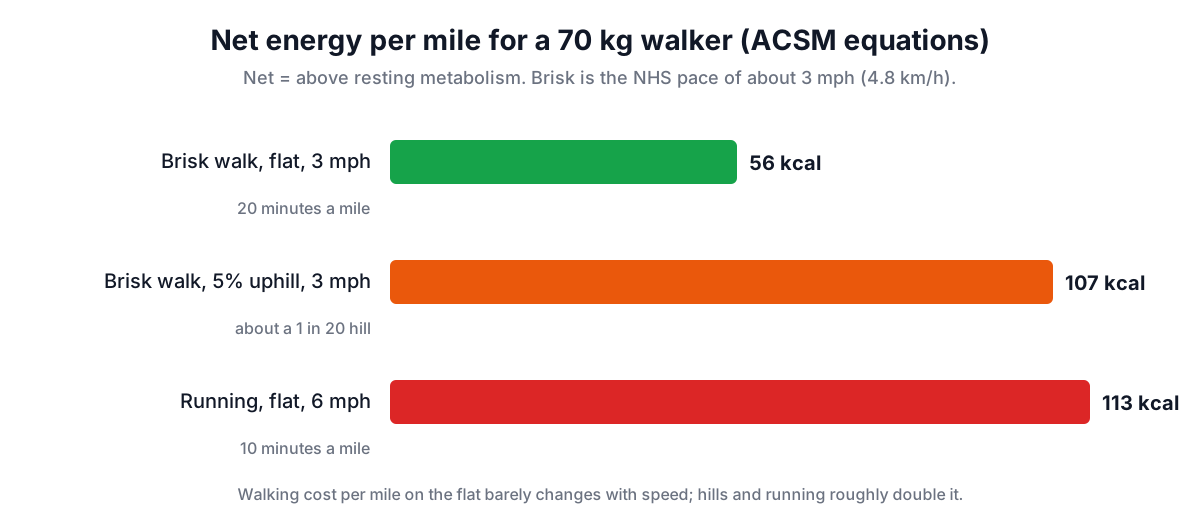
Per mile, the net cost of walking on the flat hardly changes with speed. For a 70 kg walker it is about 56 kcal a mile at 3 mph. A hill or a run roughly doubles it:
The walking equation is validated for about 3 to 6 km/h (1.9 to 3.7 mph) and the running one for speeds above about 8 km/h (5 mph); outside those ranges treat the numbers as rough.
Worked example: a 5 km charity walk
A 165 cm, 65 kg woman signs up for a 5 km sponsored walk and plans to walk it at the NHS brisk pace. In the calculator choose distance to steps, enter 5 km, female, 165 cm, 65 kg and 4.8 km/h:
- Step length: 165 x 0.413 = 68.1 cm.
- Steps: 5,000 m / 0.68145 m = 7,337 steps.
- Time: 5 / 4.8 h = 62.5 minutes, which on its own is more than 40% of the week's 150 minutes.
- Energy: 234 kcal gross, 163 kcal net.
Her 178 cm, 80 kg walking partner covers the same course in 6,769 steps and uses 200 kcal net. Same distance and time, fewer steps and more energy, because his step is longer and he is heavier.
Getting a fair count from your phone or watch
- Carry the phone on you. A phone in a handbag or a pushchair tray misses steps; a trouser pocket does better.
- Check the device's step length. Some apps say "stride length" for a single step and others mean two steps. If it wants a stride of two steps, double your step.
- Calibrate on a known mile. Walk a measured route and compare the app's distance with the real one, then correct the step length.
- Expect disagreement. Two trackers on the same walk rarely agree exactly; trust the trend on one device, not single readings across two.
Tools for this job
- Steps to Miles and Kilometres Calculator (UK): steps to miles or miles to steps, with time and calories for your height and weight.
- Calories Burned Calculator: compares walking with other activities by MET value.
- Pace Calculator: minutes per mile for a walk or run.
For how activity fits with eating less, see the calorie deficit guide. If you have a heart or joint condition, or have been inactive for a long time, ask your GP before increasing your walking a lot.
Frequently asked questions
How many steps is a mile for a 5 ft 3 in woman?
About 2,435 steps using the height estimate: her step is 160 x 0.413 = 66.1 cm, and a mile is 1,609 m. Measuring your step over 20 m is more accurate than the estimate.
Is 3 mph a good walking speed?
It is the speed the NHS gives for a brisk walk, and it counts as moderate activity. If you can still talk but could not sing, you are about there.
How many steps do I need to meet 150 minutes a week?
At 3 mph, five 30-minute walks are about 3,200 to 3,500 steps each for adults between 165 and 178 cm tall, so roughly 16,000 to 18,000 brisk steps a week. Slow steps do not count towards the minutes.
How many calories does walking a mile burn?
For a 70 kg adult at 3 mph, about 81 kcal in total or 56 kcal above resting. Heavier people use more, in direct proportion to weight, and a 5% hill nearly doubles the net figure.
Sources and further reading
- Walking for health, NHS. Brisk walking at about 3 mph, the talk-but-not-sing test and the daily 10-minute brisk walk.
- Physical activity guidelines for adults aged 19 to 64, NHS. 150 minutes moderate or 75 minutes vigorous a week, strengthening on 2 days, brisk walking as moderate activity.
- Get active, NHS Better Health. The Active 10 app records minutes of walking; 150 minutes a week is around 20 to 30 minutes a day.
- Physical activity guidelines: UK Chief Medical Officers' report, GOV.UK (published 7 September 2019). The UK-wide guidelines the NHS pages summarise.
- Walking cadence (steps/min) and intensity in 21-40 year olds: CADENCE-adults, International Journal of Behavioral Nutrition and Physical Activity. About 100 steps a minute as moderate intensity.
- Daily steps and all-cause mortality: a meta-analysis of 15 international cohorts, The Lancet Public Health (2022). 47,471 adults; mortality risk fell with more steps up to about 6,000 to 8,000 a day at 60 and over and 8,000 to 10,000 under 60.
Open the Steps to Distance and Calories Calculator
More Fitness Calculators
Every tool in the Fitness Calculators section, free and in your browser.
- BMI Calculator
- Calorie Calculator
- Protein Calculator
- Hydration Calculator
- Calorie Deficit Planner
- Body Fat Calculator
- Ideal Weight Calculator
- Running Pace Calculator
- Target Heart Rate Calculator
- One Rep Max Calculator
- Barbell Plate Calculator
- RPE Calculator
- Interval Timer
- Calories Burned Calculator
- Body Surface Area Calculator
- Waist-to-Hip Ratio Calculator
- VO2 Max Calculator
- Steps to Distance & Calories Calculator