
Employee or Self-Employed in Canada? CRA Status Tests
How the CRA decides if you are an employee or self-employed: the RC4110 factors, Quebec's Civil Code test, CPP/EI rulings, and what the status is worth in CA$.
By Redbison Dev · · 11 min read
Canada edition. Written for Canada: the CRA's RC4110 two-step test and Quebec's three-step Civil Code test instead of IRS and ABC tests, CPT1 rulings, and a CA$ example with 2026 CPP and EI rates and Ontario holidays. US edition
A Canadian business offers you work as an "independent contractor" and asks for invoices instead of a T4. Whether you really are self-employed is not settled by the contract's wording. The Canada Revenue Agency (CRA) says in its guide RC4110 that "the facts of the working relationship as a whole decide the employment status", and that status decides whether CPP contributions and EI premiums are deducted, whether you can claim EI, and how you file your income tax.
This guide explains the CRA's tests as they stand in 2026, the different approach for contracts formed in Quebec, how to get a binding ruling, and what the status is worth in dollars, using the Canadian Salary Calculator and the Freelance Rate Calculator. It covers the federal CPP/EI and tax question. Provincial employment standards, such as Ontario's, apply their own tests to rights like vacation pay; a lawyer or accountant can look at a specific contract.
Outside Quebec: the CRA's two-step test
The CRA asks one key question: is the person engaged to carry out services as a person in business on their own account, or as an employee? It answers it in two steps.
Step 1: intent. The CRA asks both parties what they intended when they set up the arrangement: a contract of service (employment) or a contract for services (a business relationship). It looks at the written contract, testimony and how the parties actually behaved.
Step 2: the facts. It then checks whether the working conditions match that intent, using these factors:
| Factor | Points to an employee | Points to self-employed |
|---|---|---|
| Control | The payer directs how and when the work is done and has the final word; you need permission to work for others | You work independently, can accept or refuse work, and can serve several payers at once |
| Tools and equipment | The payer supplies most of them and pays for repairs and insurance | You provide them and carry the cost of repairs, insurance and maintenance |
| Subcontracting and helpers | You must do the work personally | You can hire someone to do or help with the work and pay them yourself |
| Financial risk | Your expenses are reimbursed and you have no fixed ongoing costs | You have unreimbursed expenses and fixed costs |
| Investment and management | No investment in the business | Significant investment and you manage your own business |
| Chance of profit, risk of loss | Guaranteed pay per hour, day or week; access to benefit plans offered only to employees | You set or negotiate prices, are often paid a flat rate, and can increase profit by managing costs |
The CRA stresses two points that trip people up. It is the payer's right to control that matters, not whether it uses it, so an IT consultant who needs little direction can still be an employee. And supplying your own tools does not make you self-employed by itself: the CRA gives the example of auto mechanics who supply their own tools as full-time employees.
In Quebec: the Civil Code's three steps
Where the contract was formed in Quebec, or the contract says Quebec law applies, the CRA uses a three-step approach built on the Civil Code of Québec. It again starts with the parties' intent, then checks whether the relationship meets the Civil Code definition of a contract of employment or a contract for services, looking at the work done, the remuneration and, above all, whether there is a relationship of subordination. Signs of subordination include the payer controlling your absences and schedule, setting rules of conduct, being able to discipline you, requiring activity reports, and reserving your services to a single payer.
Self-employed people in Quebec may be eligible for benefits under the Quebec Parental Insurance Plan (QPIP), the CRA notes (for more information, see Revenu Québec). The pension contributions differ too: for employees whose province of employment is Quebec, the CRA tells employers to deduct Quebec Pension Plan (QPP) contributions instead of CPP contributions, so the CPP figures in the example below do not apply there.
Getting a ruling: Form CPT1
If you or the payer are unsure, either of you can ask the CRA for a ruling on whether the work is pensionable (CPP) and insurable (EI). You can request one through My Account or My Business Account ("Request a CPP/EI Ruling"), through an authorized representative, or by mailing Form CPT1. The deadline is June 29 of the year after the year in question, so for work done in 2026, June 29, 2027. A ruling covers a specific period, and unless it is appealed it is final.
What misclassification costs
The CRA is blunt about the payer's risk: an employer that fails to deduct the required CPP contributions or EI premiums has to pay both the employer's and the employee's share, plus penalties and interest. For the worker, self-employment means no regular EI benefits; the CRA notes some self-employed people can opt in to EI special benefits by contributing.
Worked example: what the status is worth in pay
A firm in Ontario offers you a role at CA$30 an hour, 40 hours a week, either on payroll or as a self-employed contractor. Ontario's Employment Standards Act gives employees nine public holidays and, for those with less than five years of service, two weeks of vacation a year.
Step 1: the employee's pay. In the salary calculator, enter 30 per hour, 40 hours, 5 days, 9 holidays and 10 vacation days. Unadjusted annual pay is CA$62,400 for 2,080 paid hours; the adjusted figure, CA$57,840 for 241 working days, is what CA$30 an hour pays with those 19 days unpaid, the contractor's position.
For 2026 the CRA sets the employee CPP rate at 5.95% on earnings between the CA$3,500 basic exemption and CA$74,600, and the EI rate at 1.63% up to CA$68,900 of insurable earnings. That is CA$3,504.55 of CPP and CA$1,017.12 of EI, leaving CA$57,878.33 before income tax, which is left out on both sides.
Step 2: the contract rate that keeps the same. A self-employed person pays both halves of CPP, 11.9% on net earnings above CA$3,500 (the CRA's maximum self-employed contribution for 2026 is CA$8,460.90, twice the employee maximum), and no EI unless they opt in. Keeping CA$57,878.33 needs about CA$65,223 of profit, so CPP takes an effective 11.26%. In the Freelance Rate Calculator, enter take-home 57878.33, expenses 4000 (an assumption for equipment, insurance and an accountant), tax 11.26, margin 0, 5 days, 8 hours, 10 vacation days, 9 holidays, 0 sick days and 100% billable.
The calculator asks for CA$35.90 an hour, a CA$287.23 day rate, and CA$69,222.37 of revenue over 1,928 billed hours. So the CA$30 payroll offer is worth about CA$35.90 an hour as a contract, about 20% more, before counting group health and dental coverage, a pension match or EI protection.
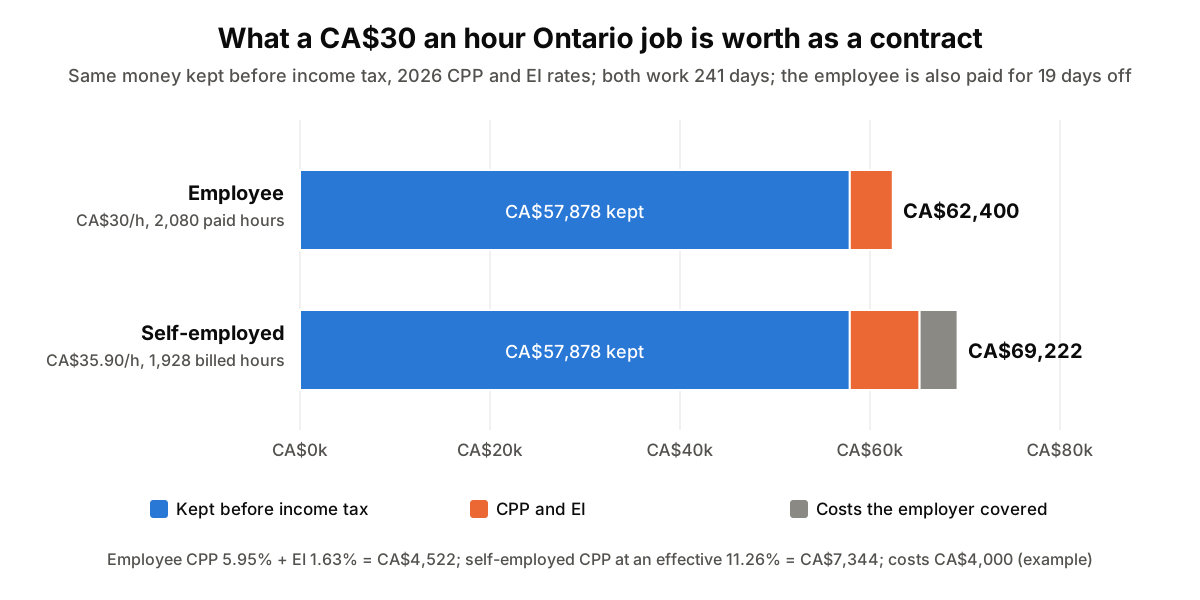
The business saves its own share too: CA$3,504.55 of employer CPP and, at 1.4 times the employee premium, CA$1,423.97 of EI. That saving, and the vacation and holiday pay, is why the CRA looks past the label.
Tools for this job
- Canadian Salary Calculator: turn an hourly offer into annual pay with and without paid statutory holidays and vacation.
- Freelance Rate Calculator: the hourly and day rate a self-employed person needs after CPP, costs, days off and unbilled time.
For freelance pricing in more depth, read how to calculate your freelance hourly rate. For overtime and pay periods in Canada, see salary and overtime maths in Canada.
Frequently asked questions
Does signing a contractor agreement make me self-employed in Canada?
No. The CRA starts with what the parties intended, but then checks whether the actual working conditions match it. Workers and payers can choose how they set up their affairs, the CRA says, but the status they choose must reflect the working relationship.
How do I ask the CRA whether I am an employee?
Request a CPP/EI ruling through My Account, My Business Account or an authorized representative, or mail Form CPT1. Either the worker or the payer can ask, and the request is due by June 29 of the year after the work. The ruling is final unless appealed.
How much CPP does a self-employed person pay in 2026?
Both the employee and employer shares: 11.9% of net self-employment earnings between CA$3,500 and CA$74,600, up to CA$8,460.90. Second additional CPP contributions apply on earnings above that ceiling.
Is the test different in Quebec?
Yes. For contracts formed in Quebec the CRA applies the Civil Code of Québec in three steps, and the deciding question is whether there is a relationship of subordination: control over how, when and where you work, your absences and your conduct.
Sources and further reading
- RC4110 Employee or self-employed?, Canada Revenue Agency. The two-step and Quebec three-step tests, CPT1 rulings and the cost of failing to deduct.
- Canada Pension Plan (CPP) contributions, Canada Revenue Agency. QPP contributions instead of CPP for employees whose province of employment is Quebec.
- CPP contribution rates, maximums and exemptions, Canada Revenue Agency. 2026: 5.95%, CA$3,500 exemption, CA$74,600 maximum pensionable earnings.
- EI premium rates and maximums, Canada Revenue Agency. 2026: 1.63% up to CA$68,900.
- Your guide to the Employment Standards Act: public holidays, Government of Ontario. Ontario's nine public holidays.
- Your guide to the Employment Standards Act: vacation, Government of Ontario. Two weeks of vacation under five years of service.