
Employed or Self-Employed? UK Employment Status and IR35
UK employment status explained: employee, worker or self-employed, HMRC's CEST tool, the off-payroll IR35 rules, Uber v Aslam, and what the label is worth in pay.
By Redbison Dev · · 11 min read
United Kingdom edition. Written for the UK: three employment law statuses instead of the US W-2 and 1099 split, HMRC's CEST tool and IR35, the Supreme Court's Uber ruling, and a £ worked example at 2026 to 2027 National Insurance rates. US edition
A UK business offers you work "on a self-employed basis". Whether you really are self-employed is not decided by that phrase. The UK has two separate questions: your employment status in law (employee, worker or self-employed), which decides rights like holiday pay and the minimum wage, and your status for tax, which decides whether you pay through PAYE or Self Assessment. GOV.UK warns that HMRC may treat someone as self-employed for tax even if they have a different status in employment law. Getting either wrong can mean unpaid tax, penalties and lost rights.
This guide explains both tests as they stand for the 2026 to 2027 tax year, the off-payroll working rules (IR35) for people who work through their own company, and what the difference is worth in pounds, using the UK Salary Calculator and the Freelance Day Rate Calculator. It is general information, not legal advice; Acas, an employment solicitor or a tax adviser can look at a specific contract.
Three statuses, not two
US law mostly splits people into W-2 employees and 1099 contractors. UK employment law has a middle category.
| Status | What GOV.UK says marks it | Key rights |
|---|---|---|
| Employee | All employees are workers, with extra rights on top | Everything workers get plus Statutory Sick Pay, statutory redundancy pay, minimum notice, unfair dismissal protection and the right to request flexible working |
| Worker | Contract to do work personally for a reward, only a limited right to send someone else, not working as part of their own business where the "employer" is really a client | National Minimum Wage, statutory paid holiday, rest breaks, the 48-hour week, protection from unlawful deductions and discrimination; may get Statutory Sick Pay and family pay |
| Self-employed | Runs their business for themselves and takes responsibility for its success or failure | Health and safety, some discrimination protection, and whatever the contract with the client says |
GOV.UK lists signs that someone is probably self-employed: they bid or quote for work, are not directly supervised, invoice for their work, pay their own tax and National Insurance, and get no holiday or sick pay. Signs of worker status include having to accept the business's terms to get work, being supervised by a manager, not being able to send someone else, and the business providing tools or equipment. A contract that uses words like "freelance" or "self-employed" does not settle it either way.
Uber v Aslam: why the label lost
The leading case is Uber BV and others v Aslam and others [2021] UKSC 5, decided by the Supreme Court on 19 February 2021. Uber argued its drivers were independent third-party contractors. The Employment Tribunal had found they were workers, "working" whenever the app was switched on, they were in the territory they were authorised to work in, and they were able and willing to accept trips. The Employment Appeal Tribunal and the Court of Appeal dismissed Uber's appeals, and the Supreme Court unanimously dismissed its final appeal. The practical lesson: tribunals look at how the work is actually done, not at what the paperwork calls it.
Status for tax: HMRC's CEST tool
For tax, HMRC's Check employment status for tax (CEST) tool gives HMRC's view of whether a worker on a specific engagement is employed or self-employed for tax purposes. Anyone can use it: hirers, workers and agencies. HMRC says it will stand by the result as long as the information you give is accurate and in line with its guidance, and the result can be used as a valid status determination statement.
You need a contract, written, verbal or implied, and to know who decides what work is done and when, where and how it is done, how you will be paid, and whether any corporate benefits or expenses are included. The tool is anonymous and you cannot save your progress, so gather the details first.
IR35: working through your own company
Many UK contractors work through a personal service company (PSC) rather than as sole traders. The off-payroll working rules, known as IR35, ask whether you would have been an employee for tax if the client had engaged you directly.
- If the client is in the public sector, or is a medium or large business, the client decides your status and must give you a status determination statement with its reasons.
- If the client is a small business outside the public sector, your own company decides.
- The rules apply contract by contract, so one contract can be inside IR35 and another outside.
If you are inside, the deemed employer deducts Income Tax and employee National Insurance from the fees paid to your company and pays employer National Insurance (and the Apprenticeship Levy where it applies). Being inside IR35 is a tax result; your rights under employment law are a separate question.
Worked example: what the status is worth in pay
A firm offers you the same role either on its payroll at £25 an hour, 37.5 hours a week, with the statutory 5.6 weeks of paid holiday (28 days for a five-day week; GOV.UK says an employer can include bank holidays in it), or as a self-employed sole trader.
Step 1: the employee's pay. In the salary calculator, enter 25 per hour, 37.5 hours a week, 5 days, 8 bank holidays and 20 holiday days. The unadjusted annual pay is £48,750 for 1,950 paid hours. The adjusted figure, £43,500 for 232 working days, is what £25 an hour would pay if those 28 days were unpaid, which is the self-employed position.
Employee National Insurance in 2026 to 2027 is 8% of earnings between £12,570 and £50,270, so £2,894.40, leaving £45,855.60 before Income Tax. Income Tax is left out on both sides because it works the same way on wages and on sole-trader profit.
Step 2: the self-employed rate that keeps the same. A sole trader pays Class 4 National Insurance at 6% on profits between £12,570 and £50,270 in 2026 to 2027. Keeping £45,855.60 needs about £47,980 of profit, so Class 4 is an effective 4.43%. In the Freelance Day Rate Calculator, enter take-home 45855.60, costs 3000 (an assumption for equipment, insurance and an accountant), tax 4.43, margin 0, 5 days, 7.5 hours, 20 holiday days, 8 bank holidays, 0 sick days and 100% billable.
The calculator asks for £29.30 an hour, a £219.75 day rate, and £50,981.17 of revenue over 1,740 billed hours. So the £25 PAYE offer is worth about £29.30 an hour as self-employed work, 17% more, before counting Statutory Sick Pay, a workplace pension contribution or any sick days you would lose.
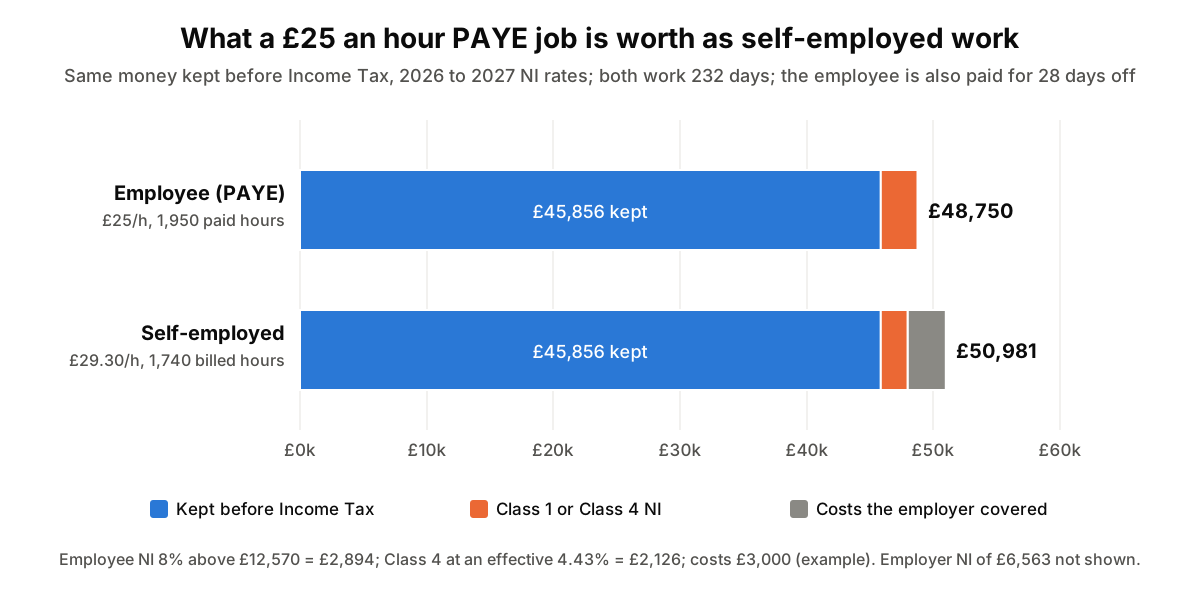
The gap is smaller than in the US guide, because Class 4 at 6% is lighter than the US self-employment tax. The bigger saving sits with the business: employer National Insurance is 15% of earnings above £5,000 a year in 2026 to 2027, £6,562.50 on this £48,750 salary, and a self-employed engagement avoids it entirely. That is the incentive the employment status rules and IR35 exist to check.
What getting it wrong costs
- For tax: GOV.UK warns that individuals and their employers may have to pay unpaid tax and penalties, or lose entitlement to benefits, if employment status is wrong.
- For rights: someone wrongly treated as self-employed may be owed holiday pay, the National Minimum Wage and other worker rights, which is what the Uber drivers claimed.
- Under IR35: the client must give reasons in its status determination statement, so ask for them and check the facts it relied on before you accept a deduction.
Tools for this job
- UK Salary Calculator: convert an hourly rate to annual pay with and without paid holidays, to see how much of an employee's pay is paid time off.
- Freelance Day Rate Calculator: the day rate a sole trader needs after Income Tax, Class 4 NI, costs, bank holidays and unbilled time.
For the full freelance pricing method, read how to calculate your freelance day rate in the UK. For holiday pay and overtime, see salary and overtime maths in the UK.
Frequently asked questions
What is the difference between a worker and an employee in the UK?
Both work personally for a business, but a worker has fewer rights. GOV.UK says workers get the National Minimum Wage, paid holiday, rest breaks and protection from unlawful deductions and discrimination, but usually not unfair dismissal protection, minimum notice, statutory redundancy pay or the right to request flexible working.
Is the CEST result binding?
HMRC says it will stand by the result as long as the information you entered is accurate and in line with its guidance, and you can use it as a status determination statement. A tribunal deciding your employment rights is not bound by it, because employment law status is a separate question.
Who decides IR35 status if I work through a limited company?
A public sector client or a medium or large private sector client decides and must give you a status determination statement. If the client is small and outside the public sector, your own company decides. The rules apply to each contract separately.
Can I be employed and self-employed at the same time?
Yes. GOV.UK gives the example of someone who works for an employer during the day and runs their own business in the evenings. Each engagement has its own status.
Sources and further reading
- Employment status, GOV.UK. Employee, worker and self-employed, with the rights each brings.
- Check employment status for tax (CEST), HM Revenue and Customs. Who can use the tool and how HMRC stands by its results.
- Understanding off-payroll working (IR35), HM Revenue and Customs. Who decides status, status determination statements and the deemed employer.
- Uber BV and others v Aslam and others, The Supreme Court. [2021] UKSC 5, with the press summary: the appeal was unanimously dismissed and the drivers were workers.
- Employment status: employee, GOV.UK. The rights employees have on top of worker rights.
- Rates and thresholds for employers 2026 to 2027, HM Revenue and Customs. Class 1 thresholds, 8% employee and 15% employer rates.
- Self-employed National Insurance rates, GOV.UK. Class 4 at 6% and 2% for 2026 to 2027.
- Holiday entitlement, GOV.UK. 5.6 weeks of statutory paid holiday.