
Employee or Contractor NZ: Gateway Test and Common Law Test
How NZ decides if you are an employee or a contractor: the gateway test in force from 21 February 2026, the four common law tests, and the status in NZ$.
By Redbison Dev · · 11 min read
New Zealand edition. Written for New Zealand: the gateway test that came into law on 21 February 2026, the four common law tests the courts use, schedular payments, KiwiSaver and holiday entitlements, with an NZ$ worked example. US edition
A New Zealand business offers you work as a contractor: you would invoice, sort your own tax and have no employment agreement. Whether that is lawful depends on the facts, and since 21 February 2026 there are two steps to check. Employment New Zealand (MBIE) explains that you first apply the new gateway test; if a worker meets every criterion they are a contractor. If not, the common law test, four tests the courts have developed to find the true nature of the relationship, decides. Contractors are not covered by most employment laws, cannot bring personal grievances, and get no paid holidays, so the answer matters.
This guide explains both tests, what changes in tax and KiwiSaver, and what the status is worth in dollars, using the NZ Salary Calculator and the Freelance Rate Calculator. It is general information; Employment New Zealand, a community law centre or an employment lawyer can look at a specific agreement.
Step 1: the gateway test
The gateway test came into law on 21 February 2026 and is not retrospective. Employment New Zealand says a worker is a specified contractor if they:
- have a written agreement that says they are an independent contractor, or are not an employee;
- are allowed to work for another person, though not at the same time as working for the person they have the arrangement with;
- can choose when to work, or can subcontract the work to a third party (without vetting, or with vetting only for qualifications the law or the work requires, or a criminal record check);
- can decline an additional offer of work without the arrangement ending; and
- had a reasonable chance to get independent advice before signing.
All five must be met. If any one is missing, the worker is not automatically an employee: you move to the common law test, under which they can still be a contractor.
For arrangements that started before 21 February 2026, the common law test applies to the time before that date, and both tests from that date on. Employment New Zealand notes the Employment Relations Authority could find that someone was an employee up to the change and a contractor after it.
What the gateway test changes in practice
The gateway test rewards paperwork and genuine choice. For it to apply, the agreement has to give the contractor the freedom to choose hours or subcontract, decline extra work and work for others, and there has to be time for independent advice. As a contractor, read those clauses as rights: if the business ends the arrangement because you turned down extra shifts, criterion 4 is not met and the gateway does not apply.
Step 2: the four common law tests
If the gateway test is not met, Employment New Zealand describes four tests. No single one decides; each case is weighed on its merits.
| Test | Points to an employee | Points to a contractor |
|---|---|---|
| Intention | A written employment agreement, which every employee must have | A contract for services; but intention alone does not decide |
| Control vs independence | The employer directs where, when, what and how you work; set hours; you ask permission for time off | You choose who to work for, when and where, plan your own day and need little supervision |
| Integration | Work commonly done by employees, continuous rather than one-off, for the business's benefit; you wear the uniform and attend team events; equipment and expenses are provided | You bring your own tools and specialist equipment, are paid by results, and absorb expenses as business costs |
| Fundamental or economic reality | Paid a wage or salary with minimum wage protection | You charge fees, can profit or lose, can subcontract or employ others, work for several principals, advertise and invoice |
The economic reality test asks whether you are in business on your own account. Employment New Zealand's examples are a builder paid by build progress and working for companies A, B and C at the same time.
Tax, ACC and KiwiSaver
Employment New Zealand lists what a contractor takes on: paying their own tax directly to Inland Revenue, registering for GST once earning over NZ$60,000, and paying their own ACC levies. In some situations the business deducts tax for them: Inland Revenue's schedular payments apply to contractors doing certain kinds of work, mainly involving the supply of labour, where tax is deducted from the payment even though it is not salary or wages.
Someone wrongly hired as a contractor, Employment New Zealand warns, may miss out on minimum entitlements such as annual holidays and sick leave and on the KiwiSaver employer subsidy, and may pay tax and ACC levies they should not have to. Inland Revenue sets the compulsory employer KiwiSaver contribution at a minimum of 3.5% of gross salary or wages.
Worked example: what the status is worth in pay
A firm offers you a role at NZ$40 an hour, 40 hours a week, either as an employee or as a contractor. An employee is entitled to at least 4 weeks of paid annual holidays after 12 months, and to a paid day off on public holidays that fall on a normal working day. In 2026 the 11 national public holidays and your regional anniversary day all fall on weekdays (Anzac Day and Boxing Day are observed on Mondays), so a Monday-to-Friday worker gets 12.
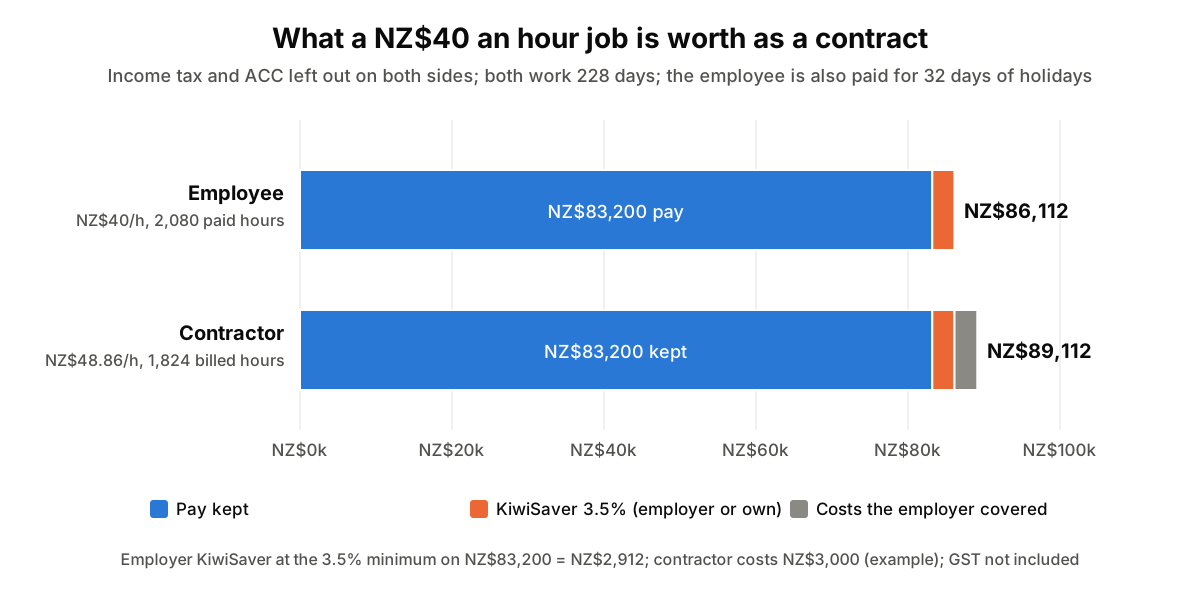
Step 1: the employee's pay. In the salary calculator, enter 40 per hour, 40 hours, 5 days, 12 public holidays and 20 annual holiday days. The unadjusted annual pay is NZ$83,200 for 2,080 paid hours. The adjusted figure, NZ$72,960 for 228 working days, is what the same hourly rate pays when those 32 days are unpaid, the contractor's position. On top, the employer pays at least 3.5% into KiwiSaver: NZ$2,912.
Step 2: the contract rate that keeps the same. New Zealand has no separate social security contribution like US payroll tax, so income tax and ACC levies are left out on both sides here. To match the employee, a contractor needs NZ$83,200 for themselves plus the NZ$2,912 KiwiSaver contribution they no longer get, plus their own costs. In the Freelance Rate Calculator, enter take-home 83200, business expenses 5912 (the KiwiSaver replacement plus an assumed NZ$3,000 for equipment, insurance and an accountant), tax 0, margin 0, 5 days, 8 hours, 20 vacation days, 12 holidays, 0 sick days and 100% billable.
The calculator asks for NZ$48.86 an hour, a NZ$390.84 day rate and NZ$89,112 of revenue over 1,824 billed hours. So the NZ$40 employee offer is worth about NZ$48.86 an hour as a contract, 22% more. Allow five unpaid sick days and it rises to NZ$49.95. At that revenue you are over the NZ$60,000 GST threshold, so you must register and charge GST on top of the rate.
If you disagree about status
Employment New Zealand's Service Centre and early resolution team can help, then mediation, and finally an application to the Employment Relations Authority for a determination, which carries a fee. Health and safety law applies to employees and contractors alike, whatever the answer.
Tools for this job
- NZ Salary Calculator: turn an hourly rate into annual pay with and without paid annual and public holidays.
- Freelance Rate Calculator: the hourly and day rate a contractor needs after costs, KiwiSaver, days off and unbilled time.
For freelance pricing in more depth, read how to calculate your freelance hourly rate. For pay, overtime and public holiday rates in New Zealand, see salary and overtime maths in NZ.
Frequently asked questions
What is a specified contractor in NZ?
A worker who meets all five gateway test criteria: a written agreement saying they are a contractor or not an employee, freedom to work for others, freedom to choose when to work or to subcontract, the right to decline extra work without the arrangement ending, and a reasonable chance to get independent advice before signing.
If I fail the gateway test, am I an employee?
Not automatically. The common law test then applies, weighing intention, control, integration and economic reality, and the worker can still be found to be a contractor.
Does the gateway test apply to my old contract?
It is not retrospective. For an arrangement that started before 21 February 2026, the common law test covers the time before that date and both tests apply from it, so the status could differ before and after.
Do contractors get KiwiSaver contributions?
No compulsory ones. Employers must contribute at least 3.5% of an employee's gross pay; a contractor who wants the same saving has to fund it from their rate, which is why the example adds NZ$2,912 to costs.
Sources and further reading
- Employee or contractor?, Employment New Zealand, MBIE. The gateway test from 21 February 2026, the four common law tests and disputes.
- Annual holidays, Employment New Zealand. At least 4 weeks of paid annual holidays after 12 months.
- Public holidays and anniversary dates, Employment New Zealand. 2026 dates and observed days.
- Schedular payments, Inland Revenue. Tax deducted from payments to contractors who mainly supply labour.
- Employer contributions to KiwiSaver and complying funds, Inland Revenue. The 3.5% minimum compulsory employer contribution.