
Hourly to Salary, Overtime and Raises in Canada
Convert hourly pay to salary with Ontario holiday and vacation pay, compare overtime under federal, Ontario and BC rules, and test a raise against Canadian CPI.
By Redbison Dev · · 8 min read
Canada edition. Written for Canadian workers: the 2,080-hour year with Ontario's nine public holidays and 4% vacation pay, overtime under the Canada Labour Code, Ontario's 44-hour week and BC's daily rules, bi-weekly pay cheques, and raises against Bank of Canada CPI and Statistics Canada wage growth. US edition
At CA$27 an hour and 40 hours a week, you earn CA$56,160 a year, or CA$2,160 every two weeks, and in Ontario that figure holds even after holidays and vacation, because public holiday pay and vacation pay replace the days you do not work. Work four 12-hour days, though, and the overtime on that 48-hour week depends on your province: CA$162 in Ontario but CA$648 under the federal or BC rules. This guide works through pay conversion, overtime and raises the Canadian way, with the Hourly to Salary Calculator (Canada), the Overtime Calculator (Canada) and the Raise Calculator (Canada).
This explains the arithmetic and the published minimum standards. A contract or collective agreement can give you more, and some jobs have special rules; your provincial employment standards office can tell you what applies.
Hourly to annual: 2,080 hours and 26 pay cheques
A 40-hour week for 52 weeks is 2,080 hours, so annual pay is the hourly rate times 2,080 and the hourly rate is annual pay divided by 2,080. If you are paid bi-weekly, that means 26 pay cheques a year, not 24:
| Hourly rate (40 h/week) | Annual | Bi-weekly (÷ 26) | Monthly (÷ 12) |
|---|---|---|---|
| CA$27.00 | CA$56,160 | CA$2,160 | CA$4,680 |
| CA$38.46 (CA$75,000 at 37.5 h/week) | CA$75,000 | CA$2,884.62 | CA$6,250 |
Usually two months a year contain three bi-weekly pay days. If you budget on two cheques a month, those two extra cheques are a bonus you planned without; if you budget on "monthly = bi-weekly × 2", you understate your income by about 8%.
If your contract says 37.5 hours, the hourly figure changes: CA$75,000 is CA$38.46 an hour at 37.5 hours but CA$36.06 at 40.
What public holidays and vacation do in Ontario
The US habit of treating an hourly worker's days off as unpaid does not fit an Ontario employee. Ontario's Employment Standards Act gives:
- Nine public holidays: New Year's Day, Family Day, Good Friday, Victoria Day, Canada Day, Labour Day, Thanksgiving, Christmas and Boxing Day. Public holiday pay is the regular wages and vacation pay from the four work weeks before the holiday's week, divided by 20, which for a steady 5-day schedule is about a normal day's pay (Ontario, public holidays).
- Two weeks of vacation after each 12-month vacation entitlement year (three weeks after five years), with vacation pay of at least 4% of gross wages, 6% after five years (Ontario, vacation).
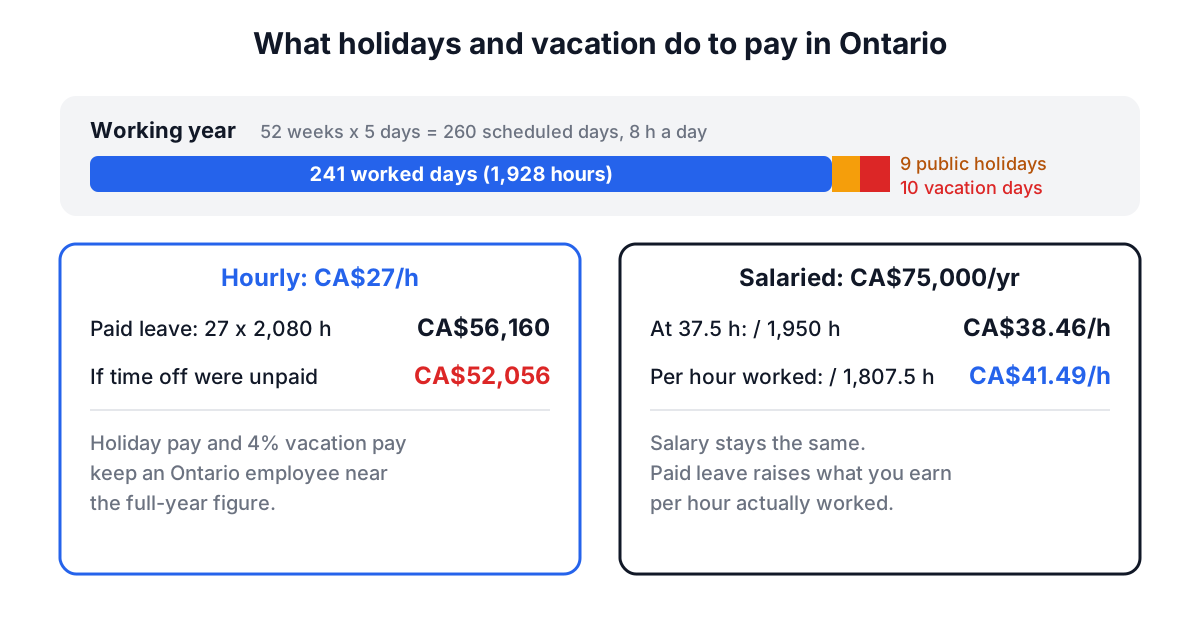
Four per cent of CA$56,160 is CA$2,246.40, slightly more than two weeks' wages (CA$2,160), because 2 weeks out of 52 is only 3.85%. So for an Ontario employee at CA$27, the year stays at about CA$56,160 even though only 241 days are worked. What changes is the pay per hour actually worked:
| Case | Per year | Per hour actually worked |
|---|---|---|
| CA$27/h, holidays and vacation paid | CA$56,160 | CA$29.13 |
| CA$27/h, time off unpaid (some contract work) | CA$52,056 | CA$27.00 |
| CA$75,000 salary, 37.5 h/week | CA$75,000 | CA$41.49 |
The CA$4,104 gap between the first two rows is what paid leave is worth. Use the unpaid row only when you truly are not paid for days off, for example as an independent contractor; the Hourly to Salary Calculator (Canada) has a paid-leave switch for that.
Overtime depends on who regulates your job
There is no single Canadian overtime rule. Federally regulated workplaces follow the Canada Labour Code; everyone else follows their province. Three of the rule sets:
| Jurisdiction | When overtime starts | Rate |
|---|---|---|
| Federal (Canada Labour Code) | Over 8 hours a day or 40 a week; the employer uses whichever gives more | At least 1.5 times, or 1.5 hours off per overtime hour |
| Ontario | Over 44 hours in a work week; no daily overtime | 1.5 times |
| British Columbia | Over 8 hours a day (1.5 times up to 12, 2 times after 12) and over 40 a week, counting only the first 8 hours of each day | 1.5 or 2 times |
Sources: Canada.ca, hours of work; Ontario, overtime pay; BC, overtime pay.
The difference shows up on compressed schedules. Four 12-hour days at CA$27, a 48-hour week, in the Overtime Calculator (Canada):
| Rule | Regular hours | Overtime hours | Week's pay |
|---|---|---|---|
| Ontario | 44 | 4 (all on day four) | CA$1,350 |
| Federal | 32 | 16 (4 a day) | CA$1,512 |
| British Columbia | 32 | 16 (4 a day) | CA$1,512 |
Ontario pays nothing extra for the long days; only the 4 hours past 44 earn time and a half (CA$40.50). Federally and in BC, every hour past 8 in a day is overtime, so the same week pays CA$162 more.
A single 13-hour shift shows BC's double time: 8 regular hours (CA$216), 4 at time and a half (CA$162) and 1 at double time (CA$54), CA$432 in all. Under the federal rule the same day is 8 regular and 5 at time and a half, CA$418.50. In Ontario, if the week stays under 44 hours, it is 13 hours at the regular rate, CA$351.
Three details catch people out:
- Ontario averaging. An employer and employee can agree in writing to average hours over two to four weeks, so overtime is owed only when the average passes 44.
- Federal maximum and time off. Federally, the weekly maximum is usually 48 hours, and you can take 1.5 hours of paid time off per overtime hour instead of money, generally within three months.
- Other provinces. Each province sets its own standards. The calculator also has an Alberta rule; elsewhere, use weekly mode with your province's threshold and check your provincial employment standards page.
Raises against CPI and the average wage
A raise is measured against the old pay, and successive raises compound: 3% then 4% is 1.03 × 1.04 = 7.12%, not 7%. What matters is the real raise after inflation:
real raise = (1 + raise) / (1 + inflation) − 1
The Bank of Canada's price index page showed total CPI up 3.1% in the 12 months to September 2026, while core measures were lower, between 1.8% (CPI-trim) and 2.5% (Bank of Canada, CPI). Statistics Canada's Labour Force Survey reported average hourly wages of employees up 2.2% year over year in October 2026, to CA$37.89 (Statistics Canada, The Daily).
On a CA$75,000 salary, the Raise Calculator (Canada) gives:
| Raise | New salary | Extra per bi-weekly cheque | Real change at 3.1% CPI |
|---|---|---|---|
| 2.2% (average wage growth) | CA$76,650 | CA$63.46 | −0.87% |
| 2.5% | CA$76,875 | CA$72.12 | −0.58% |
| 3.5% | CA$77,625 | CA$100.96 | +0.39% |
So a raise that matched the average wage was still a real pay cut against September's CPI. You needed more than 3.1% to come out ahead. Both figures change monthly; check the latest before a pay discussion.
Putting it together
- Convert both offers to annual pay with the same hours, and decide whether leave is paid.
- Add the overtime you realistically expect, under the rules for your province or the federal code.
- Test any raise against the latest CPI and the average wage growth.
Then add what these sums leave out: income tax and CPP and EI deductions, group benefits, a group RRSP match, and commuting time. The Time Card Calculator helps you total hours for a pay period before you check the overtime.
Tools for this job
- Hourly to Salary Calculator (Canada): annual, bi-weekly and hourly pay with Ontario's public holidays and paid vacation.
- Overtime Calculator (Canada): federal, Ontario, BC and Alberta rules, day by day.
- Raise Calculator (Canada): new pay, bi-weekly increase and the real change after CPI.
Related reading: the Canadian guide to inflation and savings explains how CPI eats into cash, and the US edition of this guide covers the FLSA and California rules.
Frequently asked questions
Is overtime in Ontario after 40 or 44 hours?
After 44 hours in a work week for most employees, at 1.5 times the regular rate. Ontario has no daily overtime unless your contract or collective agreement adds it, so four 12-hour days earn overtime only for the 4 hours past 44.
How much is CA$27 an hour a year?
CA$56,160 at 40 hours a week for 52 weeks, or CA$2,160 every two weeks before deductions. In Ontario, public holiday pay and at least 4% vacation pay mean the yearly total stays about the same even though you work only around 241 days.
Does BC pay double time?
Yes, for hours over 12 in a day. Hours over 8 up to 12 are paid at time and a half, and hours over 40 in a week are overtime too, though only the first 8 hours of each day count toward the 40. A 13-hour day at CA$27 pays CA$432.
Is a 2.2% raise enough in Canada?
Not against September 2026 CPI of 3.1%: 1.022 / 1.031 − 1 is about −0.87%, a real-terms cut. It did match the 2.2% average growth in hourly wages that Statistics Canada reported for October 2026.
Can I take time off instead of overtime pay?
In federally regulated jobs, yes: 1.5 hours of paid time off for each overtime hour, if your employer agrees in writing, generally taken within three months. Provincial rules differ, so check your province's employment standards page.
Sources and further reading
- Hours of work, Government of Canada. Federal standard hours, the greater of daily or weekly overtime, time off in lieu, the 48-hour maximum.
- Your guide to the Employment Standards Act: overtime pay, Government of Ontario. Overtime after 44 hours, no daily overtime, averaging agreements.
- Your guide to the Employment Standards Act: vacation, Government of Ontario. Two weeks and 4%, three weeks and 6% after five years.
- Your guide to the Employment Standards Act: public holidays, Government of Ontario. The nine holidays and how holiday pay is calculated.
- Overtime pay, Government of British Columbia. Daily overtime at 1.5 and 2 times, weekly overtime over 40.
- Consumer price index, Bank of Canada. Total and core CPI, 12-month change.
- Labour Force Survey, October 2026, Statistics Canada. Average hourly wages up 2.2% year over year.
More Pay & Shopping
Every tool in the Pay & Shopping section, free and in your browser.