
Heat Pump vs Gas or Oil Furnace Costs in Canada
Compare a cold-climate heat pump with an oil furnace, gas furnace or baseboards in CA$, with backup heat, your province's power price and its grid emissions.
By Redbison Dev · · 11 min read
Canada edition. Canadian edition in CA$ with oil in litres and gas in m³ or GJ, electric backup for cold snaps, provincial grid intensities from ECCC, Ontario's regulated rates and the closed federal oil-to-heat-pump program. US edition
In Canada, whether a heat pump saves money depends mostly on what it replaces. Against a heating oil furnace or electric baseboards it usually saves a lot: in the worked example, CA$2,304 a year over oil in Nova Scotia and CA$3,483 in Quebec. Against a 95% efficient natural gas furnace it usually costs more to run at today's prices, CA$310 a year more in the Ontario example and much more in Alberta. Emissions follow a different map again, set by how clean your province's electricity is.
This edition works through those cases with the Heat Pump Savings Calculator for Canada. The prices in the examples are illustrations; enter the all-in rates from your own bills.
Heat per dollar: how to compare
A furnace and a heat pump both deliver heat, so compare the cost of one kWh of heat:
furnace: fuel price / (energy per unit x efficiency) heat pump: electricity price / seasonal COP, with backup heat at COP 1
The energy per unit comes from the US Energy Information Administration's conversion factors: 138,500 Btu per US gallon of heating oil, 91,452 Btu per gallon of propane and 1,036 Btu per cubic foot of natural gas. In metric that is about 10.7 kWh per litre of oil and also about 10.7 kWh per cubic metre of gas. Gas billed in gigajoules, as in Alberta and BC, is 277.8 kWh per GJ.
Backup heat is part of the Canadian answer
Cold-climate heat pumps keep heating in deep cold, but their output and efficiency fall as the temperature drops. That is why installations keep backup heat, either electric resistance strips or the existing furnace, for the coldest days. The calculator asks what share of the season's heat comes from backup and charges it at a COP of 1. The examples use 10 to 15%; your installer should estimate it from your climate and how the system is sized.
Backup heat is expensive heat. In the Ontario gas example, raising the backup share from 10% to 20% adds CA$179 a year to the heat pump's bill. Ask contractors for the seasonal performance at your design temperature, not the rating at 8°C, which is the best case.
Worked examples
Enter each in the Heat Pump Savings Calculator for Canada.
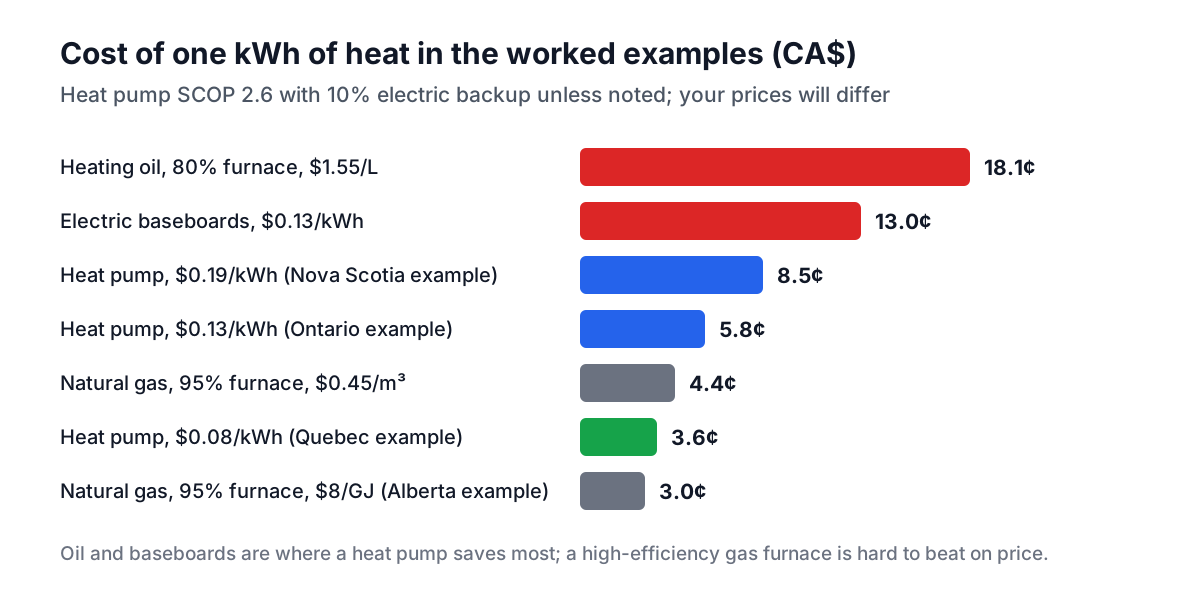
Oil furnace, Nova Scotia. 2,800 litres a year at CA$1.55 per litre in an 80% furnace; heat pump at SCOP 2.6 with 10% backup; electricity at CA$0.19 per kWh; CA$18,000 installed.
- Heat delivered: 24,020 kWh. Heat pump electricity: 10,717 kWh.
- Oil: CA$4,340 a year. Heat pump: CA$2,036. Saving: CA$2,304, a payback of 7.8 years.
- CO2: 7.58 t for oil against 6.73 t for the heat pump, because Nova Scotia's grid is fossil-heavy.
The same house in Quebec. At CA$0.08 per kWh the heat pump costs CA$857 a year, saving CA$3,483, and its CO2 falls to about 28 kg on Quebec's grid.
Gas furnace, Ontario. 2,200 m³ of gas at an all-in CA$0.45 per m³ in a 95% furnace; heat pump at SCOP 2.6 with 10% backup; electricity at CA$0.13 per kWh.
- Gas: CA$990 a year. Heat pump: CA$1,300. The heat pump costs CA$310 a year more.
- Break-even: the heat pump only matches gas below CA$0.099 per kWh.
- CO2 falls from 4.28 t to 0.73 t on Ontario's grid.
- With an older 80% furnace, the gap shrinks to CA$105 a year.
Gas billed in GJ, Alberta. 80 GJ at CA$8 per GJ all-in in a 95% furnace; heat pump at SCOP 2.4 with 15% backup; electricity at CA$0.20 per kWh. Gas costs CA$640 a year and the heat pump CA$2,129. Electricity would need to be about 6 cents per kWh to match. CO2 falls only from 4.03 t to 3.68 t on Alberta's grid.
Electric baseboards, Ontario. 15,000 kWh of baseboard heat at CA$0.13; a heat pump at SCOP 2.6 with 10% backup uses 6,692 kWh, saving CA$1,080 a year. Baseboards are resistance heat at COP 1, so any heat pump beats them.
Finding your real prices
The examples use round all-in prices. Your own are on your bills, and the delivery and fixed charges matter:
- Gas. Divide the total variable charges on a winter bill by the m³ or GJ used. The commodity alone is a small part: the Ontario Energy Board's natural gas rates page lists an Enbridge Gas supply charge of 9.1080 cents per m³ in the Enbridge Gas Inc. zone from October 1, 2026, and about 17.7 cents in the Union South and North East zones, with delivery on top.
- Electricity. Use the rate you will pay across a heating season. The OEB's Regulated Price Plan from November 1, 2026, is 9.1 cents off-peak, 14.6 mid-peak and 18.9 on-peak on time-of-use, or 11.2 and 13.2 cents on tiered pricing with a 1,000 kWh winter threshold, before delivery and regulatory charges. A heat pump runs day and night in winter, so a weighted average plus delivery is the honest figure.
Emissions depend on your province
The calculator uses Environment and Climate Change Canada's electricity consumption intensities, version 4.0 of September 2026, Table 5.4, which ECCC says must be used for reductions in 2027. Table 5.3, for 2026, gives different figures, for example 438 for Alberta and 234 for New Brunswick:
| Province | g CO2e per kWh |
|---|---|
| Quebec | 2.6 |
| Manitoba | 3.0 |
| Newfoundland and Labrador | 17 |
| British Columbia | 18 |
| Ontario | 73 |
| Alberta | 346 |
| New Brunswick | 375 |
| Saskatchewan | 581 |
| Nova Scotia | 628 |
On the first four, a heat pump removes nearly all heating emissions. In Ontario it removes most. In Alberta, Saskatchewan and Nova Scotia the cut is smaller for now, though a heat pump replacing oil still lowers CO2 in every example here.
Rebates
The federal Oil to Heat Pump Affordability program stopped taking applications on July 31, 2026. Applications made before then are still processed: it offered up to CA$10,000 paid upfront, and approved work must be finished and paid for, with receipts uploaded, by January 31, 2027. Check your province and utility for current programs, and enter only a rebate you have confirmed in the incentives field.
Tools for this job
- Heat Pump Savings Calculator for Canada: yearly cost, break-even price, payback and CO2 with backup heat and your province's grid.
- Heat Loss Calculator for Canada: how much heat your home needs at design temperature, to check a contractor's sizing.
- Carbon Footprint Calculator for Canada: heating in the context of your household's other emissions.
- Related reading: the US heat pump versus gas furnace guide explains HSPF2 ratings.
Frequently asked questions
Is a heat pump cheaper than an oil furnace in Canada?
Usually, by a wide margin. Oil at CA$1.55 per litre in an 80% furnace gives heat at about 18 cents per kWh; a heat pump with a seasonal COP of 2.6 and 10% backup at CA$0.19 electricity gives it at about 8.5 cents. In the Nova Scotia example that is CA$2,304 a year.
Is a heat pump cheaper than natural gas in Ontario?
Not usually against a high-efficiency furnace. At CA$0.45 per m³ in a 95% furnace, gas heat costs about 4.4 cents per kWh, against 5.8 cents from a heat pump at CA$0.13 electricity. The heat pump only breaks even below about 9.9 cents per kWh, though it cuts CO2 by about 80% on Ontario's grid.
How much backup heat should I plan for?
It depends on your climate and how the heat pump is sized; ask your installer for an estimate. Every point of backup is heat at COP 1, so with a seasonal COP of 2.6 it costs 2.6 times as much as heat from the heat pump. In the Ontario example, going from 10% to 20% backup adds CA$179 a year.
Can I still get the federal oil to heat pump grant?
Not as a new applicant. The last day to apply was July 31, 2026. Approved applicants must finish and pay for the work, and upload final receipts and the attestation form, by January 31, 2027.
Sources and further reading
- Oil to Heat Pump Affordability program, Government of Canada. Closed to applications July 31, 2026; up to CA$10,000; work deadline January 31, 2027.
- Emission factors and reference values, Environment and Climate Change Canada. Version 4.0 (September 2026) electricity consumption intensities by province, Table 5.4 for 2027.
- Electricity rates, Ontario Energy Board. Regulated Price Plan from November 1, 2026.
- Natural gas rates, Ontario Energy Board. Enbridge Gas supply charges from October 1, 2026.
- Units and calculators explained, US Energy Information Administration. Heat content of heating oil, propane and natural gas.
Open the Heat Pump Savings Calculator
More Energy & Sustainability
Every tool in the Energy & Sustainability section, free and in your browser.