
Reverse Cycle vs Gas Heating: Running Costs in Australia
Compare reverse cycle air conditioning with ducted gas, gas wall heaters, LPG or panel heaters, from the MJ on your gas bill, with your state's grid emissions.
By Redbison Dev · · 11 min read
Australia edition. Australian edition in A$, with gas in megajoules, reverse cycle air conditioning as the heat pump, the 2026-27 Victorian Default Offer rates and the Clean Energy Regulator's 2025-26 state emission factors. US edition
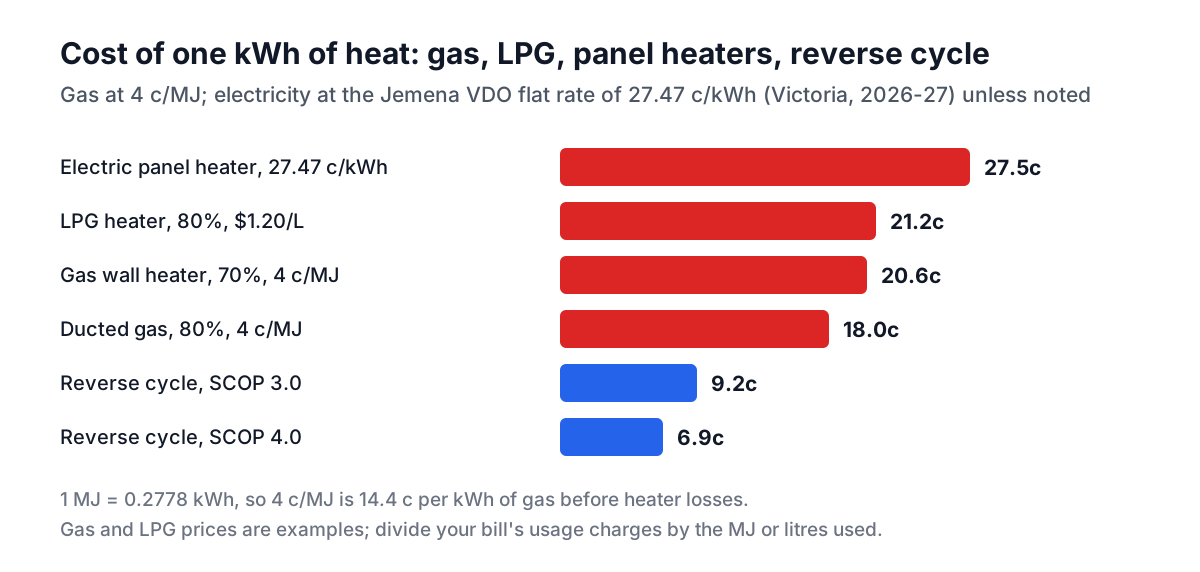
In Australia a heat pump for heating usually means a reverse cycle air conditioner, and at the prices here it is much cheaper to run than gas. With gas at 4 cents per MJ in an 80% efficient ducted heater, heat costs about 18 cents per kWh. A reverse cycle system with a seasonal COP of 4 on the Victorian Default Offer's Jemena flat rate of 27.47 cents per kWh delivers it at about 6.9 cents. For a Melbourne home burning 40,000 MJ a year for heating, that is a saving of about A$990 a year. The emissions answer depends on your state and the system's real efficiency, and in Victoria it can even go the other way.
This edition works from your gas bill with the Reverse Cycle vs Gas Heating Calculator.
From MJ on your bill to kWh of heat
Australian gas bills measure use in megajoules. One kWh is 3.6 MJ, so 40,000 MJ is 11,111 kWh of gas. A heater does not turn all of it into heat in your rooms: an 80% efficient ducted system delivers 8,889 kWh, and a wall furnace at 70% delivers about 7,778 kWh.
Two adjustments before you enter a figure:
- Heating only. Gas for hot water and cooking runs all year. Take your summer quarter's MJ as the baseline, multiply by four, and subtract it from the year's total to estimate the heating share.
- Price per MJ. Divide the usage charges on a winter bill by the MJ used. The daily supply charge stays the same whatever you use, so leave it out unless you plan to disconnect gas entirely.
The calculator does the MJ conversion when you choose MJ as the gas unit. The 4 cents per MJ in these examples is an illustration; your retailer's rate will differ.
A worked example: ducted gas in Melbourne
Enter in the Reverse Cycle vs Gas Heating Calculator: mains gas, 40,000 MJ, 80% efficient, 4 cents per MJ; reverse cycle at a seasonal COP of 4.0; electricity at 27.47 cents per kWh; A$9,000 installed.
- Heat the home needs: 8,889 kWh.
- Reverse cycle electricity: 2,222 kWh.
- Gas: A$1,600 a year. Reverse cycle: A$610. Saving: A$990, a payback of about 9.1 years.
- Break-even: electricity would have to reach 72 cents per kWh before gas was cheaper.
Where does 27.47 cents come from? The Essential Services Commission's Victorian Default Offer sets flat residential usage rates from 1 July 2026 to 30 June 2027 of 25.96 cents (CitiPower), 27.35 (United Energy), 27.47 (Jemena), 28.22 (Powercor) and 31.98 (AusNet Services), including GST. Market offers differ, and the Default Offer's time-of-use rates charge more from 4 pm to 9 pm, when heating often runs, so use the rate your plan actually charges in winter evenings.
How much the efficiency figure matters
Seasonal efficiency varies with the model, the climate and the installation, so test a range. The same Melbourne home at different seasonal COPs, all at 27.47 cents:
| Seasonal COP | Electricity | Running cost | Saving on gas | CO2 in Victoria |
|---|---|---|---|---|
| 4.0 | 2,222 kWh | A$610 | A$990 | 1.73 t |
| 3.5 | 2,540 kWh | A$698 | A$902 | 1.98 t |
| 3.0 | 2,963 kWh | A$814 | A$786 | 2.31 t |
| Gas, 80% ducted | 40,000 MJ | A$1,600 | 2.01 t |
The money saving holds up even at a COP of 3. The carbon saving does not. Victoria's grid factor is the highest in the Clean Energy Regulator's table, so a reverse cycle system at a seasonal COP below about 3.4 can emit more CO2 than the gas heater it replaces, while saving A$786 a year. Rooftop solar, a GreenPower plan, or a better installation changes that.
Your state's grid
The calculator uses the Clean Energy Regulator's 2025-26 location-based scope 2 factors, in kg CO2e per kWh:
| State or territory | Factor |
|---|---|
| Victoria | 0.78 |
| Queensland | 0.67 |
| NSW and ACT | 0.64 |
| Northern Territory | 0.56 |
| Western Australia (SWIS) | 0.50 |
| South Australia | 0.22 |
| Tasmania | 0.20 |
The Melbourne house's reverse cycle system at COP 4 would emit 1.73 t a year in Victoria but only 0.49 t on South Australia's factor. In Tasmania even a COP 3 system emits 0.59 t against 2.01 t for gas.
Other heaters it might replace
Gas wall furnace. If your wall heater is less efficient, say 70%, the same 40,000 MJ delivers only 7,778 kWh of heat at 20.6 cents per kWh, and switching saves A$1,066 a year at COP 4.
LPG. Off the gas network, bottled LPG is dearer per unit of heat. With 900 litres a year at an illustrative A$1.20 per litre in an 80% heater, heat costs 21.2 cents per kWh; a reverse cycle unit at COP 4 saves about A$730 a year.
Electric panel, bar or oil-column heaters. These are resistance heat at COP 1: every kWh of electricity is one kWh of heat. A reverse cycle unit at COP 4 delivers the same heat with a quarter of the electricity. In a Sydney example, 3,000 kWh of panel heating at 33 cents costs A$990; a reverse cycle unit at COP 4 costs A$248, saving A$743 a year and paying back a A$4,000 installation in 5.4 years.
Comparing plans and incentives
If your electricity rate is above the examples, compare offers before deciding. Energy Made Easy, a free government comparison service, covers NSW, Queensland, South Australia, Tasmania and the ACT; Victorians compare through the state's own service, linked from the ESC page. If a state program or retailer offers you a discount on the installation, enter the amount you have confirmed in the calculator's incentive field.
Tools for this job
- Reverse Cycle vs Gas Heating Calculator: running costs from MJ, kWh or litres, break-even price, payback and CO2 on your state's grid.
- Heat Loss Calculator for Australia: how much heat a room or house needs, to check a unit's sizing.
- Electricity Cost Calculator for Australia: what the extra kWh cost on your tariff.
- Solar Payback Calculator for Australia: whether panels would cut the electricity price your heating pays.
- Related reading: the US heat pump versus gas furnace guide covers US fuels and HSPF2 ratings.
Frequently asked questions
Is reverse cycle cheaper to run than ducted gas?
Usually, by a wide margin. At 4 cents per MJ in an 80% heater, gas heat costs about 18 cents per kWh. A reverse cycle unit with a seasonal COP of 4 at 27.47 cents per kWh delivers it at about 6.9 cents. In the Melbourne example that saves about A$990 a year.
How do I convert the MJ on my gas bill to kWh?
Divide by 3.6. A bill showing 40,000 MJ is 11,111 kWh of gas. Multiply by your heater's efficiency to get the heat it delivered: 8,889 kWh at 80%.
Does switching to reverse cycle reduce emissions in Victoria?
It depends on the system's efficiency. On Victoria's 0.78 kg per kWh factor, a unit at a seasonal COP of 4 emits 1.73 t a year against 2.01 t for the gas heater, but at a COP of 3 it emits 2.31 t, more than gas. Solar or GreenPower reverses that.
Should I include the gas supply charge in the comparison?
Only if you will remove every gas appliance and close the account. Then the yearly supply charge becomes an extra saving. If you keep gas for hot water or cooking, you keep paying it.
Sources and further reading
- Victorian Default Offer, Essential Services Commission. Flat and time-of-use residential rates from 1 July 2026 to 30 June 2027, including GST.
- Victorian Default Offer price review 2026-27, Essential Services Commission. Average domestic bill of A$1,591 at 4,000 kWh a year.
- Amendments to National Greenhouse and Energy Reporting legislation, Clean Energy Regulator. 2025-26 location-based scope 2 factors by state.
- Energy Made Easy, Australian Government. Electricity and gas plan comparison for NSW, Queensland, South Australia, Tasmania and the ACT.
- Units and calculators explained, US Energy Information Administration. Heat content of propane and natural gas behind the LPG conversion.
Open the Heat Pump Savings Calculator
More Energy & Sustainability
Every tool in the Energy & Sustainability section, free and in your browser.