
How to Estimate Fence Posts and Concrete in Canada
Fence posts, rails, boards and 30 kg concrete bags for a Canadian yard, why frost-depth holes double the concrete, gates and corners, and pool fence bylaws.
By Redbison Dev · · 10 min read
Canada edition. Written for Canadian yards: posts set below the frost line (48 in where Ontario deck guides set footings), 30 kg concrete bags, feet and inches as lumber is sold, the NBC's soil and frost logic, and Toronto's fence and pool enclosure rules as an example bylaw. US edition
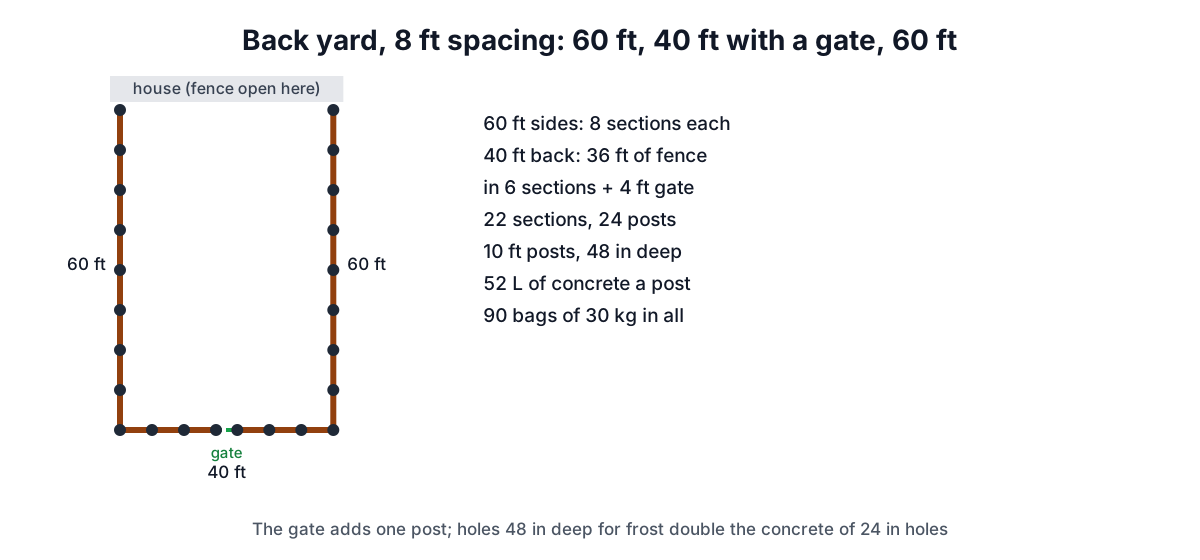
A 6 ft wood privacy fence around three sides of a Canadian back yard, 60, 40 and 60 feet with a 4 ft gate, takes 24 posts, 70 rails and 374 boards. The number that changes in Canada is the concrete: set the posts 48 inches deep to get below frost and each 10 inch hole takes about 52 litres, 90 bags of 30 kg for the fence, twice what 24 inch holes, as in the US edition of this guide, would use. The Fence Calculator (Canada) does the count with your yard; this guide explains each number and the local rules to check.
Posts: sections plus one, gates add one
Posts go at a maximum spacing; this example uses 8 ft. Each straight run is divided into whole sections, spaced evenly, with one more post than sections:
sections = round up (run length / 8 ft)
posts on a run = sections + 1
Where runs meet at a corner, they share a post. A gate splits a run into two pieces of fence, each with its own end posts, so it adds one post.
| Back yard, 8 ft maximum spacing | Fence | Sections |
|---|---|---|
| 60 ft side | 60 ft | 8 of 7.5 ft |
| 40 ft back, one 4 ft gate | 36 ft, 18 ft each side of the gate | 6 of 6 ft |
| 60 ft side | 60 ft | 8 of 7.5 ft |
| Total, open at the house | 22 sections, 24 posts |
Rails and boards
This example uses three rails per section for the 6 ft privacy fence: 22 x 3 = 66 rails, 70 with 5% extra. Boards are counted per section from the board width and gap. 1x6 boards are 5-1/2 in wide, so with no gap a 7.5 ft (90 in) section takes 17 boards and a 6 ft (72 in) section 14:
8 x 17 + 6 x 14 + 8 x 17 = 356 boards, 374 with 5% for splits and warped boards.
Frost: why Canadian holes are deeper
Frost heave lifts posts that sit in freezing, wet soil. Fence posts are not covered by the building code, but the code's foundation rules show the same logic. NBC 2025 Table 9.12.2.2 sets no minimum depth for foundations on rock, while for unheated foundations in clay or soils that are not clearly defined it requires 1.2 m and not less than the depth of frost penetration; silt and poorly drained coarse soils must go below the frost depth. Municipal deck guides apply this to small footings: the Trent Hills deck design guide, citing the Ontario Building Code, sets a minimum footing depth of 48 in (1.2 m) for a deck attached to a house or one that needs a guard.
Frost depth varies a lot across Canada, so ask your municipality for the local figure. The calculator takes whatever depth you enter.
Concrete per post, by depth
The concrete fills the hole around the post:
concrete = π x (hole diameter / 2)² x depth - post width² x depth
The calculator assumes a 30 kg bag of concrete mix yields about 14 litres, scaled by weight from QUIKRETE's published yield of about 17 litres for an 80 lb (36.2 kg) bag. Check the yield on the bag you buy.
| 4x4 posts (3-1/2 in), 24 posts | Concrete a post | Bags a post (mixed one by one) | Bags for the fence | Post length for a 6 ft fence |
|---|---|---|---|---|
| 10 in holes, 24 in deep | 26 L | 2 | 45 | 8 ft |
| 10 in holes, 48 in deep | 52 L | 4 | 90 | 10 ft |
| 10 in holes, 60 in deep | 65 L | 5 | 112 | 11 ft |
| 12 in holes, 48 in deep | 79 L | 6 | 136 | 10 ft |
Going from 24 to 48 inches doubles the concrete and lengthens every post by 2 ft. A wider hole costs more than it looks: 12 inch holes at 48 in take about half as much concrete again as 10 inch holes. Gate posts, which a swinging gate pulls sideways, are the ones worth the bigger hole and post.
Bylaws and pool enclosures
Fence heights in Canada are set by municipal bylaws. Toronto, for example, sets heights by location in its Fence Bylaw, and its fence permit guide covers pool enclosures:
- minimum enclosure height of 1.2 m for a single residential property and 1.8 m for multiple residential and non-residential properties;
- the enclosure must completely surround the pool, with no opening except a gate that complies with the bylaw;
- it must be at least 1.2 m from the edge of the pool and 1 m from easily climbable objects such as a tree, with nothing climbable on the outside between 10 cm and 1.2 m above the ground.
A pool fence built with rails on the outside could break that last rule, so plan the rails on the pool side. Other municipalities set their own rules.
Before you dig
Book a utility locate through your province's one-call service a few days before digging. Confirm the property line from your survey, and set the corner, end and gate posts first, then run a string line for the posts between them.
Frequently asked questions
How deep should fence posts be in Canada?
Below the frost line where you build. In Ontario, municipal deck guides use 48 in (1.2 m) for footings, following the Ontario Building Code; elsewhere the depth differs. Ask your municipality for the local depth.
How many 30 kg bags of concrete per fence post?
For a 4x4 post in a 10 inch hole 48 inches deep, about 52 litres, which is four 30 kg bags if you mix each hole separately. A 12 inch hole at the same depth takes about six.
How long should fence posts be for a 6 ft fence in Canada?
Fence height plus hole depth: with 48 in in the ground, 10 ft posts. With 60 in holes, 11 ft.
How high does a pool fence have to be in Toronto?
At least 1.2 m for a single residential property and 1.8 m for multiple residential or non-residential properties, surrounding the pool completely with a compliant gate.
Sources and further reading
- National Building Code of Canada 2025, National Research Council Canada. Table 9.12.2.2, minimum depths of foundations by soil type and frost.
- Deck design guide, Municipality of Trent Hills. 48 in (1.2 m) footing depth under OBC 9.12.2.2.
- Fences: building permit application guide, City of Toronto. Fence Bylaw and pool enclosure rules.
- Codes Canada, National Research Council Canada. Provincial adoption of the national codes.
- Ontario's Building Code, Government of Ontario.
- Concrete Mix 1101 data sheet, QUIKRETE. About 0.60 cu ft (17 L) per 80 lb (36.2 kg) bag, the basis of the calculator's bag yields.
- How to estimate fence materials (US edition), RedBison. The same method with 80 lb bags.
More Construction & Home
Every tool in the Construction & Home section, free and in your browser.