
How Many Colorbond Panels, Posts and Palings Do I Need?
Counting Colorbond panels or timber palings, rails, posts and 20 kg concrete bags for an Australian boundary fence, plus how neighbours share a dividing fence.
By Redbison Dev · · 10 min read
Australia edition. Written for Australian boundary fences: Lysaght Neetascreen panels in 2350 and 3100 mm widths, timber paling fences, 20 kg concrete bags, A$, NSW dividing fence cost sharing, pool barriers on a boundary and asbestos in old fibro fences. US edition
A 30 metre side boundary in Colorbond steel fencing, using 2350 mm Neetascreen panels, takes 13 panels and 14 posts; with the 3100 mm panel width it is 10 panels and 11 posts. A timber paling fence along a 20 metre boundary, with posts at 2.4 m, takes 10 posts, 29 rails and 142 palings of 150 mm. The Fence Calculator (Australia) counts panels or palings, posts and concrete for each side of your block; this guide covers how the numbers work and who pays for a dividing fence.
Colorbond panels: the panel width sets the bays
Lysaght lists Neetascreen, its Colorbond steel boundary fence, in panel widths of 2350 mm and 3100 mm and heights of 1500, 1800 and 2100 mm. The standard panel is not sold in South Australia, where Lysaght offers an SA Variant 2370 mm wide; enter 2.37 m as the spacing there. For panels, each bay is one panel, so the post spacing is the panel width in your kit:
panels = round up (run length / panel width)
posts = panels + 1
The calculator spreads the run evenly, so on 30 m of 2350 mm panels each bay is 2.31 m and panels are trimmed on site to suit.
| 30 m side boundary | Panels | Posts |
|---|---|---|
| 2350 mm panels | 13 | 14 |
| 3100 mm panels | 10 | 11 |
The wider panel saves three posts and three holes on this run. Check which widths your supplier stocks and what the installation guide says about post sizes for your wind region before choosing on post count alone.
Three sides of a block
Each side is often shared with a different neighbour, so work them out separately. Corners share a post; a fence open at the house has one more post than panels.
| Block, 2350 mm panels | Panels |
|---|---|
| 15 m side | 7 |
| 20 m back | 9 |
| 15 m side | 7 |
| Total | 23 panels, 24 posts |
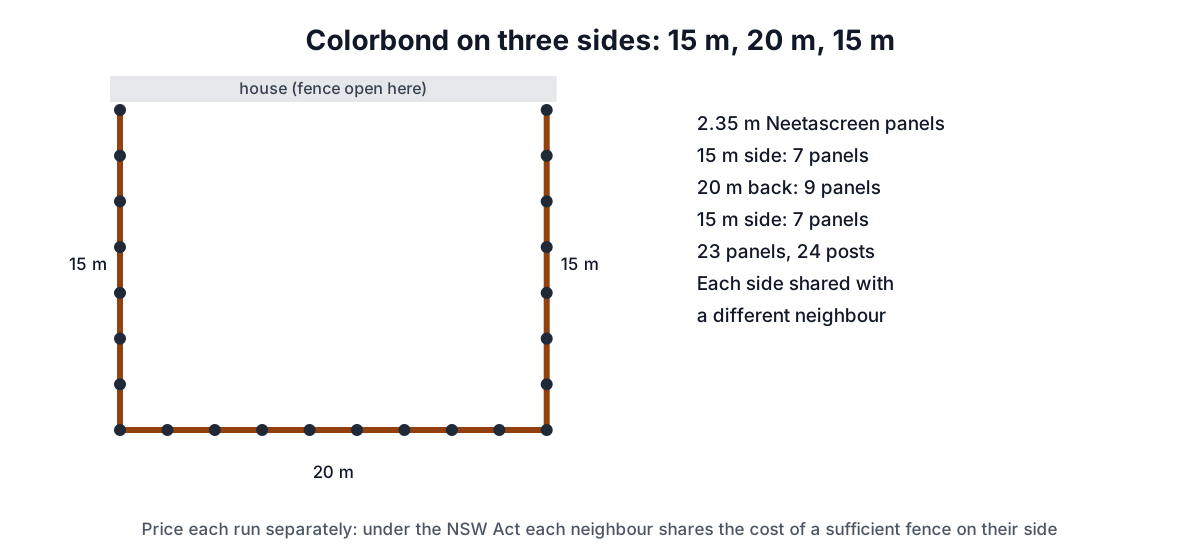
Pricing each run on its own makes it easy to split the bill with each neighbour.
Timber paling fences
A paling fence has posts, rails between them and vertical palings nailed to the rails. For a 1.8 m fence this example uses three rails per bay. Palings are counted per bay from the paling width and any gap:
palings per bay = round up (bay length / (paling width + gap))
On a 20 m run with posts at up to 2.4 m, the calculator makes 9 bays of 2.22 m and 10 posts. With 150 mm palings butted together that is 15 per bay, 135 in all, and 142 with 5% for splits; rails are 27, or 29 with the same 5%. With 100 mm palings the same fence takes 218. For lapped or lapped-and-capped fences, where palings overlap, enter the cover width (the paling width less the overlap) with no gap.
Post length and concrete
For a 1.8 m fence with 600 mm in the ground the posts are 2.4 m long. The concrete fills the hole around the post:
concrete = π x (hole diameter / 2)² x depth - post width² x depth
The calculator assumes a 20 kg bag of concrete mix yields about 9.4 litres, scaled by weight from QUIKRETE's published yield of about 17 litres for an 80 lb (36.2 kg) bag; check the yield on your bag. The table uses the calculator's default holes; follow the hole sizes in your fence system's installation guide, which can be smaller.
| Fence | Hole and post | Concrete a post | Bags for the whole fence |
|---|---|---|---|
| Colorbond, 30 m, 14 posts | 300 mm x 600 mm, 50 mm post | 40.9 L | 62 |
| Colorbond, 30 m, 3100 mm panels, 11 posts | same | 40.9 L | 49 |
| Paling, 20 m, 10 posts | 300 mm x 600 mm, 100 mm post | 36.4 L | 39 |
Mixed hole by hole, a 40.9 litre hole takes five 20 kg bags; the whole-fence total is lower because part bags carry over from hole to hole.
Who pays: dividing fences in NSW
A boundary fence between neighbours is usually a dividing fence, and each state has its own law. In NSW, Legal Aid NSW explains that under the Dividing Fences Act 1991 owners must share the cost of building, repairing or replacing a sufficient dividing fence, except where the fence acts as a pool barrier or was damaged by one owner. What counts as sufficient depends on the existing fence, other fences in the area, how the land on each side is used and other matters. A fence that is not exactly on the boundary line is still a dividing fence, so you need your neighbour's agreement for the work.
In practice that means agreeing the fence type and the quote first, then splitting each side's cost with that side's neighbour. Other states have their own Acts and notice rules; check yours before ordering.
Pool barriers on a boundary
If the fence also forms part of a pool barrier, it is held to a different standard. Under the NSW variation in NCC 2025 Volume Two, Part H7, a pool with water more than 300 mm deep associated with a house needs safety barriers to AS 1926.1 and AS 1926.2, and a clause of AS 1926.1 that would not otherwise apply to boundary barriers is made to apply. The calculator counts materials; it does not check a barrier against those standards.
Old fibro fences
Replacing an old fibro fence is not a DIY demolition job until you know what it is. SafeWork NSW says asbestos cement sheeting was commonly used in building materials from the 1940s to the late 1980s. Have old sheeting checked before you cut, break or remove it.
Frequently asked questions
How many Colorbond panels do I need for a 30 m fence?
With 2350 mm panels, 13 panels and 14 posts. With 3100 mm panels, 10 panels and 11 posts. Divide each run by the panel width in your kit and round up.
How many palings per metre?
With 150 mm palings butted together, 1,000 / 150 = 6.7, so about 7 per metre; with 100 mm palings, 10. On a 20 m fence with 2.22 m bays that is 135 or 207 palings before extra for splits.
Do I have to share the cost of a fence with my neighbour in NSW?
Usually. Owners must share the cost of a sufficient dividing fence under the Dividing Fences Act 1991, except where the fence is a pool barrier or was damaged by one owner.
How many bags of concrete per fence post?
A 300 mm hole 600 mm deep around a 50 mm Colorbond post holds about 41 litres, five 20 kg bags if you mix each hole separately. Check the hole size in your installation guide.
Sources and further reading
- NEETASCREEN fencing, Lysaght. Panel widths of 2350 and 3100 mm, heights, availability by state and the 2370 mm SA Variant.
- Fences, boundaries and retaining walls: FAQs, Legal Aid NSW. Cost sharing for a sufficient dividing fence under the Dividing Fences Act 1991.
- NCC 2025 Volume Two, Part H7, Australian Building Codes Board. Pool safety barriers to AS 1926.1, including the NSW variation for boundary barriers.
- Asbestos, SafeWork NSW. Asbestos cement sheeting from the 1940s to the late 1980s.
- Concrete Mix 1101 data sheet, QUIKRETE. About 0.60 cu ft (17 L) per 80 lb (36.2 kg) bag, the basis of the calculator's bag yields.
- How to estimate fence materials (US edition), RedBison. The method in feet with 80 lb bags.
More Construction & Home
Every tool in the Construction & Home section, free and in your browser.