
How Many Fence Panels and Posts Do I Need? UK Guide
Counting 6 ft fence panels, posts and bags of post mix for a UK garden fence in metres, why bay width is panel plus post, gates, corners and fence height rules.
By Redbison Dev · · 10 min read
United Kingdom edition. Written for UK garden fences: 1.83 m (6 ft) panels between 100 mm posts, 2.4 m posts, 20 and 25 kg bags of post mix, the 1 m and 2 m permitted development heights in England and Wales, boundary ownership and checking for buried services. US edition
A 25 metre garden boundary in standard 6 ft (1.83 m) fence panels needs 13 panels and 14 posts, if the posts are 100 mm wide. Each bay is a panel plus a post, about 1.93 m, not 1.83 m; counting on the panel width alone gives 14 panels and 15 posts, one of each more than you need. For a 1.8 m fence the posts are 2.4 m long with 600 mm in the ground, and each hole takes about 23.5 litres of concrete. The Fence Panel Calculator (UK) does the count for each side of your garden; this guide explains the rules behind it.
Bays: panel width plus post width
A UK panel fence is a row of bays. Each bay is one panel fixed between two posts, so the distance from the centre of one post to the next is the panel width plus one post width:
bay = panel width + post width = 1.83 m + 0.10 m = 1.93 m
panels = round up (run length / bay)
posts = panels + 1
For 25 m: 25 / 1.93 = 12.95, so 13 panels and 14 posts. The calculator spreads the run evenly, so each bay comes out at 1.923 m and you trim one panel slightly or nudge the posts. Enter 1.83 m as the spacing by mistake and the same 25 m gives 14 panels and 15 posts. With slotted concrete posts, use the centre-to-centre spacing the post maker gives.
There is always one more post than panels on a straight run, for the same reason a row of ten trees one metre apart is nine metres long. That off-by-one is an easy mistake to make in a fence order.
Corners share a post, gates add one
Many back gardens are fenced on three sides and open at the house. Work each side separately, because each is rounded up to whole panels on its own:
| Back garden, 1.93 m bays | Panels | Posts |
|---|---|---|
| 10 m side | 6 | |
| 6 m back | 4 | |
| 10 m side | 6 | |
| Total, open at the house | 16 | 17 |
| Same, with a 0.9 m gate in the back | 16 | 18 |
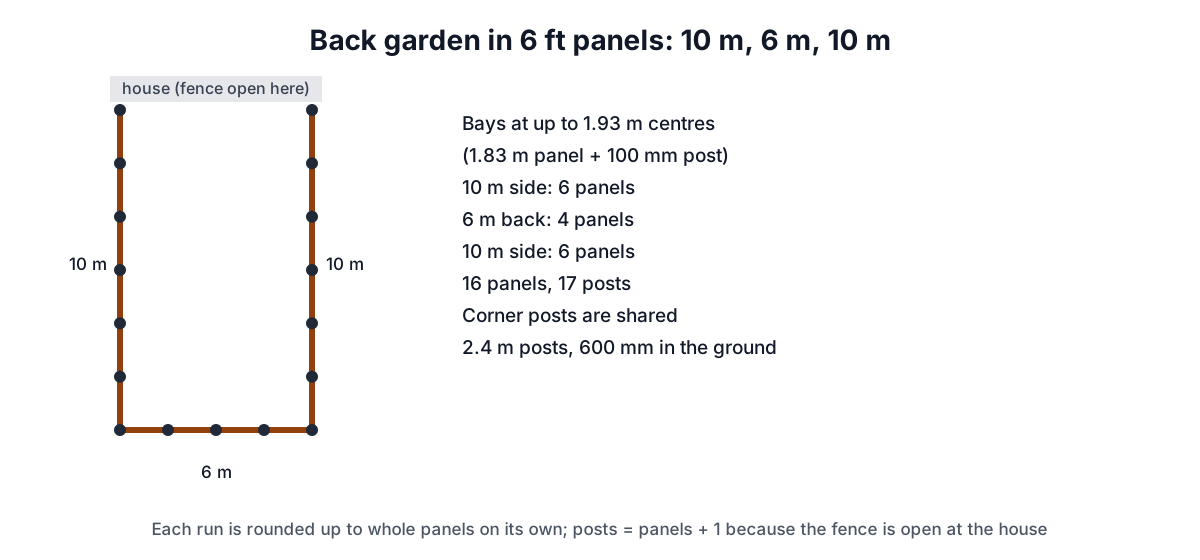
The corner posts finish one side and start the next, so they are counted once. A gate needs a post on each side of the opening, which adds one post to the run; in the 6 m back, a 0.9 m gate leaves 2.55 m of fence on each side, which still takes two panels each, four in all.
Post length and holes
For a 1.8 m fence, about 600 mm of post goes in the ground, so the post is 2.4 m (8 ft) long. A 0.9 m front fence with 450 mm in the ground needs 1.35 m posts.
The concrete fills the hole around the post. For a round hole the volume is:
concrete = π x (hole diameter / 2)² x depth - post width² x depth
A 250 mm hole 600 mm deep around a 100 mm post holds 29.5 litres, the post takes 6 litres, and 23.5 litres of concrete are left. A 300 mm hole at the same depth takes 36.4 litres.
Bags of post mix
Bags are sold by weight, but what matters is how much concrete each bag makes. The calculator assumes a 20 kg bag yields about 9.4 litres and a 25 kg bag about 11.7 litres, scaled by weight from QUIKRETE's published yield of about 17 litres for an 80 lb (36.2 kg) bag of concrete mix. Rapid-set post mixes may yield a different amount, so check the yield printed on the bag you buy and adjust.
| 25 m of panels, 14 posts | Concrete a post | Bags a post if mixed one by one | Bags for the whole fence |
|---|---|---|---|
| 250 mm holes, 20 kg bags | 23.5 L | 3 | 36 |
| 250 mm holes, 25 kg bags | 23.5 L | 3 | 29 |
| 300 mm holes, 20 kg bags | 36.4 L | 4 | 55 |
The whole-fence total is lower than bags a post times 14, because a part bag left over from one hole goes into the next when you mix in a barrow. A 20 or 25 kg bag is a real lift: HSE's manual handling guidance is written for work, but the same care with loads applies to a weekend fence.
Rails and boards for picket and feather edge fences
Not every fence uses panels. For a front picket fence, choose rails and boards and enter the width of each pale and the gap between them. An 8 m front fence with a 0.9 m gate, 0.9 m high, 70 mm pales with 50 mm gaps, two rails and 75 mm posts comes to 6 posts, 9 rails and 63 pales including 5% for splits, and 13 bags of 20 kg.
For a feather edge (close board) fence, the boards overlap, so enter the cover width of each board, its width less the overlap, with a gap of 0.
Height limits and permission
Most garden fences do not need planning permission, but the heights matter. In England, the Planning Portal sets out that a new fence, wall or gate is permitted development if it is no more than one metre high next to a highway used by vehicles (or its footpath), and no more than two metres elsewhere. The rights do not apply to a listed building or its curtilage, and they can be removed by an Article 4 direction or a planning condition. Wales has the same 1 m and 2 m limits. Scotland and Northern Ireland have their own rules.
That makes a 1.8 m panel fence fine for a back boundary and keeps anything next to the pavement at the front to 1 m or less.
Whose fence is it, and what is under it?
GOV.UK says that in England and Wales there is usually no record of the exact boundary between two properties or of who owns the fence between them. Title plans show the general position. Before you replace a boundary fence, check your deeds and talk to your neighbour.
Before digging post holes near the house, the drive or the front boundary, check for buried cables and pipes. HSE sets out the precautions in HSG47, Avoiding danger from underground services, and LinesearchbeforeUdig offers a free service with utility asset maps.
Frequently asked questions
How many fence panels do I need for 25 metres?
With 1.83 m (6 ft) panels on 100 mm posts each bay is about 1.93 m, so 25 m needs 13 panels and 14 posts. Measure your posts: wider posts, or slotted concrete posts, change the bay.
How many bags of postcrete per fence post?
It depends on the hole. A 250 mm round hole 600 mm deep around a 100 mm post holds about 23.5 litres of concrete, three 20 kg bags at the yield the calculator assumes. Read the yield on your bag, as mixes differ.
How tall can a garden fence be without planning permission?
In England and Wales, up to 2 metres, or up to 1 metre next to a highway used by vehicles or its footpath. Listed buildings, Article 4 directions and planning conditions can remove those rights.
How long should fence posts be for a 6 ft fence?
About 2.4 m (8 ft), with roughly 600 mm in the ground for a 1.8 m fence.
Sources and further reading
- Fences, gates and garden walls, Planning Portal. Permitted development heights and exceptions in England.
- Planning permission: fences, gates and garden walls, Welsh Government.
- Your property boundaries, GOV.UK. Boundary and fence ownership records in England and Wales.
- HSG47: Avoiding danger from underground services, Health and Safety Executive.
- LinesearchbeforeUdig, LSBUD. Free utility asset maps before digging.
- Manual handling at work, Health and Safety Executive.
- Concrete Mix 1101 data sheet, QUIKRETE. About 0.60 cu ft (17 L) per 80 lb (36.2 kg) bag, the basis of the calculator's bag yields.
More Construction & Home
Every tool in the Construction & Home section, free and in your browser.