
25 vs 30 Year Amortization in Canada: Payment and Interest
A 25- or 30-year amortization on one Canadian mortgage: CMHC premium, payment, balance at renewal, and paying a 30 like a 25 within your prepayment limits.
By Redbison Dev · · 10 min read
Canada edition. Written for Canadian buyers: the choice is amortization, not a 15- or 30-year fixed loan, with CA$ examples compounded half-yearly, CMHC premiums, renewal balances and prepayment privileges. US edition
Canadians rarely face the American choice between a 15-year and a 30-year fixed loan, because Canadian mortgage terms, the period your rate is set for, run from a few months to five years or more, as FCAC puts it, not the life of the loan. The real decision is the amortization: 25 years, or 30 if you are an insured first-time buyer or buying a new build. On a CA$600,000 home with 10% down at an example 4.5% five-year fixed rate, a 30-year amortization lowers the payment by CA$268.79 a month, adds CA$1,080 of CMHC premium, and leaves you owing CA$19,378 more when the first five-year term ends. Pay the 30-year mortgage at the 25-year amount and it costs only about CA$2,200 more in total interest than the 25-year one, with a fallback payment you can drop to at renewal.
The figures come from the Canadian Mortgage Calculator with compounding set to half-yearly, the usual convention for Canadian fixed rates; section 6 of the Interest Act requires a blended-payment mortgage to state its rate calculated yearly or half-yearly, not in advance.
Term and amortization are separate choices
The Financial Consumer Agency of Canada (FCAC) separates two clocks on every mortgage:
- Term: how long your contract, rate and conditions last, "from a few months to 5 years or more". Most Canadian borrowers choose five years or less and then renew.
- Amortization: how long it would take to repay the whole loan at the current rate. FCAC calls it "an estimate based on your current term's interest rate".
So when a US article compares a 15-year and a 30-year mortgage, the nearest Canadian equivalent is a five-year term on a 25-year amortization against a five-year term on a 30-year amortization. Your rate is set by the term and the product, and it will be reset four or five times before either mortgage is paid off.
Who can choose 30 years
FCAC states the limits for a down payment under 20%, where mortgage default insurance is required:
| Buyer | Maximum amortization (under 20% down) |
|---|---|
| First-time buyer | 30 years |
| Buying a new build | 30 years |
| Everyone else | 25 years |
These rules came into force on December 15, 2024, when the Department of Finance extended 30-year insured amortizations to all first-time buyers and all buyers of new builds. With 20% or more down, the mortgage is uninsured and FCAC says your lender sets the maximum amortization.
CMHC charges more for the longer option. Its premium table charges 3.10% of the loan for a loan-to-value from 85.01% to 90%. CMHC announced a 20-basis-point surcharge, effective August 1, 2024, for qualified first-time buyers who opt for a 30-year amortization, and its premium information page notes that an amortization beyond 25 years is subject to a 0.20% surcharge. Premiums in Quebec, Ontario and Saskatchewan also attract provincial sales tax, which must be paid at closing and cannot be added to the loan.
The same home at 25 and 30 years
A first-time buyer pays CA$600,000 with CA$60,000 down. In the mortgage calculator, enter a price of 600000, a down payment of 10%, a rate of 4.5, compounding half-yearly, insurance CMHC, and set property tax and other costs to 0 so you see the loan alone. Then switch the amortization between 25 and 30.
| 25-year amortization | 30-year amortization | |
|---|---|---|
| CMHC premium | 3.10% = CA$16,740 | 3.30% = CA$17,820 |
| Mortgage including premium | CA$556,740 | CA$557,820 |
| Monthly payment | CA$3,081.41 | CA$2,812.62 |
| Interest in the first five years | CA$116,941.93 | CA$119,112.64 |
| Owing at the first renewal (month 60) | CA$488,797.61 | CA$508,175.73 |
| Owing after 10 years | CA$403,923.74 | CA$446,159.93 |
| Interest over the full amortization, if 4.5% never changed | CA$367,681.60 | CA$454,721.48 |
The last row is the number most people quote, CA$87,040 more interest for the longer amortization, but it assumes your rate stays at 4.5% for 30 years, far beyond any five-year term. The renewal row is the one you can rely on. After five years of payments the 30-year borrower has paid CA$16,127 less and owes CA$19,378 more.
These rates are examples. The Bank of Canada's weekly survey of the six largest banks showed a posted five-year conventional rate of 6.19% for the week of November 4, 2026; most borrowers negotiate a discount from the posted rate, so check what you are actually offered.
What happens at renewal
The two borrowers renew with 20 and 25 years left. The new rate sets the new payment:
| Renewal rate (half-yearly) | 25-year mortgage, 20 years left | 30-year mortgage, 25 years left |
|---|---|---|
| 4.5% | CA$3,081.41 | CA$2,812.62 |
| 5.5% | CA$3,345.29 | CA$3,101.86 |
| 6.5% | CA$3,619.55 | CA$3,403.88 |
If rates rise two points, the 25-year borrower's payment goes up by CA$538.14 a month; the 30-year borrower's stays CA$215.67 lower than that. That gap is the cushion the longer amortization buys, and it is why the federal government framed the change as lowering monthly payments, not the cost of the home.
Paying a 30-year amortization like a 25-year one
Take the 30-year amortization and pay the 25-year amount, CA$3,081.41, by adding 268.79 as an extra monthly payment in the calculator:
- The mortgage is paid off in 302 months, 25 years and 2 months, if the rate stayed at 4.5%.
- Total interest is CA$369,900.05, CA$84,821 less than the plain 30-year amortization and only CA$2,218 more than the true 25-year mortgage. The difference is mainly the extra CA$1,080 of premium, which is borrowed and charged interest.
- At the first renewal you owe CA$490,146.76, almost the same as the 25-year borrower.
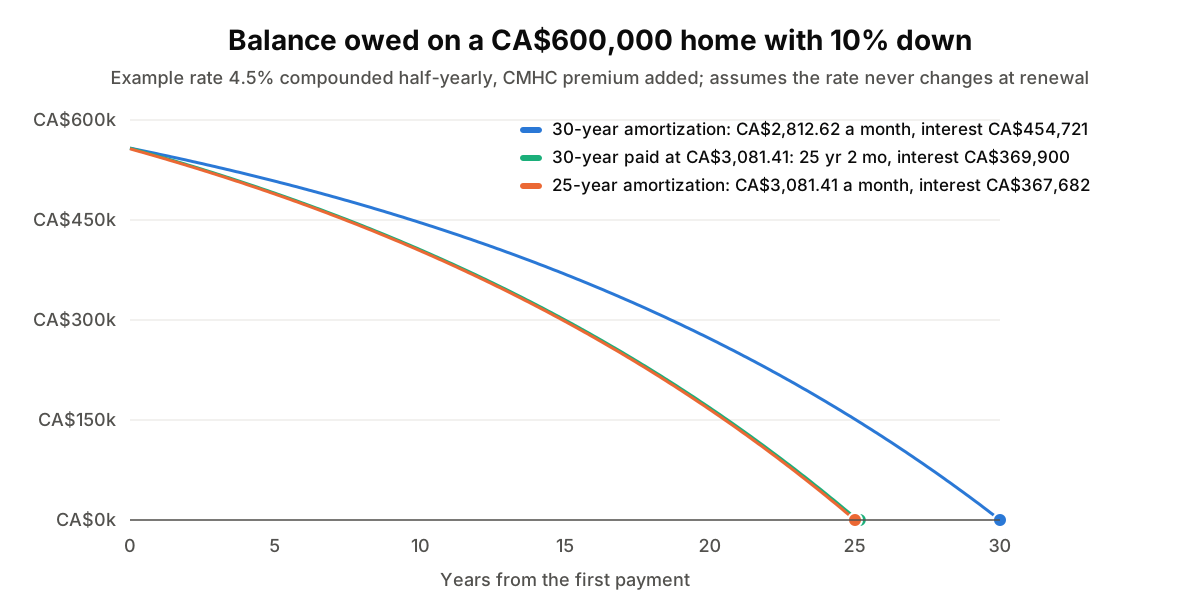
That is a much smaller penalty for flexibility than in the US guide, because here both amortizations carry the same example rate. A US 30-year fixed loan usually costs more than a 15-year one; a Canadian five-year fixed rate is priced on the term, so check whether your lender quotes a different rate for the longer amortization before you assume the two are equal.
The catch: prepayment privileges
In the US, extra payments are usually unlimited. A closed Canadian mortgage limits them. FCAC explains that prepayment privileges let you:
- increase your regular payments by a certain percentage;
- make lump-sum payments up to a certain amount or percentage of the original mortgage amount.
They "vary from lender to lender", most lenders cap them per year, and unused room usually does not carry forward. Paying more than the privilege allows triggers a prepayment penalty, typically the higher of three months' interest and the interest rate differential. FCAC also warns that once you increase your payments, you normally cannot lower them until the end of the term.
In this example the CA$268.79 increase is 9.6% of the 30-year payment. Before you rely on the plan, find the payment-increase limit in your contract and confirm the increase fits. If it does not, the same money can go in as an annual lump sum within your lump-sum privilege. FCAC notes that an open mortgage lets you prepay any amount without a penalty.
Because a raised payment is locked for the term, the 30-year amortization's flexibility arrives at renewal, not mid-term. At renewal you can choose to drop back to the 30-year payment if money is tight, or keep paying the higher amount.
Which amortization fits
Choose 25 years if the payment fits comfortably at a rate two points above your contract rate, you would not keep up voluntary extra payments, and you want the larger cushion of equity at each renewal.
Choose 30 years if you qualify, you value the lower required payment, and you have a plan for the difference: an emergency fund, paying off higher-rate debt, or using prepayment privileges each year. The longer amortization can also help you pass the stress test, but borrowing the maximum the longer amortization allows removes most of its cushion.
Either way, this comparison assumes a fixed rate for each term and does not fit variable-rate mortgages, and it ignores land transfer tax and closing costs. A licensed mortgage professional or a fee-only planner can test your own numbers.
Tools for this job
- Canadian Mortgage Calculator: half-yearly compounding, the CMHC premium with the 30-year surcharge, extra monthly or yearly payments, and bi-weekly or accelerated frequencies.
- Mortgage Refinance and Renewal Calculator: the payment at renewal on the balance you will owe, and whether breaking early pays.
- Mortgage Affordability Calculator: how the amortization changes what you qualify for under the stress test.
For CMHC, the stress test and accelerated payments in more depth, read how mortgages work in Canada. For the shape of each payment, see EMI and loan amortization.
Frequently asked questions
Can I get a 30-year amortization with less than 20% down?
Yes, if you are a first-time buyer or buying a new build. FCAC sets the maximum for insured mortgages at 30 years for those buyers and 25 years for everyone else. CMHC adds 0.20 points to the premium for the 30-year option, so 10% down costs 3.30% of the loan instead of 3.10%.
How much lower is the payment on a 30-year amortization?
On a CA$557,820 insured mortgage at 4.5% compounded half-yearly, the 30-year payment is CA$2,812.62 a month against CA$3,081.41 for 25 years on CA$556,740, a difference of CA$268.79. The gap shrinks as rates fall and widens as they rise.
Will I pay much more interest with a 30-year amortization?
Only if you make just the required payments. If the 4.5% rate held for the whole loan, the 30-year option would cost CA$87,040 more. Paying it at the 25-year amount cuts the extra to about CA$2,200, mostly the larger CMHC premium, provided your prepayment privileges allow the higher payment.
Can I shorten my amortization later?
Yes. At renewal you can choose a shorter amortization or keep a higher payment, and during the term you can use prepayment privileges. Lengthening it again in the middle of a term is a change to your contract, so ask your lender what it allows and what it costs.
Sources and further reading
- Mortgage terms and amortization, Financial Consumer Agency of Canada. Term versus amortization and the 25- and 30-year maximums for insured mortgages.
- Boldest mortgage reforms in decades come into force today, Department of Finance Canada. 30-year amortizations for first-time buyers and new builds from December 15, 2024.
- CMHC mortgage loan insurance cost, Canada Mortgage and Housing Corporation. Premium table and provincial sales tax on premiums.
- CMHC revises homeowner mortgage loan insurance premiums, Canada Mortgage and Housing Corporation. The 20-basis-point surcharge for 30-year amortizations.
- Mortgage fees: prepayment penalties, Financial Consumer Agency of Canada. Prepayment privileges, three months' interest and the IRD.
- Paying off your mortgage faster, Financial Consumer Agency of Canada. Payment increases, lump sums and accelerated payments.
- Premium information for homeowner and small rental loans, Canada Mortgage and Housing Corporation. Premium schedules and the 0.20% surcharge for amortizations beyond 25 years.
- Interest Act, section 6, Justice Laws Website. Rates on blended-payment mortgages stated yearly or half-yearly.
- Posted interest rates offered by chartered banks, Bank of Canada. Weekly posted five-year conventional mortgage rate.