
Age, School Year and Timesheet Sums: The UK Rules
Exact ages for school start and compulsory school age, leap-day birthdays, and timesheet hours checked against the National Living Wage and clock changes.
By Redbison Dev · · 9 min read

United Kingdom edition. Written for the UK: school year and compulsory school age dates in England, the Family Law Reform Act rule on reaching an age, timesheets checked against the National Minimum Wage rates from April 2026, and BST night shifts. US edition
Most UK questions about ages and hours are really questions about a cut-off. Will my child be four on 1 September? Has a teenager reached 18 on the day of the form? Does this week's pay, divided by the hours actually worked, still clear the National Minimum Wage? The arithmetic is short, but each answer turns on a rule set by law or by an employer, and getting the rule wrong by a day or by a few minutes changes the result. This edition works through those UK cases with the Age Calculator (UK), the Timesheet Calculator (UK) and the Time Calculator.
How the calculator counts an age
An age is counted the way a paper calendar counts it: whole years up to the last birthday on or before the date you ask about, then whole months from that birthday, then the days left over. If a month is too short for the birth day (a child born on 31 January has no 31 February), the month ends on that month's last day. Totals in days and weeks come straight from subtracting the two dates, so they never depend on that rule.
The law in England and Wales fixes the moment someone reaches an age. Section 9 of the Family Law Reform Act 1969 says a person attains a particular age at "the commencement of the relevant anniversary of the date of his birth". In plain terms, you are 18 from the first moment of your 18th birthday, not the day after and not at the hour you were born. The calculator works in whole calendar days for the same reason, which is also why a clock change never moves a birthday.
School year cut-offs in England
The GOV.UK school starting age page gives two dates that parents mix up:
- Reception. Most children start reception full time in the September after their fourth birthday.
- Compulsory school age. A child must be in full-time education from 31 December, 31 March or 31 August following their fifth birthday, whichever comes first.
So the useful "age on" dates are 1 September (is the child four yet?) and the three prescribed days (when does full-time education become a legal duty?). Here is what the calculator gives for three children:
| Born | Age on 1 September 2026 | Reaches compulsory school age | Age on that day |
|---|---|---|---|
| 10 October 2021 | 4 years, 10 months, 22 days | 31 December 2026 | 5 years, 2 months, 21 days |
| 15 January 2022 | 4 years, 7 months, 17 days | 31 March 2027 | 5 years, 2 months, 16 days |
| 20 June 2022 | 4 years, 2 months, 12 days | 31 August 2027 | 5 years, 2 months, 11 days |
All three were born between 1 September 2021 and 31 August 2022, so they share a year group and the usual start is reception in September 2026. The October-born child reaches compulsory school age during that first term; the June-born child, the youngest in the class, not until 31 August 2027, after the reception year ends. If the June-born child's family waits, the child must still be in full-time education by 31 August 2027, which in practice means the following September; a later start in reception rather than year 1 is something to agree with the council before applying. Scotland, Wales and Northern Ireland set their own admission dates, so check with the council or education authority where you live.
Driving and other age thresholds
The same "age on" setting answers form questions. GOV.UK lets you apply for a provisional licence from 15 years and 9 months, and most people can start driving a car at 17. Someone born on 6 February 2010 is 16 years, 9 months and 0 days old on 6 November 2026, so they passed the provisional licence age a year earlier. Someone born on 20 November 2009 is 16 years, 11 months and 17 days old on the same date, with 14 days to go before 17.
Leap-day birthdays
A person born on 29 February 2008 turns 18 in 2026, a year with no 29 February. On 28 February 2026 they are either 17 years, 11 months and 30 days old (if the birthday is taken as 1 March) or exactly 18 (if it is taken as 28 February). On 1 March 2026 both conventions agree they are 18. The 1969 Act speaks of the "anniversary" without saying which day it is in a common year, so when it matters (a contract, a bank account, an age-restricted sale on 28 February) ask the organisation which day it uses. The calculator's leap-day setting lets you show both answers.
Timesheets: hours, breaks and the minimum wage
A UK timesheet is the starting point for checking pay, and the checks are different from the US ones:
- No statutory overtime premium. GOV.UK says employers do not have to pay for overtime, but average pay for the hours you work must not fall below the National Minimum Wage. Time and a half after 37.5 or 39 hours comes from a contract, which is why the UK timesheet starts with the overtime threshold off.
- Breaks. A worker doing more than 6 hours a day is entitled to one uninterrupted 20 minute break, which does not have to be paid (rest breaks at work). Unpaid break time goes in the break column.
- What counts as time worked. HMRC's minimum wage guidance on working hours counts time spent at the workplace working, excluding rest breaks, and its example treats a worker asked to come in 30 minutes early to prepare for the shift as working that time.
From 1 April 2026 the minimum hourly rates are £12.71 at 21 and over (the National Living Wage), £10.85 at 18 to 20, and £8.00 for under-18s and apprentices. From 1 April 2027 the rates rise to £13.21, £11.27 and £8.31.
Worked example: rounding that drops below the rate
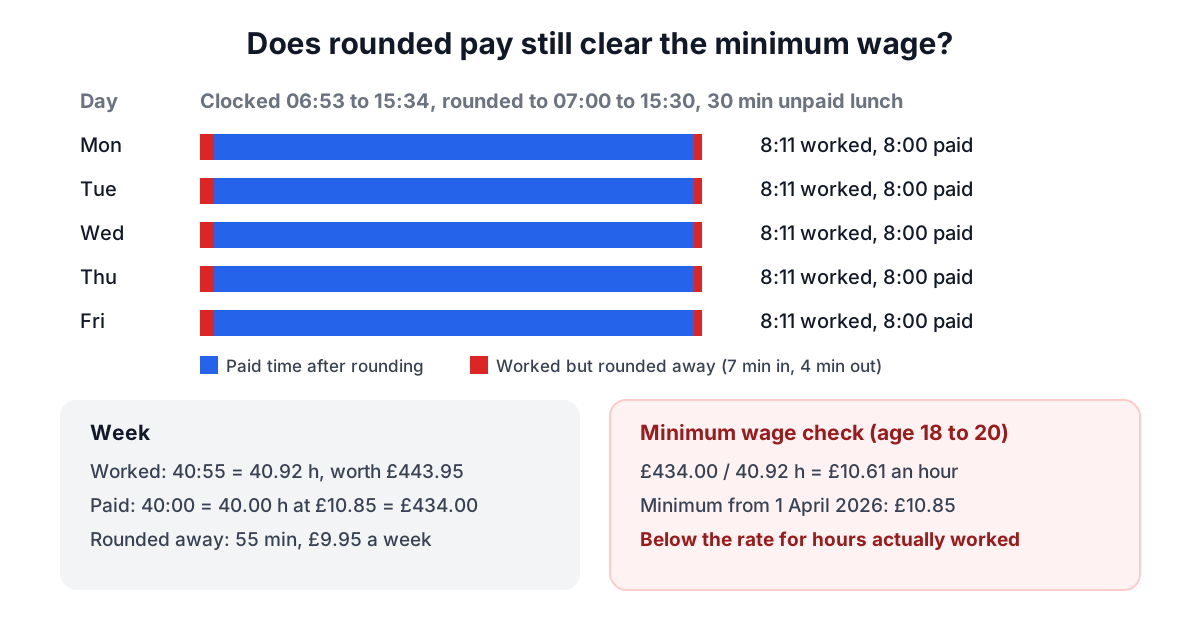
A 19 year old warehouse operative on £10.85 an hour is rostered 07:00 to 15:30 with a 30 minute unpaid lunch. The site asks staff to be on the floor for the briefing at 06:55, so across a week they clock in at 06:53 and out at 15:34 each day. Payroll rounds every punch to the nearest quarter hour.
Enter the five days in the timesheet twice: once with rounding off and once at 15 minutes.
| Rounding off | Nearest 15 minutes | |
|---|---|---|
| Recorded start and finish | 06:53 to 15:34 | 07:00 to 15:30 |
| Hours a day after the break | 8:11 | 8:00 |
| Hours in the week | 40:55 (40.92 decimal) | 40:00 (40.00 decimal) |
| Pay at £10.85 | £443.95 | £434.00 |
Payroll pays the right-hand column. Divide that £434.00 by the 40.92 hours actually worked and the worker receives about £10.61 an hour, below the £10.85 rate for an 18 to 20 year old. Rounding is not banned in UK law, but this rounding only ever cuts time, and the minimum wage is checked against the time actually worked in the pay reference period. If the briefing is required, the 7 minutes before 07:00 count.
Contract overtime
If your contract does pay a premium, set the weekly threshold to your contract hours. The timesheet counts hours in order through the week, so the overtime lands on the last shifts worked. A worker on £12.71 with time and a half after 37.5 hours who works 47 hours in a week is paid 37.5 hours at £12.71 and 9.5 hours at time and a half (£19.065, shown as £19.07), a total of £657.75 before tax and National Insurance.
Clock changes and night shifts
UK clocks go forward at 1am on the last Sunday in March and back at 2am on the last Sunday in October (GOV.UK). In 2026 those were 29 March and 25 October; in 2027 they are 28 March and 31 October.
A timesheet works on the clock face, so a 22:00 to 06:00 shift with a 30 minute break shows 7:30 hours however the night falls. On the night of 24 to 25 October 2026 the hour from 01:00 to 02:00 happened twice, so the worker was actually on site for 9 hours and worked 8:30. On the night of 28 to 29 March 2026 the hour from 01:00 to 02:00 never happened: 7 hours on site and 6:30 worked. Add or remove the hour by hand on those two nights, and check which way your employer's system records it.
For durations rather than shifts, the Time Calculator adds and subtracts in seconds and carries at 60. Two legs of a journey of 2 h 45 min and 1 h 30 min add up to 4 h 15 min, not 3 h 75 min, and 22:30 plus 3 hours is 01:30 the next day.
Decimal hours on UK payslips
Payroll and rota software often prints hours as decimals. Minutes are sixtieths, so 40:55 is 40.92 hours, 7:40 is 7.67 and 15 minutes is 0.25. A payslip showing 37.30 hours means 37 hours 18 minutes, not 37 and a half; if your contract is 37.5 hours a week it should read 37.50. When you compare your own timesheet with a payslip, convert in one direction only and multiply decimal hours, never h:mm, by the hourly rate.
Tools for this job
- Age Calculator (UK): age on any date, including 1 September for a school year and the prescribed days for compulsory school age.
- Timesheet Calculator (UK): daily and weekly hours, unpaid breaks, rounding, contract overtime and gross pay at the National Living Wage.
- Time Calculator: add or subtract durations and clock times across midnight.
- Date Difference: days or working days between two dates.
The US edition of this guide covers the US overtime rules and the 7-minute rounding rule.
Frequently asked questions
When is my child old enough to start reception in England?
In the September after their fourth birthday, for most children. Set the age-on date to 1 September of the year you are checking: a child who is already four that day normally starts that September.
Do I legally turn 18 at the start of my birthday?
In England and Wales, yes. Section 9 of the Family Law Reform Act 1969 says a person attains an age at the commencement of the relevant anniversary of their birth, so the time of day you were born does not matter.
Can my employer round my clock-in time?
UK law does not ban rounding, but your pay for all the hours you actually work, divided by those hours, must not fall below the National Minimum Wage for your age. Rounding that only ever trims time can push a worker on the minimum rate below it.
How do I count a night shift when the clocks go back?
Add an hour to the timesheet total for the shift that runs through 1am to 2am on the last Sunday in October, and take an hour off for the shift that runs through that time on the last Sunday in March. The calculator reads clock times, so it will not do this for you.
Sources and further reading
- Family Law Reform Act 1969, section 9, legislation.gov.uk. Time at which a person attains a particular age (England and Wales).
- School admissions: school starting age, GOV.UK. Reception start and compulsory school age dates.
- Apply for your first provisional driving licence, GOV.UK. Minimum age of 15 years and 9 months.
- National Minimum Wage and National Living Wage rates, GOV.UK. Rates from 1 April 2026 and 1 April 2027.
- Calculating the minimum wage: working hours, HM Revenue and Customs. Time work hours and the early-start example.
- Rest breaks at work, GOV.UK. The 20 minute break for more than 6 hours.
- When do the clocks change?, GOV.UK. British Summer Time dates.
More Everyday Calculators
Every tool in the Everyday Calculators section, free and in your browser.
- Age Calculator
- Time Card Calculator
- Time Calculator
- GPA Calculator
- Final Grade Calculator
- Fuel Cost Calculator
- Tire Size Calculator
- Ring Size Converter
- Shoe Size Converter
- Cooking Measurement Converter
- Heat Index Calculator
- Wind Chill Calculator
- Week Number Calculator
- Day of the Week Calculator
- Recipe Scaler
- Unit Price Calculator