
Blood Alcohol in UK Units: Limits and the Morning After
How pints, 175 ml glasses and single measures turn into units and blood alcohol, why Scotland's 50 mg limit differs, and how slowly it falls overnight.
By Redbison Dev · · 7 min read
United Kingdom edition. Written for UK drinkers and drivers: units of 8 g, pints and 175 ml glasses, weight in stones, the 80 mg and 50 mg drink-drive limits, GOV.UK penalties and the Chief Medical Officers' 14 units. US edition
In the UK, alcohol is counted in units of 10 ml (8 g) of pure ethanol, and the drink-drive limit is 80 mg per 100 ml of blood in England, Wales and Northern Ireland but 50 mg in Scotland. A calculator can turn your pints and glasses into units and an estimated blood alcohol level, and show how slowly that level falls. What it cannot do is tell you that you are fit to drive: GOV.UK says it is impossible to say exactly how many drinks equal the limit, because it differs for each person. This guide works through UK drinks with the UK version of the Blood Alcohol Calculator and explains where the estimate is weakest.
Units first: what is actually in the glass
The NHS formula is short: strength (ABV) times volume in millilitres, divided by 1,000, gives units. The trouble is that UK serves rarely come to a round number:
| Drink | Units (NHS formula) | Grams of ethanol |
|---|---|---|
| Pint (568 ml) of 4% lager | 2.3 | 17.9 |
| Pint of 4.5% bitter or cider | 2.6 | 20.2 |
| 175 ml glass of 13% wine | 2.3 | 17.9 |
| 250 ml glass of 13% wine | 3.3 | 25.6 |
| 25 ml single measure of 40% spirit | 1.0 | 7.9 |
| 35 ml large single of 40% spirit | 1.4 | 11.0 |
The NHS lists a 175 ml glass of 12% wine at 2.1 units and a 250 ml glass at 3, and a pint of 5.2% lager at 3. Many pub wines are 13% or more, and a "large" glass is a third of a bottle. Order two large glasses and you have drunk two thirds of a bottle, about 6.5 units, while feeling you had "a couple".
The calculator works in grams (ml x ABV x 0.789, the density of ethanol) and divides by 8 for units, so its totals can differ from the NHS shortcut by a few hundredths. That difference is noise next to the uncertainty in the blood alcohol estimate itself.
Units and the 14-unit guideline
The UK Chief Medical Officers' low-risk guideline, which the NHS publishes, is not to drink more than 14 units a week on a regular basis. That is about six pints of 4% lager (13.6 units by the formula) or six 175 ml glasses of 13% wine (13.7). It is a health guideline about long-term harm, and it has nothing to do with driving. Fourteen units spread over a week can still mean being over the limit on the one evening you drink most of them.
From units to an estimated blood level
The estimate uses the Widmark formula: grams of alcohol divided by body weight times a body-water factor (0.68 for men, 0.55 for women), minus a steady fall of 0.015% for every hour since the first drink. The UK expresses blood alcohol in milligrams per 100 ml, so 0.069% on the calculator is 69 mg, and the limits line up as 80 mg (0.08%) and 50 mg (0.05%).
Example 1, an evening in the pub. A man of 12 st 8 lb (79.8 kg) has two pints of 4% lager and a 175 ml glass of 13% wine over two hours. Enter weight in stones and pounds, the three drinks and 2 hours:
- 53.8 g of alcohol, 6.7 units
- peak if absorbed at once: 0.099%
- estimate now: 0.069%, or 69 mg per 100 ml
- below 50 mg in about 1 h 16 min; about zero in 4 h 36 min
On paper that is under the English limit and over the Scottish one. The same drinks consumed in Carlisle and then driven over the border at Gretna cross from one side of the law to the other on the estimate alone, and the estimate may be wrong in either direction.
Example 2, dinner for two. A woman of 10 st (63.5 kg) drinks three 175 ml glasses of 13% wine over a three-hour dinner, 525 ml or most of a bottle:
- 53.8 g of alcohol, 6.7 units, the same dose as the man in example 1
- estimate after 3 hours: 0.109%, or 109 mg
- below 80 mg in about 1 h 57 min, below 50 mg in about 3 h 57 min, about zero in 7 h 17 min
The same 6.7 units give her a level well above both limits, because she is lighter and the female factor assumes less body water per kilogram. Units count alcohol, not its effect on a particular body.
The morning after
The morning after needs its own section because the arithmetic is unforgiving. Elimination runs at roughly one unit an hour for an average adult, the NHS says, though it varies from person to person. The formula assumes a steady fall that nothing you do after drinking changes, so only time lowers the estimate.
Example 3, a night out. A man of 13 st (82.6 kg) drinks six pints of 4.5% bitter and two single vodkas between 7pm and midnight:
- 136.8 g of alcohol, 17.1 units, more than the weekly guideline in one evening
- estimate at midnight: 0.169% (169 mg)
- estimate at 7am, 12 hours after the first pint: 0.064% (64 mg)
- below 50 mg at about 7:55am; about zero at about 11:15am
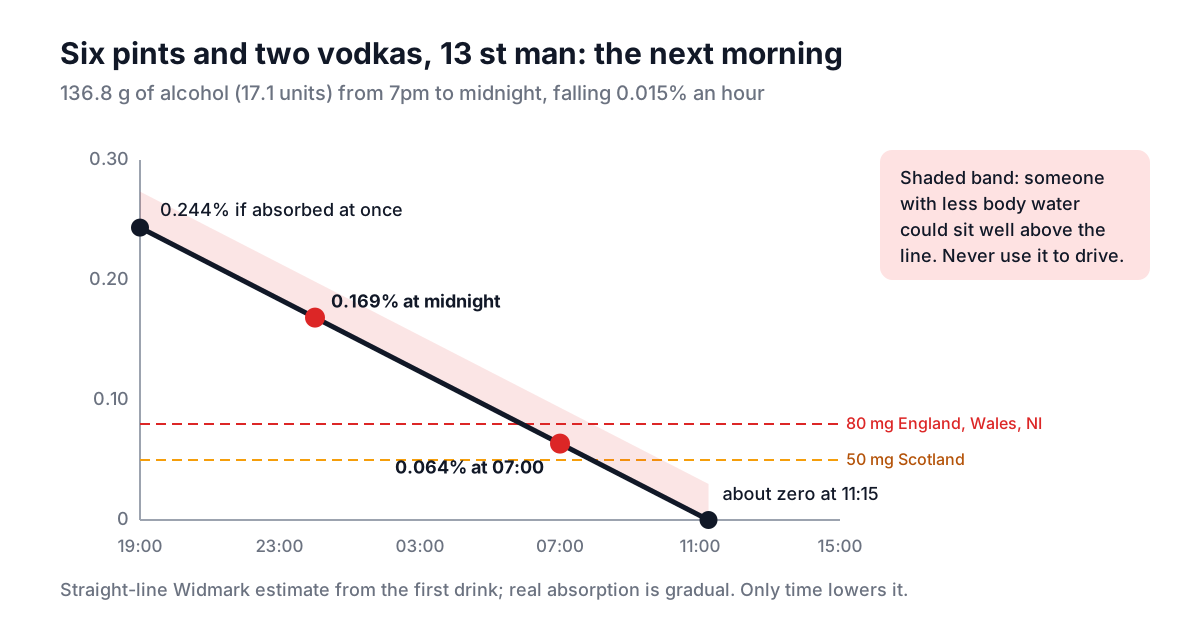
At 7am the estimate is under the English limit, over the Scottish one and nowhere near zero. A smaller person, a later finish or one more round moves it over 80 mg.
The limits and the penalties
GOV.UK publishes the limits for each specimen. Police use breath at the roadside, so the breath figure is the one most drivers meet:
| Specimen | England, Wales and Northern Ireland | Scotland |
|---|---|---|
| Breath (micrograms per 100 ml) | 35 | 22 |
| Blood (mg per 100 ml) | 80 | 50 |
| Urine (mg per 100 ml) | 107 | 67 |
THINK!, the Department for Transport's road-safety campaign, notes that Scotland's lower limit has applied since 5 December 2014. Once you cross into Scotland, the 50 mg limit applies to you whatever your licence says.
GOV.UK lists the penalties. Driving or attempting to drive over the limit can bring up to 6 months in prison, an unlimited fine and a ban of at least a year, rising to at least 3 years for a second conviction within 10 years. Being in charge of a vehicle over the limit, for example sitting in a parked car with the keys, can bring up to 3 months in prison, a fine of up to £2,500 and a possible ban. Causing death by careless driving while under the influence carries up to life imprisonment.
Why the estimate is only a guide
Everything in the formula is an average. Body-water share varies with build, so two people of 13 st can differ by a tenth or more. Food in the stomach slows absorption and lowers the peak; drinking on an empty stomach does the opposite. Elimination varies with genetics, liver health and medication. Queensland's road-safety page makes a point that applies everywhere: blood alcohol can keep rising for 30 to 60 minutes after the last drink, while the calculator's straight line assumes everything was absorbed at the start.
Impairment also begins before any legal limit. THINK!'s advice is the plain one: it is not possible to say how much you can drink and stay below the limit, so if you are driving, have none. Use the calculator to see how many units are in your usual drinks and how long they take to clear, then plan the evening around a designated driver, a taxi, the last train or staying over.
When it is an emergency
Alcohol poisoning needs help, not a calculation. The NHS lists the signs: confusion, slurred speech or being unable to speak, being unable to stand or walk, being sick, wetting or soiling themselves, pale or blue-tinged skin, slow or irregular breathing, a seizure or fit, and loss of consciousness. If you think someone has alcohol poisoning, call 999. Stay with them, because they could choke on their own vomit or stop breathing, and if they have passed out, put them in the recovery position and check they are breathing properly. The NHS also says not to give them coffee or put them in a cold shower.
Tools for this job
- Blood Alcohol Calculator (UK units): units, estimated mg per 100 ml, and the time to fall below 50 mg, 80 mg and zero, with weight in stones and pounds.
- Hydration Calculator: a daily water target for the day after.
- Sleep Calculator: bedtimes and wake times, remembering that only time lowers the estimate.
Frequently asked questions
How many units can I drink and still drive in the UK?
There is no number that works for everyone, and GOV.UK says so. In the examples above, 6.7 units leave one man under the English limit but over the Scottish one, and give a lighter woman 109 mg. The only reliable answer if you are driving is none.
How many units are in a pint?
Multiply the ABV by 568 and divide by 1,000. A pint of 4% lager is 2.3 units, 4.5% bitter or cider is 2.6, and the NHS lists a pint of 5.2% lager at 3 units. Craft beers at 6% or more are 3.4 units a pint and upwards.
How long does it take for alcohol to leave your system?
The NHS describes about one unit an hour for the average adult, and the calculator uses a fall of 0.015% an hour, which is close to that for a man of average size: about 8 g, one unit, an hour for the 12 st 8 lb man in example 1, but only about 5.2 g, two thirds of a unit, for the 10 st woman in example 2. Seventeen units from a night out can still show as alcohol in the estimate late the next morning.
Is the Scottish limit really different from England's?
Yes. Scotland's limit is 50 mg per 100 ml of blood, or 22 micrograms per 100 ml of breath, against 80 mg and 35 micrograms in England, Wales and Northern Ireland. The limit depends on where you are driving, not where your licence was issued.
Does the 14-unit guideline mean 14 units is safe to drive on?
No. The Chief Medical Officers' 14 units a week is a long-term health guideline. It says nothing about driving, and a fraction of it in one evening can put you over the limit.
Sources and further reading
- The drink drive limit, GOV.UK. Breath, blood and urine limits for England, Wales and Northern Ireland and for Scotland; no fixed number of drinks.
- Drink-driving penalties, GOV.UK. Prison, fines and bans for driving, attempting to drive and being in charge over the limit.
- Alcohol units, NHS. One unit is 10 ml or 8 g; ABV x ml / 1,000; units in common drinks; 14 units a week.
- Alcohol poisoning, NHS. Signs of alcohol poisoning, when to call 999, staying with the person and the recovery position.
- Drink driving, THINK! (Department for Transport). Limits, the Scottish limit from 5 December 2014, and why no safe amount can be given.
- Alcohol consumption: advice on low risk drinking, Department of Health and Social Care. The UK Chief Medical Officers' guidelines.
- Alcohol limits, Queensland Government. Blood alcohol can peak 30 to 60 minutes after the last drink.
- Alcohol calculations and their uncertainty, Medicine, Science and the Law. Searle on the Widmark formula and its error range.
More Wellness Tools
Every tool in the Wellness Tools section, free and in your browser.