
How to Split Co-founder Equity in a UK Start-up
Split founder shares three ways, protect the split with leaver terms, and check who stays above the 5% Business Asset Disposal Relief line after funding rounds.
By Redbison Dev · · 7 min read
United Kingdom edition. Written for UK founders: ordinary shares issued at incorporation, vesting written as good and bad leaver terms, cash in pounds, the 5% Business Asset Disposal Relief test after dilution, EMI for small stakes, and telling Companies House about new shares. US edition
Four UK co-founders, two full-time, one at 60% time with £10,000 put in, and one part-time adviser with 15 years' experience, can land anywhere from 37.6% to 41.0% for the CEO and from 5.8% to 14.9% for the adviser, depending on how they score contributions. The UK Co-founder Equity Split Calculator shows all three scorings side by side. In the UK two more things decide whether the split holds up: founders usually own their shares outright from day one, so "vesting" has to be written as leaver terms, and a small stake can fall below the 5% Business Asset Disposal Relief test after a couple of funding rounds. This guide works through both with the tool's numbers. It is a starting point for a conversation with a solicitor and an accountant, not legal or tax advice.
The team and three ways to score it
The calculator takes each founder's role, main contribution, time commitment, cash, experience and risk tolerance. Here is the team, with cash in pounds:
| Founder | Role | Contribution | Time | Cash | Experience | Risk |
|---|---|---|---|---|---|---|
| A | CEO | the idea | 100% | £0 | 8 years | high |
| B | CTO | technical | 100% | £0 | 6 years | high |
| C | COO | execution | 60% | £10,000 | 4 years | medium |
| D | adviser (Other) | network | 10% | £0 | 15 years | low |
The tool scores them three ways:
- Contribution-based: points for the idea (5, or 1 if not the idea), time (full time is 5), cash (1 per £10,000, capped at 5), experience (1 per two years, capped at 5) and risk (5, 3 or 1).
- Role-based: fixed weights (CEO 30, CTO 25, COO 15, Other 5) plus up to 20% more for time.
- Hybrid: half of each.
| Method | A (CEO) | B (CTO) | C (COO) | D (adviser) |
|---|---|---|---|---|
| Contribution-based | 37.6% | 27.7% | 19.8% | 14.9% |
| Role-based | 41.0% | 34.1% | 19.1% | 5.8% |
| Hybrid | 39.0% | 31.1% | 19.9% | 10.0% |
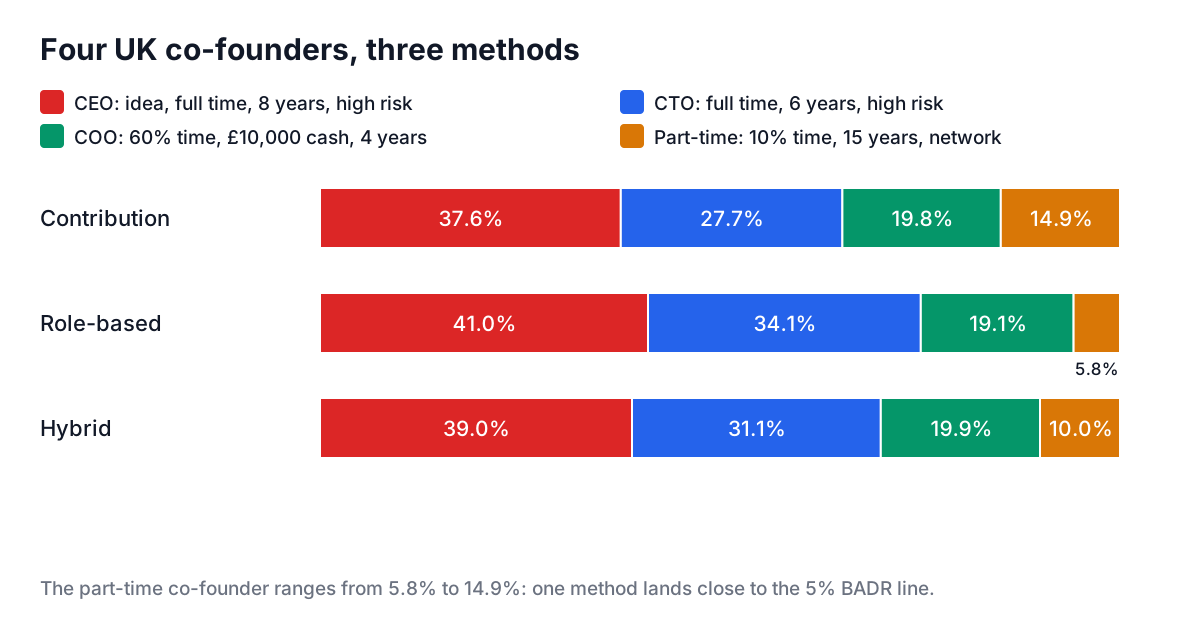
The range is the point. The adviser's 15 years of experience counts heavily in contribution scoring and hardly at all in role scoring. Before choosing a method, agree what you are rewarding: past experience, time from now on, or the cash. If you plan to hire, reserve a pool first: with a total of 90% the hybrid split becomes 35.1%, 28.0%, 17.9% and 9.0%.
Vesting in the UK is a leaver clause
In a US start-up, founders often receive restricted stock that vests. In a UK private company, founders are usually issued ordinary shares at incorporation and own them outright. The protection that vesting gives has to be written into the articles or a shareholders' agreement as leaver provisions: if a founder leaves before the end of the schedule, the company or the other shareholders can buy back the unvested part, usually on different terms for a "good leaver" and a "bad leaver". Which events count as good or bad, and the price each pays, are for the founders and their solicitor to agree.
The calculator's cliff and vesting fields model the schedule. On a four-year schedule with a 12-month cliff:
- leave in month 11: nothing has vested
- at month 12: 25% vests at once
- leave at month 18: 18 ÷ 48 = 37.5% vested
So if the COO on the hybrid split (19.9%) leaves at month 18, they keep 37.5% of it, about 7.46% of the company, and the leaver clause decides what happens to the other 12.44%.
New shares issued later also need paperwork: GOV.UK says you must tell Companies House within a month if you issue more shares.
The 5% line after funding
Business Asset Disposal Relief cuts Capital Gains Tax on selling shares in your own company. GOV.UK gives the rate as 18% on qualifying gains from 6 April 2026 (14% between 6 April 2025 and 5 April 2026). For shares, you must have held at least 5% of the shares and voting rights, and be entitled to 5% of either the profits and assets or the sale proceeds, for two years before the sale, while working for the company as an employee or office holder.
That is where small founder stakes need a second look, because every funding round dilutes them. In the UK cap table example (a SEIS and EIS seed, then a Series A), each holder keeps 7/9 of their percentage after the seed and 24.32 ÷ 45 after the Series A.
| Adviser's starting stake | After the seed | After the Series A |
|---|---|---|
| 5.8% (role-based) | 4.51% | 3.13% |
| 10.0% (hybrid) | 7.78% | 5.40% |
| 14.9% (contribution-based) | 11.59% | 8.05% |
On the role-based split the adviser drops under 5% at the seed. Gains after that point would not get the relief, although GOV.UK allows an election to be treated as having sold and re-bought the shares just before the new issue, so relief applies to the gain up to then, and the tax can be postponed until the actual sale. Voting rights count too, so non-voting shares do not help anyone meet the test. The UK cap table guide works the rounds in full.
EMI for small stakes, if they work enough hours
EMI shares are an exception to the 5% test: they qualify if the option was granted at least two years before the sale. GOV.UK lets an employee hold up to £250,000 of EMI options granted in a three-year period, but only if they work at least 25 hours a week, or 75% of their working time, for the company. A part-time adviser with a day job elsewhere usually cannot meet that, so ordinary shares, or options outside EMI, are what is left.
Have the conversation first
The split is downstream of bigger questions: whether the founders want the same company (a lifestyle business or a Series A) and will put in the same hours. The Founding Team Alignment tool has each founder answer separately on vision, values, goals for 12 months, concerns, time and expected equity, then compares them and checks whether expected equity adds up to 100%. Do that first, then run the calculator with all three methods, and take the split, the schedule and the leaver terms you agree to a solicitor.
Tools for this job
- Co-founder Equity Split Calculator (UK): three scorings, cash in pounds, cliff and vesting.
- Founding Team Alignment: compare each founder's answers before the split.
- Cap Table Calculator (UK): what the split becomes after SEIS, EIS and a Series A.
- Option Pool Shuffle Calculator (UK): the EMI pool's cost in each round.
The original co-founder equity guide covers dynamic equity and the US 83(b) election.
Frequently asked questions
How do UK founders vest shares they already own?
Through leaver provisions in the articles or a shareholders' agreement. If a founder leaves early, the unvested part of their shares can be bought back on the agreed good leaver or bad leaver terms. The cliff and vesting schedule decide how much counts as vested.
Does a co-founder need 5% for Business Asset Disposal Relief?
For ordinary shares, yes: at least 5% of the shares and voting rights, plus 5% of profits and assets or of sale proceeds, for two years before the sale, while working for the company. EMI shares are not subject to the 5% test.
What happens if a funding round takes a founder below 5%?
Gains after that point do not qualify. GOV.UK allows an election to be treated as having sold and re-bought the shares just before the new issue, so relief applies to the gain up to then, and the tax can be postponed until the sale.
Can a part-time co-founder get EMI options?
Only if they work at least 25 hours a week, or 75% of their working time, for the company. Someone with a full-time job elsewhere usually cannot.
Should UK co-founders split shares equally?
Equal is simple and fine when chosen on purpose. Where time, cash and roles differ, the calculator shows the honest range, and in the UK it is worth checking what each stake looks like after the rounds you expect.
Sources and further reading
- Business Asset Disposal Relief: eligibility, GOV.UK. The 5% tests, two-year period, EMI exception, dilution election and rates.
- Enterprise Management Incentives (EMIs), GOV.UK. The 25-hour working time condition and the £250,000 limit.
- Make changes to your private limited company: shares, GOV.UK. Tell Companies House within a month of issuing shares.
- Use the Seed Enterprise Investment Scheme to raise money, GOV.UK (HMRC). The ordinary share conditions for seed investors.
- How to Split Equity Among Co-Founders, Y Combinator. Michael Seibel on equal splits and vesting.
- Slicing Pie, Slicing Pie. Mike Moyer's dynamic equity model.
- How Not to Die, Paul Graham. Founder fights as a cause of start-up failure.
Open the Co-founder Equity Split Calculator
More Team & Funding
Every tool in the Team & Funding section, free and in your browser.