
How to Split Co-founder Equity in a Canadian Start-up
Score a co-founder split three ways in CA$, see when a US-resident co-founder's majority costs CCPC status, and set vesting before shares are issued.
By Redbison Dev · · 7 min read
Canada edition. Written for Canadian founders: cash in Canadian dollars, a US-resident co-founder and the CCPC control test, QSBC shares and the lifetime capital gains exemption, vesting in a shareholders' agreement, and the federal register of individuals with significant control. US edition
Two co-founders, a US-resident CEO who brought the idea and CA$50,000 and a full-time Canadian CTO, split between 54.5/45.5 and 64.1/35.9 depending on how the Canadian Co-founder Equity Split Calculator scores them. In Canada that range matters for more than fairness: under every method the non-resident holds more than half the shares, and a corporation controlled by non-residents is not a Canadian-controlled private corporation (CCPC). That status decides when employees are taxed on stock options and is one of the tests for the lifetime capital gains exemption on founder shares. This guide works the split with the tool, shows how a third founder changes control, and covers vesting and the federal filings. It is a starting point for a talk with a Canadian lawyer and tax adviser, not legal or tax advice.
Scoring the split three ways
The calculator takes each founder's role, main contribution, time, cash, experience and risk tolerance:
- Contribution-based gives points for the idea (5, or 1 otherwise), time (full time is 5), cash (1 per CA$10,000, capped at 5 from CA$50,000), experience (1 per two years, capped at 5) and risk (5, 3 or 1).
- Role-based uses fixed weights (CEO 30, CTO 25, CMO 15, Other 5) plus up to 20% more for time.
- Hybrid takes half of each.
| Founder | Role | Contribution | Time | Cash | Experience | Risk |
|---|---|---|---|---|---|---|
| US-resident CEO | CEO | the idea | 100% | CA$50,000 | 12 years | high |
| Canadian CTO | CTO | technical | 100% | CA$0 | 6 years | high |
| Method | US-resident CEO | Canadian CTO |
|---|---|---|
| Contribution-based | 64.1% | 35.9% |
| Role-based | 54.5% | 45.5% |
| Hybrid | 58.5% | 41.5% |
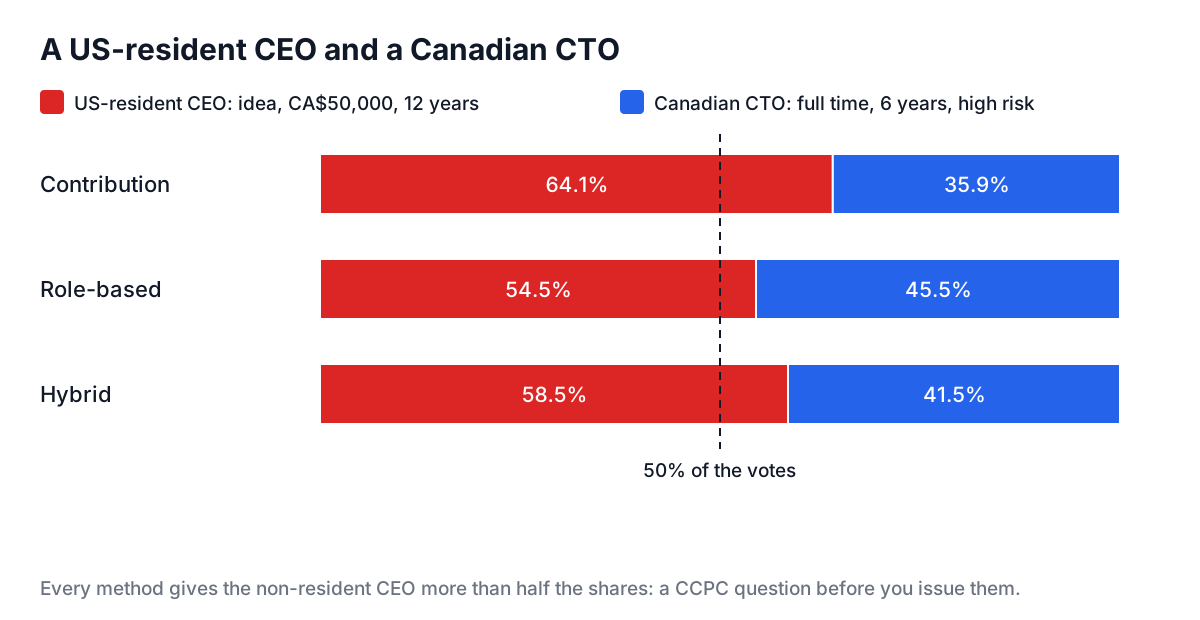
The CA$50,000 maxes out the cash score, and the idea and 12 years of experience add more. The calculator treats cash as a contribution, not as shares bought at a price; if the CEO is really subscribing for shares, that is a separate line on the cap table.
The CCPC question
The CRA's capital gains guide defines a CCPC as a private corporation that is a Canadian corporation, other than one controlled by non-residents or public corporations, one that would be controlled by one person if all the shares held by non-residents and public corporations were attributed to that person, or one with a class of shares listed on a designated stock exchange. A US-resident founder with 58.5% of the voting shares controls the company, so on that split it is not a CCPC from day one.
Two things ride on it:
- Employees' stock options. The CRA says employees of a CCPC they deal with at arm's length report the security option benefit in the year they sell the shares; employees of other corporations generally report it in the year they exercise, which can mean tax on shares they cannot yet sell.
- Founders' shares. Qualified small business corporation (QSBC) shares must be shares of a CCPC. The CRA's line 25400 page shows a lifetime capital gains exemption of CA$1,250,000 for dispositions after June 24, 2024 and, under proposed changes, for 2025. The T4037 guide also requires that only you or a related person owned the shares for the 24 months before the sale and that more than 50% of the company's assets by fair market value were used in an active business carried on mainly in Canada throughout that time, and that at the time of sale it was a small business corporation, with all or most (90% or more) of its assets by fair market value in that use.
What a third founder does
Add a Canadian CMO at 50% time, with a network contribution, 3 years' experience and medium risk:
| Method | US-resident CEO | Canadian CTO | Canadian CMO | Canadians together |
|---|---|---|---|---|
| Contribution-based | 53.2% | 29.8% | 17.0% | 46.8% |
| Role-based | 43.6% | 36.4% | 20.0% | 56.4% |
| Hybrid | 47.0% | 33.3% | 19.7% | 53.0% |
On role-based or hybrid scoring the non-resident now holds less than half; on contribution scoring still more. If each share carries one vote, the choice of method is also a choice about CCPC status. Control can also come from voting agreements, share classes and rights to acquire shares, which is why the structure, not only the percentage, needs a tax lawyer's review before shares are issued. Fixing it later, after US funds invest, is harder: the Canadian cap table guide shows US investors passing half of the issued shares at a Series B.
Vesting in a Canadian company
Founders are usually issued their shares at incorporation and own them outright, so vesting is written into the shareholders' agreement: if a founder leaves early, the company or the other founders can buy back the unvested part on agreed terms. The calculator's cliff and vesting fields model the schedule. On four years with a 12-month cliff:
- leave in month 11: nothing has vested
- at month 12: 25% vests at once
- leave at month 30: 30 ÷ 48 = 62.5% vested
So if the CEO on the two-founder hybrid split (58.5%) left at month 30, they would keep 62.5% of it, about 36.56% of the company. That alone can change who controls the votes, which is one more reason to model departures before signing.
The register of individuals with significant control
For a corporation under the Canada Business Corporations Act, Corporations Canada says anyone with 25% or more of the voting shares, or of all shares by fair market value, is an individual with significant control. Since June 2019 most CBCA corporations must keep a register of them, and since January 22, 2024 they must file the information with Corporations Canada, with the annual return and within 15 days of any change. Both founders in the two-founder split, and the CEO and CTO in the three-founder split, hold 25% or more, so the split you agree puts them on that register; the CMO at 17.0% to 20.0% would not be on it unless they have control in fact over the corporation. Provincial corporations have their own rules.
Have the conversation first
The split is downstream of bigger questions: whether the founders want the same company and will put in the same hours. Founding Team Alignment has each founder answer separately on vision, values, 12-month goals, concerns, time and expected equity, and flags when expected equity does not add up to 100%. Do that, run the calculator with all three methods, and take the split, the schedule and the residency facts to a lawyer.
Tools for this job
- Co-founder Equity Split Calculator (Canada): three scorings, cash in CA$, cliff and vesting.
- Founding Team Alignment: compare each founder's answers before you split.
- Cap Table Calculator (Canada): how the split and the non-resident share change through funding rounds.
- Option Pool Shuffle Calculator (Canada): the cost of the pool in each round.
The original co-founder equity guide covers dynamic equity and the US 83(b) election for US-taxed founders.
Frequently asked questions
Can a non-resident co-founder own shares in a CCPC?
Yes. The company stops being a CCPC if non-residents or public corporations control it, or if one person would control it once all the non-resident and public corporation shares were attributed to them. A minority non-resident stake alone does not do that.
Which split method is fairest for a US co-founder?
None is objectively fair; each rewards different things. In the three-founder example the non-resident CEO holds 43.6% to 53.2% depending on the method, so agree what you are rewarding before you pick one.
Do founder shares qualify for the lifetime capital gains exemption?
They can if they are QSBC shares when sold: shares of a CCPC that meets the active business asset tests, owned only by you or a related person for the 24 months before the sale. The CRA applies CA$1,250,000 for dispositions after June 24, 2024, and for 2025 under proposed changes.
How does vesting work if founders already own their shares?
Through the shareholders' agreement. Unvested shares can be bought back if a founder leaves before the schedule ends. A founder leaving at month 30 of 48 with a 12-month cliff keeps 62.5% of their stake.
Do we have to report who owns 25% or more?
For a CBCA corporation, yes. Founders with 25% or more of the votes or of the shares by value go on the register of individuals with significant control, which is filed with Corporations Canada.
Sources and further reading
- Guide T4037: Capital Gains, Canada Revenue Agency. CCPC and qualified small business corporation share definitions.
- Line 25400: Capital gains deduction, Canada Revenue Agency. The CA$1,250,000 lifetime exemption for QSBC shares, shown for 2025 under proposed changes.
- Line 10100: Employment income, Canada Revenue Agency. When the stock option benefit is reported for CCPC and other employers.
- Individuals with significant control, Corporations Canada. The 25% test, the register and filing within 15 days of a change.
- How to Split Equity Among Co-Founders, Y Combinator. Michael Seibel on equal splits and vesting.
- Slicing Pie, Slicing Pie. Mike Moyer's dynamic equity model.
Open the Co-founder Equity Split Calculator
More Team & Funding
Every tool in the Team & Funding section, free and in your browser.