
How to Split Co-founder Equity in a Singapore Pte Ltd
Score a co-founder split three ways in S$, protect it with vesting, and see why IRAS treats shares a founder buys differently from shares awarded for work.
By Redbison Dev · · 7 min read
Singapore edition. Written for Singapore founders: cash in Singapore dollars, ordinary shares in a private limited company, ACRA's general meeting approval and EROM for new founder shares, and IRAS rules on share gains, vesting share awards and options. US edition
Three Singapore co-founders, a CEO who brought the idea and S$30,000, a full-time CTO and a part-time industry co-founder with 20 years' experience, split anywhere from 47.8/34.4/17.8 to 50.6/42.1/7.3 depending on how the Singapore Co-founder Equity Split Calculator scores them. Singapore makes one part of the decision simpler and another more important. IRAS generally does not tax gains from selling shares held as an investment, so there is no shareholding threshold to protect. But how each person gets their shares matters a great deal: shares a founder subscribes and pays for are an investment, while shares awarded to someone because of their work are taxed as employment income when they vest. This guide works the split with the tool, then covers vesting and the ACRA and IRAS steps. It is not legal or tax advice.
Scoring the split three ways
The calculator scores each founder on role, main contribution, time, cash, experience and risk tolerance:
- Contribution-based: the idea (5, or 1 otherwise), time (full time is 5), cash (1 per S$10,000, capped at 5), experience (1 per two years, capped at 5) and risk (5, 3 or 1).
- Role-based: fixed weights (CEO 30, CTO 25, Other 5) plus up to 20% more for time.
- Hybrid: half of each.
| Founder | Role | Contribution | Time | Cash | Experience | Risk |
|---|---|---|---|---|---|---|
| CEO | CEO | the idea | 100% | S$30,000 | 7 years | high |
| CTO | CTO | technical | 100% | S$0 | 9 years | high |
| Industry co-founder | Other | network | 20% | S$0 | 20 years | low |
| Method | CEO | CTO | Industry co-founder |
|---|---|---|---|
| Contribution-based | 47.8% | 34.4% | 17.8% |
| Role-based | 50.6% | 42.1% | 7.3% |
| Hybrid | 49.0% | 38.6% | 12.4% |
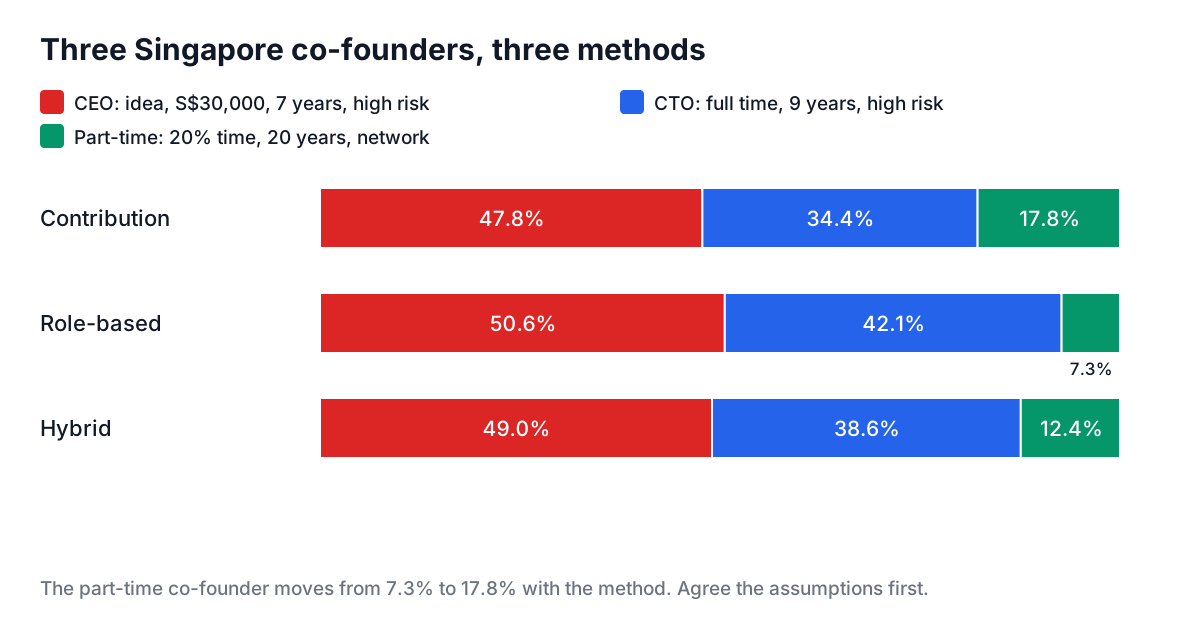
The part-time co-founder's stake more than doubles between methods, because contribution scoring rewards 20 years of experience and role scoring barely does. That is the conversation to have: are you paying for the network and credibility they bring now, or for hours over the next four years? A middle answer is to give them a smaller stake on day one and an option grant that vests with the work they actually do.
A co-founder who joins later
Six months in, the team replaces the part-time adviser with a full-time chief product officer (CPO) with 6 years' experience, medium risk and an execution contribution (the tool scores a CPO with its "Other" role weight):
| Method | CEO | CTO | CPO |
|---|---|---|---|
| Contribution-based | 43.9% | 31.6% | 24.5% |
| Role-based | 50.0% | 41.7% | 8.3% |
| Hybrid | 47.2% | 37.2% | 15.6% |
How the CPO receives that stake now matters more than which row you pick.
Buying shares or being awarded them
IRAS says gains from selling shares are generally viewed as personal investments and are not taxable, unless the person is trading in shares. Founders who subscribe for ordinary shares at incorporation and pay for them are in that position.
A co-founder who is given shares or options because they work in the company falls under IRAS's employee equity rules instead. IRAS taxes a share award with a vesting period when it vests and one without a vesting period at grant, and options when they are exercised. The taxable amount depends on the open market value of the shares at that moment. Suppose the company has 10,000,000 shares and the CPO is awarded 1,560,000 (15.6%) vesting over 48 months with a 12-month cliff. At month 12, 390,000 shares vest. If the shares then had an open market value of S$0.10, the employment income would be S$39,000. If a seed round had just priced shares at S$0.7778, and that were taken as the open market value, it would be about S$303,333. The same award costs far more tax once a priced round has happened, which is why the timing and route of a late co-founder's equity should be settled with a tax adviser before the shares are allotted.
For a co-founder who is not a Singapore citizen (permanent residents included) and stops being employed in Singapore, IRAS applies a "deemed exercise" rule to unvested share awards and unexercised options, so tax is payable at that time, which can be before any sale.
Vesting for founders who already own shares
Founders who hold ordinary shares from day one do not vest like option holders. The protection is written into the shareholders' agreement: if a founder leaves before the schedule ends, the company or the other founders can buy back the unvested part on the agreed terms. The calculator's cliff and vesting fields model it. On four years with a 12-month cliff:
- leave in month 11: nothing has vested
- at month 12: 25% vests
- leave at month 18: 18 ÷ 48 = 37.5% vested
If the CTO on the hybrid split (38.6%) left at month 18, they would keep 37.5% of it, about 14.5% of the company.
The ACRA steps
New founder shares, and any shares issued to a late co-founder, are an allotment. ACRA's guidance says the company needs approval at a general meeting before directors allot shares, even where the constitution lets the directors decide. For a private company the allotment takes effect when the Electronic Register of Members (EROM) is updated through the return of allotment. ACRA lists five share types a company can issue: ordinary, preference, redeemable preference, convertible preference and treasury shares. Founders normally hold ordinary shares, and the rights between them, including vesting and buy-back, sit in the constitution and the shareholders' agreement.
Have the conversation first
The split is downstream of bigger questions: whether the founders want the same company and will put in the same hours. Founding Team Alignment has each founder answer separately on vision, values, 12-month goals, concerns, time and expected equity, and flags when expected equity does not add up to 100%. Do that first, run the calculator with all three methods, and take the split, the schedule and the share route for each person to your corporate secretary and tax adviser.
Tools for this job
- Co-founder Equity Split Calculator (Singapore): three scorings, cash in S$, cliff and vesting.
- Founding Team Alignment: compare each founder's answers before you split.
- Cap Table Calculator (Singapore): what the split becomes through a seed and a Series A.
- Option Pool Shuffle Calculator (Singapore): the cost of the ESOP pool in each round.
The Singapore cap table guide follows founders from 45% each through two rounds, and the original co-founder equity guide covers dynamic equity.
Frequently asked questions
Do Singapore founders pay tax when they sell their shares?
IRAS generally treats gains from selling shares as personal investment gains that are not taxable. Someone found to be trading in shares can be taxed on the gains.
Is a co-founder's vesting share award taxable in Singapore?
Yes, if the shares are given because of employment. IRAS taxes share awards with a vesting period when they vest, those without one at grant, and options when exercised, on the open market value at that time.
Can directors issue new founder shares without asking shareholders?
No. ACRA says approval at a general meeting is needed before shares are allotted, even if the constitution gives the directors that power.
How much equity should a part-time co-founder get?
There is no rule. In the example the same person gets 7.3% to 17.8% depending on the method. One way through is a smaller day-one stake plus equity that vests with the time they actually put in.
Sources and further reading
- Gains from sale of property, shares and financial instruments, IRAS. Share sale gains generally not taxable, with the trading exception.
- Gains from the exercise of stock options, IRAS. Share awards taxed at vesting or grant, options at exercise, deemed exercise for employees who are not Singapore citizens.
- Allotment of shares, ACRA. General meeting approval and when a private company's allotment takes effect.
- Share types and shareholding, ACRA. The five share types and who counts as a member.
- How to Split Equity Among Co-Founders, Y Combinator. Michael Seibel on equal splits and vesting.
- Slicing Pie, Slicing Pie. Mike Moyer's dynamic equity model.
Open the Co-founder Equity Split Calculator
More Team & Funding
Every tool in the Team & Funding section, free and in your browser.