
Founder Dilution After SEIS, EIS and a Series A in the UK
How a UK cap table moves through a SEIS and EIS seed and a Series A, what the EMI pool top-up costs founders, and the 5% line for Business Asset Disposal Relief.
By Redbison Dev · · 10 min read
United Kingdom edition. Written for UK founders: pounds, ordinary shares for SEIS and EIS investors, an EMI option pool checked against the £6 million company limit, and the 5% shareholding test for Business Asset Disposal Relief. US edition
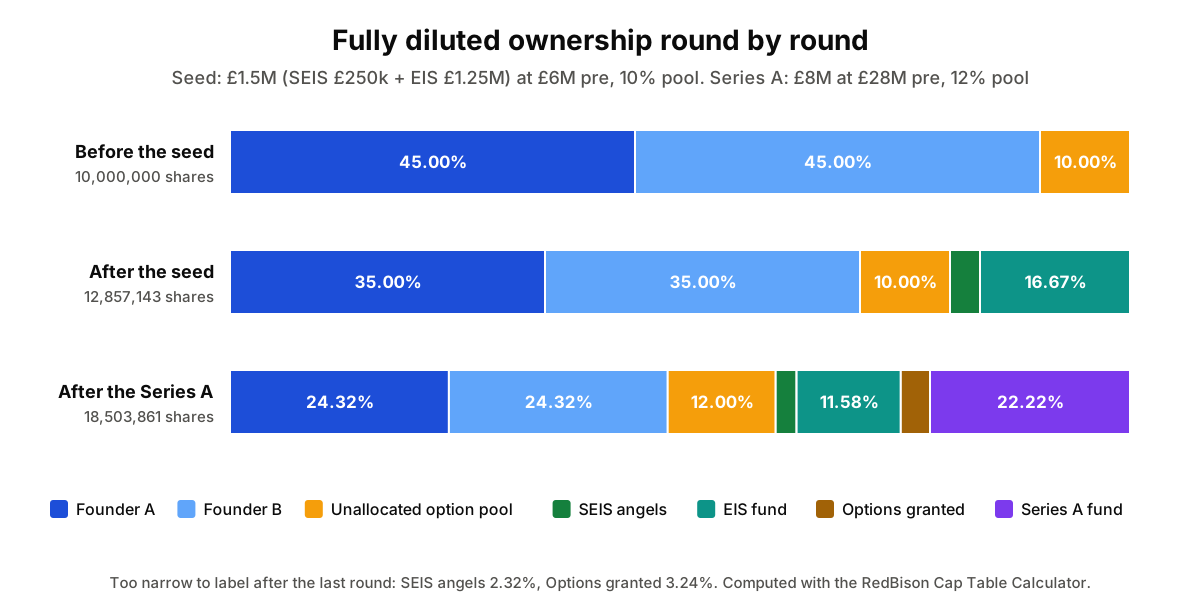
Two UK founders who start on 45% each, raise a £1.5 million seed under SEIS and EIS at a £6 million pre-money and then an £8 million Series A at £28 million pre, end with 24.32% each. About a tenth of that Series A headline, £2,985,915, is new EMI option pool that the founders pay for before the money arrives, so the effective pre-money is £25,014,085. The UK version of the Cap Table Calculator opens on exactly this path and the UK Option Pool Shuffle Calculator prices the pool on its own. This guide walks through each step with the numbers the tools produce, and then through the three UK rules that change how a cap table should be read: SEIS and EIS share rights, EMI limits and the 5% test for Business Asset Disposal Relief.
The starting cap table
The founders hold 4,500,000 ordinary shares each and set aside 1,000,000 shares for an employee pool. "Fully diluted" counts all of it, including pool shares that nobody holds yet, because term sheets usually price a company on that basis.
| Holder | Shares | Fully diluted |
|---|---|---|
| Founder A | 4,500,000 | 45.00% |
| Founder B | 4,500,000 | 45.00% |
| Unallocated pool | 1,000,000 | 10.00% |
| Total | 10,000,000 | 100.00% |
The seed: SEIS angels and an EIS fund
GOV.UK sets the SEIS company maximum at £250,000, including any de minimis state aid in the previous three years, so a seed that uses both schemes puts the first £250,000 through SEIS and the rest through EIS. Here SEIS angels invest £250,000 and an EIS fund £1,250,000 at a £6,000,000 pre-money, and the term sheet asks for a pool of 10% of the post-round shares, counted in the pre-money.
The existing 1,000,000-share pool would only be 7.78% after the round, so 285,714 new pool shares are created first. The price is the pre-money divided by all the shares before the investors' money, new pool included: £6,000,000 ÷ 10,285,714 = £0.5833.
| Holder | Shares | Fully diluted |
|---|---|---|
| Founder A | 4,500,000 | 35.00% |
| Founder B | 4,500,000 | 35.00% |
| Unallocated pool | 1,285,714 | 10.00% |
| SEIS angels | 428,571 | 3.33% |
| EIS fund | 2,142,857 | 16.67% |
| Total | 12,857,143 | 100.00% |
The investors own exactly their £1.5 million of a £7.5 million post-money, 20%. The new pool shares, worth £166,667 at the round price, came out of the founders, so the effective pre-money is £5,833,333.
SEIS and EIS shares are ordinary shares
A US seed often issues preferred stock with a liquidation preference. Under SEIS and EIS, GOV.UK says the shares must be full risk ordinary shares that are not redeemable and carry no special rights to the company's assets; limited, non-cumulative preferential dividend rights are allowed if the rate cannot change. So a SEIS or EIS round cannot give its investors the preference over the company's assets that a US preferred round would. The tool labels investor rows "Preferred" because that is its US default; for a SEIS or EIS round read them as ordinary shares. The arithmetic of price and dilution is identical.
The Series A and the option pool shuffle
Between rounds the company grants 600,000 EMI options to its first hires, leaving 685,714 unallocated. Grants do not dilute anyone on a fully diluted basis: shares move from the pool line to the options line.
The Series A fund then offers £8,000,000 at a £28,000,000 pre-money with an unallocated pool of 12% after the round, in the pre-money. The calculator finds that 1,534,749 new pool shares are needed, sets the price at £1.9455 and issues the fund 4,111,969 shares:
| Holder | Shares | Fully diluted |
|---|---|---|
| Founder A | 4,500,000 | 24.32% |
| Founder B | 4,500,000 | 24.32% |
| Unallocated pool | 2,220,463 | 12.00% |
| EMI options granted | 600,000 | 3.24% |
| SEIS angels | 428,571 | 2.32% |
| EIS fund | 2,142,857 | 11.58% |
| Series A fund | 4,111,969 | 22.22% |
| Total | 18,503,861 | 100.00% |
The Option Pool Shuffle Calculator, given the same round (12,857,143 shares before it, 685,714 unallocated, 12% target), separates out what the pool costs:
- Effective pre-money: £28,000,000 less the new pool shares at the round price (£2,985,915) = £25,014,085.
- Pre-money excluding the whole pool: £23,680,000, the value of issued shares and granted options only. Quote one figure or the other, and do not subtract the old pool twice.
- Shuffle cost: existing holders keep 65.78% with the pool in the pre-money against 67.60% if it were added after the round, 1.82 points.
- Counter-offer: a headline pre-money of £31,212,121 with the same 12% pool would leave the existing shares priced at a real £28 million.
Across both rounds each founder gives up 45.96% of their starting stake, yet each founder's shares are worth £2,625,000 at the seed price and £8,754,930 at the Series A price. Dilution reduces your share; only a lower price per share reduces its value.
Three UK checks on the cap table
Is the EMI pool inside the company limit?
EMI is the tax-advantaged option scheme for smaller UK companies. GOV.UK gives the current company conditions as gross assets of £120 million or less and fewer than 500 full-time employees (the limits on or before 5 April 2026 were £30 million and 250), with up to £250,000 of options per employee in any three-year period. HMRC's manual caps the unrestricted market value of shares under unexercised EMI options at £6 million per company for options granted from 6 April 2026, or £3 million for a Specified Company; options granted before that date stay under the old £3 million limit.
The limit counts shares under unexercised options, so test the pool as if it were all granted. After this Series A that is 2,820,463 shares (the 600,000 already granted plus 2,220,463 unallocated), worth about £5,487,324 at the £1.9455 round price: inside £6 million, but with little room for the next top-up. The round price is a cautious upper check: EMI uses the market value of the ordinary shares under option, which can be agreed with HMRC before grant and is often lower than the price an investor pays.
Will founders and early staff keep 5% for Business Asset Disposal Relief?
On a share sale, Business Asset Disposal Relief needs at least 5% of the shares and voting rights, and 5% of profits and assets or of sale proceeds, for two years before the sale, while you work for the company. GOV.UK gives the rate as 18% on gains from 6 April 2026. The founders at 24.32% are well clear. An early employee who held 600,000 ordinary shares (6% before the seed) would be at 3.24% after the Series A, because every percentage on the starting table is multiplied by 10,000,000 ÷ 18,503,861. GOV.UK lets a holder diluted below 5% by a new share issue elect to be treated as selling and re-buying just before it, keeping relief on the gain to that point. EMI shares are the exception: the 5% test does not apply, as long as the option was granted at least two years before the sale.
What is not on this table
The calculator models priced rounds. Advance subscription agreements and convertible loans need converting into shares first and entering as a holder. And because SEIS and EIS relief depends on the share rights, a solicitor and an accountant should check the articles and the scheme paperwork before shares are issued; this guide is planning arithmetic, not legal or tax advice.
Tools for this job
- Cap Table Calculator (UK): the whole table through each round, with every holder's dilution.
- Option Pool Shuffle Calculator (UK): one round's pool top-up, both effective pre-money figures and the counter-offer.
- Co-founder Equity Split (UK): agree the founders' split and the pool before the first round.
- Percentage Calculator: check one holder's stake by hand.
The UK guide to splitting co-founder equity covers the starting split and founder vesting, and the US edition of this guide covers post-money SAFEs.
Frequently asked questions
How much equity should SEIS investors get?
There is no fixed share: it is the investment divided by the post-money valuation. In this example £250,000 at a £6 million pre-money and £7.5 million post buys 3.33%, which falls to 2.32% after the Series A.
Can a SEIS or EIS round have a liquidation preference?
Not of the usual US kind. GOV.UK requires full risk ordinary shares with no special rights to the company's assets and no redemption. Limited, non-cumulative preferential dividends are allowed.
How big can an EMI option pool be?
For options granted from 6 April 2026, the total value of shares under unexercised EMI options is capped at £6 million per company (£3 million for a Specified Company), with £250,000 per employee over three years. Options above that can still be granted, but not as EMI.
Should we negotiate the pool size or the valuation?
Both move the effective pre-money. In this Series A, cutting the pool target to the hires you plan before the next round, or asking for £31,212,121 with the same 12% pool, each protect the founders. A hiring plan is usually the easier argument.
Does dilution below 5% lose Business Asset Disposal Relief?
It can, for ordinary shares. GOV.UK allows an election to be treated as having sold and re-bought the shares just before the new issue, so relief applies to the gain up to then. EMI shares are not subject to the 5% test.
Sources and further reading
- Use the Seed Enterprise Investment Scheme to raise money, GOV.UK (HMRC). The £250,000 company maximum and the ordinary share conditions.
- Use the Enterprise Investment Scheme to raise money, GOV.UK (HMRC). EIS share and company conditions.
- Enterprise Management Incentives (EMIs), GOV.UK. £250,000 per employee, £120 million assets and 500 employees, tax on exercise.
- ETASSUM51060: Maximum company limit, HMRC internal manual. £6 million from 6 April 2026; £3 million for Specified Companies and earlier grants.
- Business Asset Disposal Relief: eligibility, GOV.UK. The 5% conditions, the EMI exception, the dilution election and the 18% rate from 6 April 2026.
- The Option Pool Shuffle, Venture Hacks. The article that named the shuffle.
- Post-Money SAFE User Guide, Y Combinator. A worked Series A with the pool in the pre-money.
Open the Cap Table and Dilution Calculator
More Fundraising & Equity
Every tool in the Fundraising & Equity section, free and in your browser.