
Hourly Rate to Salary, Overtime and Pay Rises in the UK
Turn an hourly rate into a UK salary with paid holiday, check overtime against the National Living Wage and holiday pay rules, and test a pay rise against CPI.
By Redbison Dev · · 8 min read
United Kingdom edition. Written for UK workers: the £12.71 National Living Wage from April 2026, 5.6 weeks of paid holiday, no legal right to overtime pay but a minimum wage floor across all hours, regular overtime in holiday pay, the 48-hour average week and ONS CPI and pay growth. US edition
At the National Living Wage of £12.71 an hour, which applies to workers aged 21 and over from 1 April 2026, a 37.5-hour week is £476.63 and a year is £24,784.50 before tax. That annual figure counts all 52 weeks, because almost every UK worker is entitled to 5.6 weeks of paid holiday. Overtime is different: there is no legal right to be paid extra for it, but your pay averaged over all the hours you work must not fall below the minimum wage. This guide works through those rules with the Hourly to Annual Salary Calculator (UK), the Overtime Calculator and the Pay Rise Calculator (UK). It covers the arithmetic and the GOV.UK rules behind it; for a dispute, Acas gives free advice.
Hourly to annual, with paid holiday
For a contract of 37.5 or 40 hours a week, the yearly figure is the hourly rate × weekly hours × 52:
| Hourly rate | Week | 37.5 h a week, a year | 40 h a week, a year |
|---|---|---|---|
| £12.71 (National Living Wage) | £476.63 at 37.5 h | £24,784.50 | £26,436.80 |
| £10.85 (age 18 to 20) | £406.88 at 37.5 h | £21,157.50 | £22,568.00 |
All 52 weeks count because holiday is paid. GOV.UK says almost all workers are entitled to 5.6 weeks of paid holiday a year, which is 28 days for a five-day week, capped at 28 days even for people who work six days. Employers can count bank holidays as part of the 28 days but do not have to. Part-time workers get a pro rata share: 16.8 days for a three-day week.
The other number to know is pay per hour actually worked. On 37.5 hours a week there are 260 scheduled days; take off 8 bank holidays and 20 days of leave (the calculator's UK default, which together make the 28 days) and 232 remain, or 1,740 hours. A £32,000 salary is £16.41 per paid hour but £18.39 for each hour you are at work. That is the fairer number when comparing a salaried job with day-rate or contract work that pays nothing when you are off.
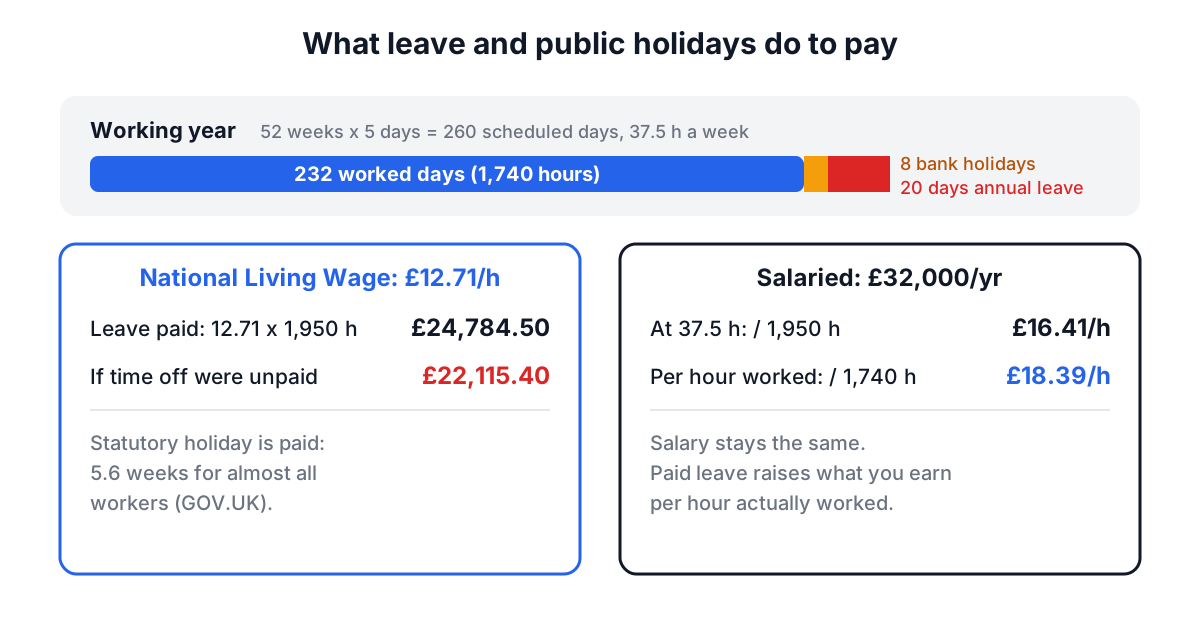
If the time off were unpaid, the National Living Wage worker would earn £22,115.40 instead of £24,784.50, which shows what paid holiday is worth: £2,669.10 a year. In the calculator, keep "Holidays and vacation are paid" switched on for UK employment.
Overtime: what the law does and does not require
GOV.UK is blunt: employers do not have to pay workers for overtime. The overtime rate, if any, is whatever your contract says. Three rules still protect you.
The minimum wage applies to every hour
Your average pay for all the hours you work cannot fall below the National Minimum Wage. That matters most for salaried staff who work long unpaid hours. Take a £26,500 salary:
| Hours actually worked every week | Pay per hour (£26,500 ÷ 52 ÷ hours) | Against £12.71 |
|---|---|---|
| 40 | £12.74 | just above |
| 48 | £10.62 | below |
The real minimum wage calculation for salaried workers runs over each pay reference period with its own rules on which hours count, so treat this as a warning sign rather than a final answer. If your hours regularly push your rate below £12.71, raise it with your employer or Acas.
Paid overtime at time and a half
Where a contract does pay overtime, the Overtime Calculator handles it. A warehouse worker on £14 an hour with time and a half after 40 hours works 46 hours:
40 × £14.00          = £560.00
 6 × £21.00 (1.5×)   = £126.00
Total for the week   = £686.00   (an average of £14.91 an hour)
If the contract paid overtime at the basic rate instead, the week would be £644. If time and a half started after the contracted 37.5 hours rather than 40, the week would be £703.50.
Regular overtime counts in holiday pay
GOV.UK says the first 4 weeks of statutory leave must be paid at the normal rate, which includes commission and regular overtime payments; bonuses usually are not included. So if the warehouse worker regularly does those 6 hours of overtime, a week of holiday under those first 4 weeks is worth about £686, not £560. For irregular-hours and part-year workers, holiday pay uses average pay over the previous 52 paid weeks, and employers can use rolled-up holiday pay for them in leave years starting from 1 April 2024.
The 48-hour week
Workers cannot be made to work more than 48 hours a week on average, normally averaged over 17 weeks, unless they sign an opt-out. Under-18s are limited to 8 hours a day and 40 a week.
Pay rises against inflation
A pay rise is measured against your old pay, and what matters is what it buys after prices move:
real rise = (1 + rise) ÷ (1 + inflation) − 1
The ONS put CPI inflation at 3.5% in the 12 months to September 2026 (CPIH 3.6%). On a £32,000 salary:
| Rise | New salary | Extra a year | Real change at 3.5% CPI |
|---|---|---|---|
| 3% | £32,960 | £960 | −0.48% |
| 4% | £33,280 | £1,280 | +0.48% |
The other yardstick is the market. The ONS says employees' average regular pay, excluding bonuses, grew 3.7% a year in June to August 2026, 0.8% above CPI. A rise below 3.7% is behind the average; a rise below CPI is a cut in what your pay buys.
For hourly workers, the April 2026 increase in the National Living Wage from £12.21 to £12.71 is 4.10%, a real gain of 0.57% at 3.5% CPI.
Putting it together
Before you accept an hourly job, a salary or a pay offer, check four numbers: the annual pay with holiday paid, the pay per hour actually worked, the overtime terms in the contract (and whether long hours push you towards the minimum wage), and the rise against both CPI and average pay growth. All figures here are gross, before Income Tax, National Insurance, pension contributions and any student loan repayment.
Frequently asked questions
Is overtime pay a legal right in the UK?
No. GOV.UK says employers do not have to pay workers for overtime; any overtime rate is set by your contract. Your average pay across all hours you work must not fall below the National Minimum Wage, though.
How much is the National Living Wage a year?
£12.71 an hour from 1 April 2026 for workers aged 21 and over. At 37.5 hours a week for 52 weeks that is £24,784.50 before tax; at 40 hours, £26,436.80. Holiday is paid, so the year counts all 52 weeks.
Does holiday pay include overtime?
For the first 4 weeks of statutory leave, yes, if the overtime is regular. GOV.UK says the normal rate for those weeks includes commission and regular overtime payments. Bonuses are usually not included.
Is a 4% pay rise good this year?
At 3.5% CPI inflation in the 12 months to September 2026 it is a real rise of about 0.48%, and it is above the 3.7% growth in average regular pay the ONS reported for June to August 2026.
Sources and further reading
- National Minimum Wage and National Living Wage rates, GOV.UK. £12.71 for 21 and over from 1 April 2026; £10.85 for 18 to 20; previous rates.
- Holiday entitlement, GOV.UK. 5.6 weeks, 28 days, bank holidays and part-time pro rata.
- Holiday pay, GOV.UK. Normal rate including regular overtime for the first 4 weeks; irregular-hours workers.
- Overtime: your rights, GOV.UK. No legal right to overtime pay; the minimum wage across all hours.
- Maximum weekly working hours, GOV.UK. The 48-hour average and the opt-out.
- Inflation and price indices, Office for National Statistics. CPI 3.5% and CPIH 3.6% in the 12 months to September 2026.
- Average weekly earnings in Great Britain, Office for National Statistics. Regular pay growth of 3.7% in June to August 2026.
More Pay & Shopping
Every tool in the Pay & Shopping section, free and in your browser.