
How Long to Charge an Electric Car in the UK?
Charging times on a 3-pin plug, a 7 kW wallbox, three-phase and rapid chargers, in hours and miles, with the cost in pence at overnight, price-cap and rapid rates.
By Redbison Dev · · 10 min read
United Kingdom edition. UK edition for 230 V single-phase homes: 3-pin portable chargers, 7.4 kW wallboxes, rapid chargers, costs on Ofgem's October to December 2026 cap, smart charge point rules and the OZEV chargepoint grant for flat owners and renters. US edition
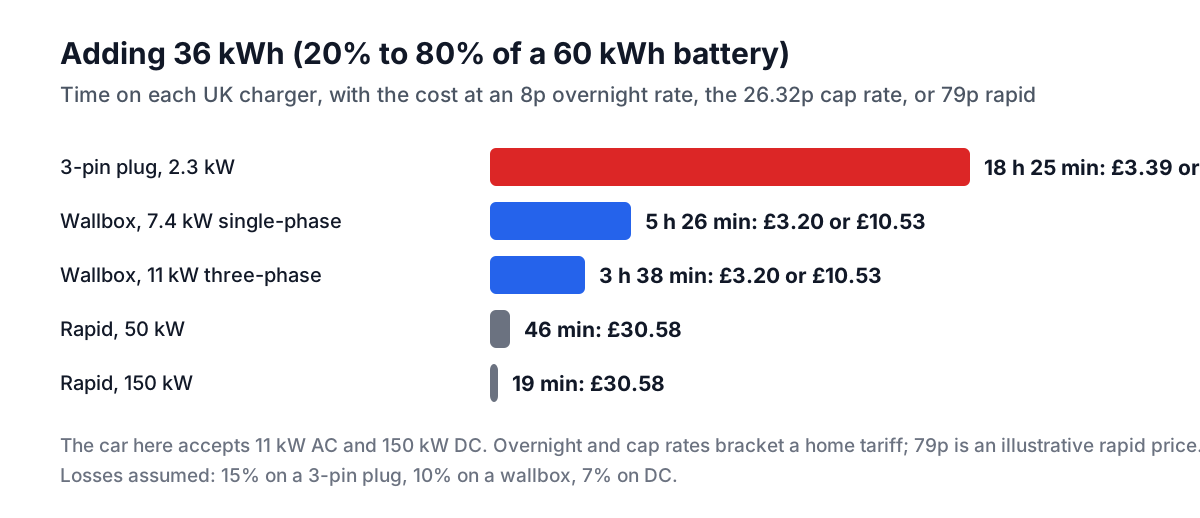
On a 7 kW home wallbox, adding 36 kWh, enough to take a 60 kWh battery from 20% to 80%, takes about 5 hours 26 minutes. On a 3-pin plug it takes about 18 hours 25 minutes. On a 150 kW rapid charger it takes about 19 minutes, if the car can accept that much. The cost varies even more than the time: about £3.20 on an illustrative 8p overnight rate, £10.53 at the 26.32p price-cap rate and about £30.58 at a rapid charger charging 79p per kWh.
This edition works through UK charging with the EV Charging Time and Cost Calculator for the UK: what limits the speed in a British home, why rapid charging slows after 80%, and how to keep the cost down.
The sum behind every charging time
time = energy into the battery / (charging power x efficiency)
Energy into the battery is the usable capacity times the percentage you add: 60 kWh x 60% = 36 kWh. Charging power is the lower of what the charger supplies and what the car's onboard charger (on AC) or battery system (on DC) accepts. Efficiency covers the energy lost as heat; the calculator assumes 85% on a portable charger, 90% on a wallbox and 93% on DC, so the meter records more than the battery stores. For a wallbox charge of 36 kWh, that is 40 kWh from the meter.
What a UK home can supply
On a single-phase 230 V supply, the options are:
- 3-pin plug. A portable charger in a household socket drawing 10 A delivers about 2.3 kW. It is a top-up tool: about 7.7 miles of range an hour for a car using 30 kWh per 100 miles.
- Single-phase wallbox. At 32 A, 230 V x 32 A = 7.36 kW, marketed as 7 kW. About 24.5 miles of range an hour.
- Three-phase wallbox. 11 kW, or 22 kW at 32 A per phase, needs a three-phase supply, so check whether your home has one, and a car whose onboard charger accepts it.
A car with a 7.4 kW onboard charger charges no faster on an 11 kW wallbox; the calculator caps the power at whichever is lower. For the 60 kWh car, an 11 kW three-phase supply cuts the 20% to 80% charge to 3 hours 38 minutes.
A worked example: will it finish overnight?
If your tariff has a cheaper overnight window, whether one night's window is enough depends on the charger. In the EV Charging Time and Cost Calculator, enter a 60 kWh battery, 20% to 80%, the 7.36 kW wallbox, 90% efficiency, 8p per kWh and 30 kWh per 100 miles:
- Energy into the battery: 36 kWh. From the meter: 40 kWh.
- Time: 5 hours 26 minutes, so it fits a window of six hours or more.
- Cost: £3.20. Range added: about 133 miles.
The same charge at the price-cap rate costs £10.53, so charging in the off-peak window is worth about £7.33 a time. A bigger top-up, 10% to 90% (48 kWh into the battery), takes 7 hours 15 minutes on the same wallbox and costs £4.27 at 8p, so it may spill out of a short window.
On a 3-pin plug the 20% to 80% charge takes 18 hours 25 minutes and draws 42.35 kWh, because more is lost at low power: £3.39 at 8p, or £11.15 at the cap rate. The plug works for a car that covers modest daily mileage, but it cannot fit a whole charge into one cheap night.
The 8p figure is an illustration. Check your own tariff's off-peak rate and hours, and note what the price cap does not cover: Ofgem's cap page gives the GB average of 26.32p per kWh for 1 October to 31 December 2026, and notes there is no VAT on electricity from 1 October 2026 to 31 March 2027.
Rapid charging and the 80% rule
On DC, the car decides the speed. The calculator's model holds the car's peak power to a slow-down point (50% by default) and then reduces it in a straight line to 15% of peak at 100%, with the charger capping it throughout. For the same 60 kWh car on a 150 kW rapid charger:
| Window | Energy into battery | Time | Cost at 79p |
|---|---|---|---|
| 10% to 80% | 42 kWh | 21 min | £35.68 |
| 20% to 80% | 36 kWh | 19 min | £30.58 |
| 80% to 100% | 12 kWh | 18 min | £10.19 |
The last 20% takes almost as long as the 70% before it. On a motorway trip, two short stops from about 10% to 80% are usually quicker than one long one to 100%. Real curves vary by model and battery temperature; if you know your car's, move the slow-down point to match.
A 50 kW rapid charger is a different story for the same car: the 20% to 80% charge takes about 46 minutes, because now the charger, not the car, is the limit. Rapid prices vary by network and some add a session fee or charge per minute, which the calculator has fields for. The 79p used here is illustrative.
Smart charge points and grants
Wallboxes sold for UK homes fall under the Electric Vehicles (Smart Charge Points) Regulations 2021. Among the requirements: a charge point must not be configured so that it loses its smart functionality if you change electricity supplier (regulation 6), and it must still be able to charge the car if it loses its network connection (regulation 7). In practice, smart scheduling is what lets you aim a charge at your tariff's cheap hours.
If you own the flat you live in, or rent any residential property (a house or a flat), and your home has its own private off-street parking space, the Office for Zero Emission Vehicles' chargepoint grant pays 75% of the cost of buying and installing a socket, up to £500. People who own the house they live in are not eligible unless it has been converted into flats and they live in one of them, and lodgers renting from a landlord who lives in the home are excluded too. You also need an eligible vehicle, owned, leased, used for work or on order, according to the eligibility page.
Tools for this job
- EV Charging Time and Cost Calculator for the UK: time, cost and miles added on each charger, with session and per-minute fees.
- EV vs Petrol Cost Calculator for the UK: running costs over the years against a petrol or diesel car.
- Electricity Cost Calculator for the UK: what a given number of kWh costs on your tariff.
- Related reading: EV vs petrol costs in the UK, and the US EV charging guide for US Level 1 and Level 2 charging.
Frequently asked questions
How long does it take to charge an electric car with a 7 kW charger?
About 5 hours 26 minutes to add 36 kWh, enough to take a 60 kWh battery from 20% to 80%, at 7.36 kW and 90% efficiency. That is roughly 24.5 miles of range an hour for a car using 30 kWh per 100 miles. A full charge from empty takes about 9 hours.
Is it OK to charge an electric car from a 3-pin plug?
For occasional or light use, using the portable charger supplied for it. At about 2.3 kW it adds roughly 7.7 miles an hour, so 36 kWh takes about 18 hours 25 minutes. Have an electrician check the socket and circuit if you will use it often, because it runs at full load for hours.
Why does rapid charging slow down after 80%?
The car reduces power as the battery fills to protect the cells. In the calculator's model a 60 kWh car on a 150 kW charger takes 21 minutes from 10% to 80% but another 18 minutes from 80% to 100%, so stopping at 80% saves time on a trip.
Can I get a grant for a home charger?
If you own the flat you live in (including one in a converted house) or rent your home, house or flat, and it has its own private off-street parking, the OZEV chargepoint grant pays 75% of the cost of a socket, up to £500. Owners of houses are not eligible, and nor are lodgers living with their landlord.
Sources and further reading
- Get energy price cap standing charges and unit rates by region, Ofgem. Electricity at 26.32p per kWh from 1 October to 31 December 2026; no VAT on electricity from 1 October 2026 to 31 March 2027.
- The Electric Vehicles (Smart Charge Points) Regulations 2021, legislation.gov.uk. Smart functionality, supplier interoperability (regulation 6) and charging without a network connection (regulation 7).
- EV chargepoint grant for households, GOV.UK. 75% of the cost of a socket, up to £500.
- EV chargepoint grant: eligibility, GOV.UK. Flat owners and renters of any residential property with private off-street parking, the exclusions for house owners and lodgers, and vehicle evidence.
- Charging electric vehicles at home, US Department of Energy. Home charging basics, including having an electrician check the home's capacity.
Open the EV Charging Time and Cost Calculator
More Energy & Sustainability
Every tool in the Energy & Sustainability section, free and in your browser.