
Electric vs Petrol Car Running Costs in the UK
Electric against petrol and diesel in pounds: cost per mile on the price cap, an off-peak EV tariff and rapid chargers, vehicle tax, break-even and CO2.
By Redbison Dev · · 10 min read
United Kingdom edition. Written for UK drivers: miles and UK mpg, the DESNZ pump price of 172.78p for petrol and 198.58p for diesel (2 November 2026), the Ofgem price cap of 26.32p per kWh for October to December 2026, vehicle tax for EVs and the DESNZ 2026 grid factor. US edition
A petrol car doing 48 mpg on petrol at 172.78p a litre costs about 16.4p a mile in fuel. An electric car using 29 kWh per 100 miles (about 3.4 miles per kWh) costs 7.6p a mile charged at home on the Ofgem price cap of 26.32p, about 2.0p on a 7p overnight tariff, and 22.9p a mile if every charge is at a 79p rapid charger. Where you charge decides the answer more than which car you buy.
This edition works through the UK numbers: pump prices, the price cap, off-peak EV tariffs, rapid charging, vehicle tax and the break-even on a dearer car, all run in the UK electric vs petrol calculator. Prices are the latest published when this was written; fuel and electricity move, so put in your own. The calculator opens with a different example driver (7,000 miles, 45 mpg, 30 kWh per 100 miles, 85% home charging, £28,000 against £33,000); enter 8,000 miles, 48 mpg, 29 kWh, 90% at home and £27,000 against £32,000 to reproduce the tables below.
Petrol and diesel in pence per mile
UK pumps price per litre, but fuel economy is quoted in miles per imperial gallon (4.546 litres). The calculator converts for you:
litres a year = miles / UK mpg x 4.54609
8,000 / 48 x 4.54609 = 757.7 litres
757.7 x £1.7278 = £1,309 a year, or 16.4p a mile
The Department for Energy Security and Net Zero's weekly figures for 2 November 2026 put average petrol at 172.78p and diesel at 198.58p a litre, both including fuel duty of 52.95p a litre and VAT at 20%. A diesel doing 58 mpg on 198.58p costs £1,245 a year for the same 8,000 miles: the higher pump price almost cancels its better economy.
Use the mpg you actually get from fill-up records. Official test figures can be hard to match on short winter journeys.
Electricity: price cap, EV tariff or rapid charger
For an EV the sum is kWh times price:
kWh a year = miles x kWh per 100 miles / 100 = 8,000 x 29 / 100 = 2,320 kWh
Ofgem's cap for 1 October to 31 December 2026 is 26.32p per kWh on Direct Debit, the average for England, Scotland and Wales, with a standing charge of 54.83p a day that you pay whether or not you own an EV. Ofgem notes there is no VAT on electricity from 1 October 2026 to 31 March 2027. If your supplier offers an EV tariff with a cheap overnight rate, use that; 7p is used below only as an example.
| Where you charge | Price per kWh | Pence per mile | Electricity a year, 8,000 miles |
|---|---|---|---|
| All at home, price cap | 26.32p | 7.6p | £611 |
| All at home, 7p overnight | 7p | 2.0p | £162 |
| 90% home on the cap, 10% rapid at 79p | 31.59p blended | 9.2p | £733 |
| 90% home at 7p, 10% rapid at 79p | 14.20p blended | 4.1p | £329 |
| All on rapid chargers at 79p | 79p | 22.9p | £1,833 |
| Petrol, 48 mpg at 172.78p | 16.4p | £1,309 fuel |
A driver with no home charging who relies on rapid chargers pays more per mile than the petrol car: on those figures the EV costs £284 a year more to run, before any saving on servicing could make up the gap. Public charger prices vary a lot by speed and network, so enter what you actually pay.
Putting it together: the yearly saving
The calculator adds upkeep per mile. The figures here are assumptions to replace with your own quotes: 8p a mile for the petrol car (servicing, tyres, MOT) and 5p for the EV (no oil changes or exhaust, less brake wear, but tyres can wear faster on a heavy car).
| 8,000 miles a year | Petrol, 48 mpg | EV, cap and 10% rapid | EV, 7p off-peak and 10% rapid |
|---|---|---|---|
| Energy | £1,309.12 | £732.84 | £329.44 |
| Upkeep | £640.00 | £400.00 | £400.00 |
| Total a year | £1,949.12 | £1,132.84 | £729.44 |
| Per mile | 24.4p | 14.2p | 9.1p |
| Saving against petrol | £816.28 | £1,219.68 |
Break-even on the higher price
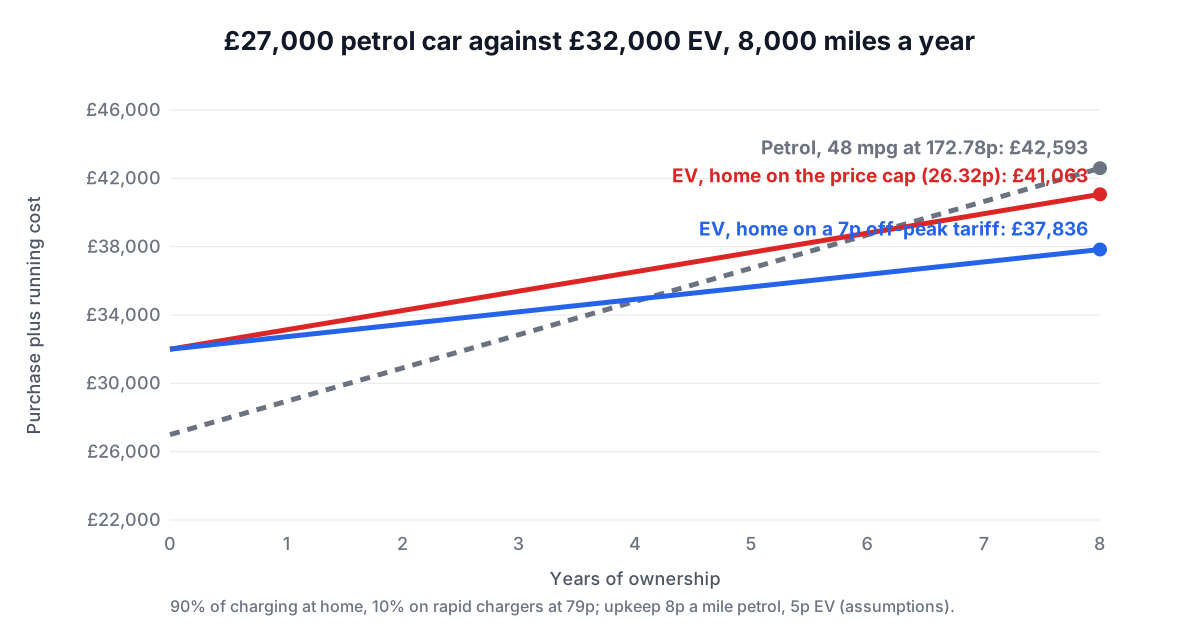
With a £27,000 petrol car against a £32,000 EV, the £5,000 gap is recovered in £5,000 / £816.28 = 6.1 years on the price cap, and in 4.1 years on the 7p tariff. After eight years the EV is £1,530 ahead on the cap and £4,757 ahead on the off-peak tariff.
Mileage moves the answer most:
| Change from 8,000 miles on the cap | Saving a year | Break-even |
|---|---|---|
| 12,000 miles, price cap | £1,224.42 | 4.1 years |
| 12,000 miles, 7p off-peak | £1,829.52 | 2.7 years |
| 5,000 miles, price cap | £510.18 | 9.8 years |
| No home charging (all rapid at 79p) | £283.68 a year more for the EV | never |
| Diesel at 58 mpg instead of petrol | £752.35 | 6.6 years |
Vehicle tax and the expensive car supplement
Electric cars pay vehicle tax. GOV.UK's rate tables list £10 for the first year of a zero-emission car and then the standard rate of £200 for 12 months, the same standard rate a petrol car registered after April 2017 pays, so in most comparisons tax cancels out. The exception is price: an electric car with a list price over £50,000 pays the expensive car supplement of £440 a year for five years from its second tax payment (the threshold is £40,000 for petrol or diesel). GOV.UK says the £50,000 threshold applies to EVs registered between 1 April 2025 and 31 March 2026. Add any supplement to the upkeep figure if your car is near the threshold.
For a company car the decision often turns on benefit-in-kind tax and salary sacrifice rather than running costs, so ask your payroll team for the figure before comparing.
CO2: tailpipe against the grid
DESNZ's 2026 conversion factors put electricity generated in the UK at 0.13096 kg CO2e per kWh, so the EV's 2,320 kWh emit about 0.30 tonnes a year. The petrol car's 757.7 litres emit about 1.76 tonnes using the calculator's factor, or about 1.57 tonnes using the DESNZ factor of 2.075 kg per litre for petrol with the average biofuel blend. Either way the EV's running emissions are a fifth of the petrol car's or less. Making the battery adds emissions up front, which neither figure includes. The UK carbon footprint calculator puts both in a household total.
What the comparison leaves out
- Insurance, which can be higher for some EVs; add the difference to upkeep.
- Depreciation, which varies by model; reduce the purchase price of the car you expect to hold its value better.
- Finance: interest on the dearer car adds to the gap, which the UK car finance calculator shows.
- Home charger installation, a one-off cost to add to the EV price.
- The standing charge, which you pay either way and so does not belong in the comparison.
Tools for this job
- The UK electric vs petrol calculator runs every scenario above with your mileage and prices.
- The UK EV charging calculator works out charge time and cost per session, explained in the guide on how long an EV takes to charge.
- The UK fuel cost calculator prices a single journey in petrol or diesel.
- The UK electricity cost calculator checks what home charging adds to the bill.
Frequently asked questions
How much does it cost to charge an electric car at home in the UK?
Multiply the kWh by your unit rate. On the Ofgem price cap for October to December 2026, 26.32p per kWh, a car using 29 kWh per 100 miles costs about 7.6p a mile; 8,000 miles a year is about £611. On a 7p overnight tariff the same miles cost about £162.
Is rapid charging more expensive than petrol?
At 79p per kWh, yes for most cars: 29 kWh per 100 miles costs about 22.9p a mile, against 16.4p for a 48 mpg petrol car at 172.78p a litre. An EV saves money mainly when most charging is at home or on a cheaper public charger.
Do electric cars pay vehicle tax in the UK?
Yes. GOV.UK lists £10 for the first year and then £200 a year, the same standard rate as a petrol car. An EV with a list price over £50,000 also pays the £440 expensive car supplement for five years.
Should I use UK mpg or US mpg?
UK mpg, based on the 4.546 litre imperial gallon; it is about 20% higher than a US mpg figure for the same car. Choose the UK miles and mpg setting in the calculator and enter the pump price per litre.
Sources and further reading
- Weekly road fuel prices, Department for Energy Security and Net Zero. Petrol 172.78p and diesel 198.58p a litre for 2 November 2026, duty 52.95p.
- Energy price cap: standing charges and unit rates by region, Ofgem. 26.32p per kWh and 54.83p a day for 1 October to 31 December 2026.
- Vehicle tax rate tables, GOV.UK. £10 first year, £200 standard rate and the expensive car supplement.
- Greenhouse gas reporting: conversion factors 2026, Department for Energy Security and Net Zero. UK electricity 0.13096 kg CO2e per kWh; petrol 2.075 kg per litre.
- GHG Emission Factors Hub, US Environmental Protection Agency. The 8.78 kg per US gallon petrol factor the calculator uses.
Open the EV vs Gas Cost Calculator
More Energy & Sustainability
Every tool in the Energy & Sustainability section, free and in your browser.